

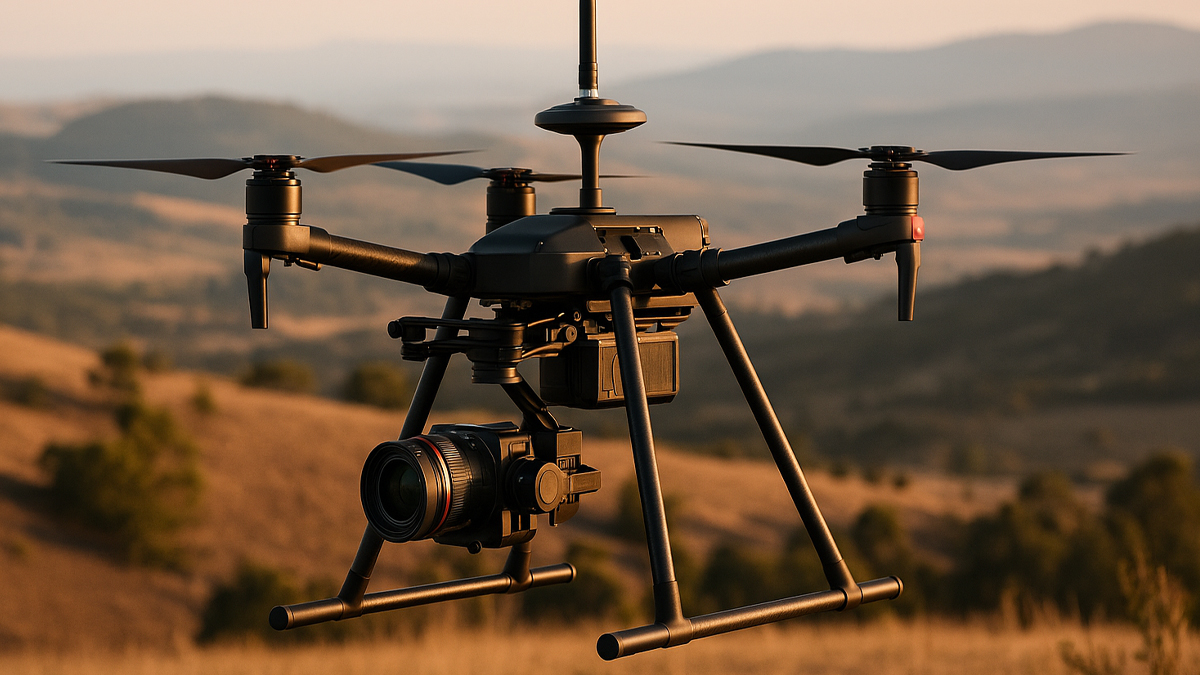
What is Post-Processed Kinematic?
Post-Processed Kinematic, often shortened to PPK, is a high-precision satellite positioning method used to calculate an accurate trajectory after data has been collected. Instead of relying on real-time correction signals during flight, PPK records raw GNSS data on the drone and combines it later with reference data from a base station or a continuously operating reference station network. The result is a corrected flight path that can reach centimeter-level accuracy under good conditions.
In the context of Drone Cinematography within the Cinema Industry, PPK is not just a surveying concept. It is a precision tool that can help filmmakers plan, repeat, and refine complex aerial camera moves. It supports accurate geotagging for aerial plates, improves the reliability of previsualization, and can strengthen workflows that involve visual effects, virtual production, or multi-day continuity shots.
PPK is especially valuable when a stable real-time link is difficult, when interference is expected, or when production teams want high accuracy without the complexity of live correction infrastructure. This makes PPK an appealing option for controlled cinematic environments as well as remote locations.
How does Post-Processed Kinematic Work?
PPK works by collecting two main streams of satellite data and combining them after the flight.
First, the drone records raw GNSS observations throughout the mission. These observations capture satellite signals in a detailed form that allows later correction. Second, a reference station on the ground records its own raw data over the same time window. Because the reference station is located at a known and fixed position, the difference between what the station observes and what it should observe can be used to compute correction information.
After the flight, software aligns the timestamps of the drone and base station data. It then applies mathematical models to reduce errors caused by atmospheric delays, satellite clock drift, multipath interference, and other common GNSS limitations. The software generates a corrected trajectory for the drone, which can be synchronized with camera metadata and other onboard sensor logs.
For cinematography, this corrected trajectory can be used to confirm the exact camera path, altitude changes, speed profiles, and positional consistency between takes. Even when the purpose is not mapping, the precision can support more dependable creative control and technical validation.
What are the Components of Post-Processed Kinematic?
A functional PPK workflow requires a combination of hardware, data, and processing tools. The exact setup can vary based on the drone platform and production goals, but the core components are consistent.
GNSS receiver on the drone
The drone must have a receiver capable of logging raw satellite data. This is common in enterprise or survey-grade platforms and in specialized payload integrations.
Antenna system
A high-quality antenna improves signal stability. Good antenna placement and shielding can also reduce multipath effects.
Base station or reference data source
This can be a portable base station set up near the filming location or data obtained from an existing reference network.
Precise time synchronization
Accurate timestamps are essential for aligning drone and base station observations.
IMU and flight controller logs
While PPK is primarily GNSS-based, inertial data can support smoother trajectory estimation and help validate motion during dynamic maneuvers.
PPK processing software
The software performs the correction and outputs the refined trajectory. Options range from open-source solutions to professional commercial suites.
Satellite ephemeris and correction files
Access to precise orbit and clock data can enhance the quality of final results.
In cinematic workflows, additional components may include camera metadata systems, lens data capture tools, and software that can merge positional data with production and post-production pipelines.
What are the Types of Post-Processed Kinematic?
PPK can be categorized based on how reference data is acquired and how corrections are modeled.
Single-base PPK
A local base station is set up near the filming site. This is a common, reliable approach that delivers strong accuracy when the baseline distance is small.
Network-based PPK
Instead of a single base station, corrections are derived using data from multiple reference stations in a regional network. This can improve robustness when a local base station is not available.
Short-baseline PPK
This describes setups where the base station is very close to the drone operation area. It usually offers excellent correction quality.
Long-baseline PPK
Used when the base station is farther away, which may reduce accuracy depending on conditions. This can still be useful for certain production environments if local infrastructure is unavailable.
Hybrid GNSS and inertial post-processing
Some advanced workflows integrate PPK with refined inertial modeling to improve continuity during brief signal drops or aggressive motion sequences.
For cinema, the most practical categories are single-base and network-based PPK, chosen based on location, logistics, and the level of precision required.
What are the Applications of Post-Processed Kinematic?
PPK has a strong foundation in geospatial industries, but its accuracy and reliability make it relevant for creative and technical filmmaking use cases.
Aerial photogrammetry for set planning
Production teams can create accurate site models for location scouting, previsualization, and safety planning.
LiDAR and environment capture
When drones carry LiDAR sensors, PPK improves positional accuracy and supports more reliable digital replicas of environments.
High-precision inspection and documentation
In documentary-style or industrial film projects, PPK helps ensure accurate spatial references.
Repeatable aerial paths for multi-day shoots
Filmmakers can review corrected trajectories to match shots across different days or different lighting conditions.
Visual effects plate acquisition
Accurate positional logs can assist with matchmoving, camera tracking, and compositing workflows.
Virtual production support
When physical and digital environments must align, stable positional data helps maintain consistency between real-world movement and digital elements.
Complex choreography with multiple drones
High-precision positional records can support safer planning and better post-analysis in multi-drone sequences.
PPK bridges creative ambition and technical reliability, especially when aerial shots must integrate smoothly with broader production pipelines.
What is the Role of Post-Processed Kinematic in Cinema Industry?
In the Cinema Industry, PPK plays a behind-the-scenes role that enhances precision where creativity and technology intersect.
One major role is shot repeatability. While RTK can offer real-time precision, PPK can provide similar accuracy without relying on an uninterrupted live correction link. This is useful for remote locations, urban environments with radio noise, or sets where real-time infrastructure is impractical.
Another key role is improving VFX alignment. When aerial plates are used for compositing, accurate position and trajectory data can help VFX teams understand camera movement and spatial context with greater confidence. This can reduce guesswork in post-production and improve the realism of digital integrations.
PPK also supports safety and accountability. In complex aerial setups near controlled sets, having a highly accurate record of where the drone actually flew can help teams review performance, refine flight plans, and maintain compliance with production safety protocols.
In short, PPK brings measurable technical confidence to cinematic drone work, helping crews deliver precise results even when real-time constraints exist.
What are the Objectives of Post-Processed Kinematic?
The objectives of PPK in drone cinematography focus on accuracy, reliability, and workflow efficiency.
Achieve high-precision positioning
PPK aims to deliver centimeter-level accuracy for the recorded drone trajectory.
Reduce dependence on real-time links
It supports missions where real-time correction signals are unstable or unavailable.
Improve consistency across takes
Corrected trajectories help validate and refine repeated cinematic movements.
Support VFX and virtual production needs
Accurate motion data can improve the quality of camera tracking and environment alignment.
Strengthen planning and analysis
PPK data can be used to evaluate flight performance and optimize future shots.
Enhance data integrity
It helps reduce GNSS errors that might otherwise distort location-based metadata.
The overarching objective is to combine creative freedom with dependable technical precision.
What are the Benefits of Post-Processed Kinematic?
PPK provides practical advantages that can directly improve drone-based filmmaking.
High accuracy without live correction
You can achieve strong positional accuracy even without a continuous radio or internet link.
Improved reliability in challenging environments
PPK can handle situations where real-time corrections may drop out.
Better post-production support
VFX and editorial teams can benefit from accurate motion references.
Reduced on-set complexity
Teams can simplify real-time infrastructure needs while still aiming for high precision.
Enhanced continuity
Repeatable movement becomes easier to verify when you have corrected trajectory records.
Cost efficiency for certain productions
Using existing reference data sources can reduce the need for specialized real-time systems.
Strong documentation
Accurate flight records can aid safety reviews and technical reporting.
For many productions, PPK is a strategic middle path between standard GPS and fully real-time precision systems.
What are the Features of Post-Processed Kinematic?
Key features of PPK reflect why it is widely trusted in precision drone operations.
Post-flight correction workflow
Corrections are applied after data collection.
Raw GNSS data logging
The method relies on detailed satellite observations.
Base station or network compatibility
PPK can use local or regional reference data.
Centimeter-level accuracy potential
Under solid conditions, accuracy can approach RTK-like results.
Improved tolerance to link interruptions
Since corrections are not needed live, the workflow is less vulnerable to real-time signal issues.
Flexible deployment
Portable base stations can be set up near sets or remote locations.
Integration with sensor logs
PPK outputs can be aligned with IMU and camera metadata for deeper analysis.
Strong audit trail
The corrected trajectory provides a reliable flight record.
These features make PPK attractive for both technical and creative aerial missions.
What are the Examples of Post-Processed Kinematic?
In practical filmmaking and drone operations, PPK can appear in several real-world scenarios.
A production team captures a sweeping coastal sequence over multiple days
PPK helps confirm the precise path for continuity and matching angles.
A VFX-heavy film collects aerial plates of a city skyline
Corrected trajectory data supports more accurate matchmoving and compositing.
A remote desert shoot with limited communication infrastructure
PPK enables high-precision results without needing stable real-time correction links.
A studio-backed project builds a digital twin of a location
PPK improves the accuracy of photogrammetry or LiDAR data used in previsualization.
A multi-drone choreography for an action sequence
PPK data supports post-flight analysis for timing, spacing, and safety improvements.
Documentary filmmaking that requires accurate location referencing
PPK strengthens the credibility of spatially anchored visuals.
These examples show that PPK is not limited to mapping. It can be a valuable precision layer for cinematic storytelling.
What is the Definition of Post-Processed Kinematic?
Post-Processed Kinematic is a GNSS positioning technique that determines a moving receiver’s precise trajectory by applying corrections after data collection using reference station observations recorded over the same time period. The correction process reduces satellite and environmental errors to produce high-accuracy positional results.
This definition highlights the two core ideas. The receiver is moving, and the accuracy is achieved through post-processing rather than live correction.
What is the Meaning of Post-Processed Kinematic?
The meaning of Post-Processed Kinematic can be understood in a simple way. It describes a method where a drone collects raw satellite positioning data during flight, and the accurate position is calculated later using reference data. The word kinematic indicates movement. The phrase post-processed indicates that the correction happens after the mission is complete.
In filmmaking terms, it means you can focus on capturing the shot on set and refine positional accuracy during post-flight technical workflows. This separation of creative execution and precision refinement can be especially useful in complex production environments.
What is the Future of Post-Processed Kinematic?
The future of PPK in drone cinematography is likely to grow alongside broader advances in GNSS, onboard sensors, and virtual production pipelines.
First, more drone platforms may offer built-in raw data logging as demand for precision expands beyond surveying into creative industries. This could make PPK more accessible to film crews that want high accuracy without advanced geospatial expertise.
Second, integration with camera metadata systems is expected to improve. As cinematic drones become more tightly connected to digital production tools, PPK trajectories could be automatically synchronized with lens data, stabilization logs, and production tracking software.
Third, hybrid workflows may become more common. Productions might use RTK for immediate on-set confidence and PPK for final verification and post-production alignment. This layered approach can provide both real-time assurance and final high-accuracy deliverables.
Finally, the rise of virtual production and mixed reality is a strong driver. When real-world aerial movement must align with digital environments, reliable position and motion data will become increasingly valuable.
PPK is positioned to remain a quiet but powerful technical enabler of cinematic ambition.
Summary
- Post-Processed Kinematic is a post-flight GNSS correction method that can deliver high-accuracy drone trajectories.
- It uses raw data from the drone and a base station or reference network recorded during the same time window.
- PPK reduces dependence on real-time correction links, making it useful in remote or signal-challenged locations.
- In drone cinematography, PPK supports shot repeatability, continuity, and technical validation.
- It can strengthen VFX and virtual production workflows by providing more reliable camera path data.
- Core components include raw-capable GNSS hardware, a reference data source, precise timing, and processing software.
- Common types include single-base and network-based PPK, depending on infrastructure and baseline distance.
- Benefits include higher reliability, simplified on-set requirements, improved documentation, and strong post-production support.
- The future of PPK will likely include deeper integration with cinematic metadata and hybrid RTK plus PPK workflows.
- PPK helps bridge creative aerial storytelling with precision-driven production needs.

