

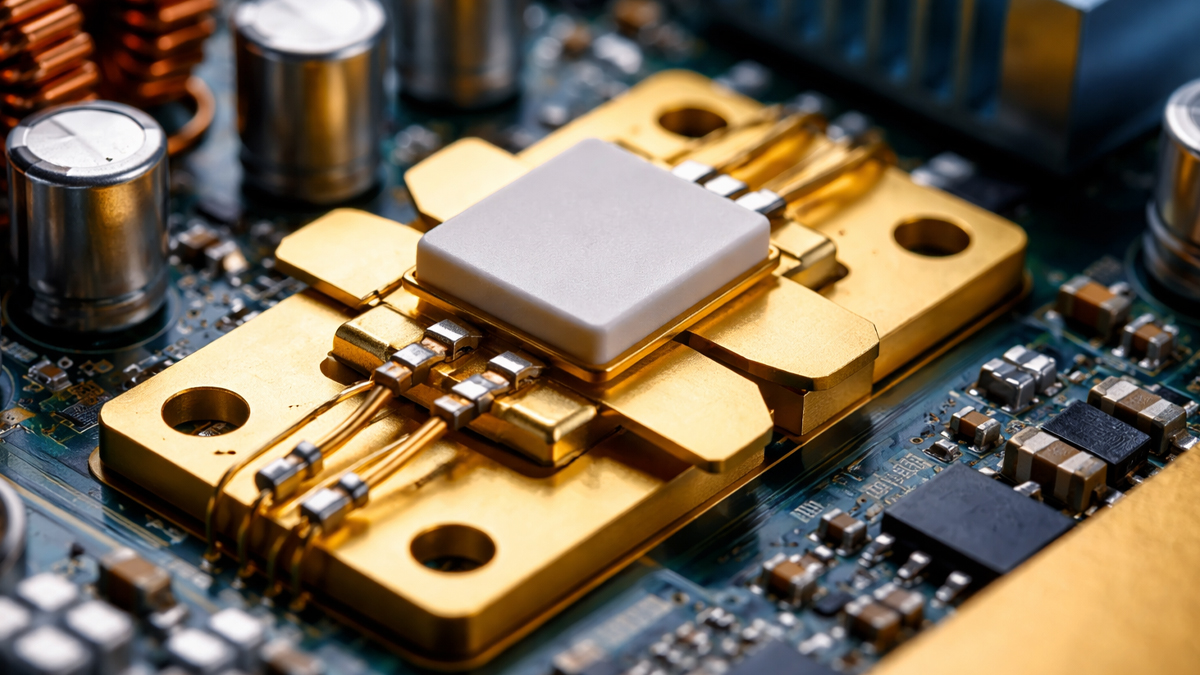
What is Lateral Diffused MOSFET (LDMOS)?
Lateral Diffused MOSFET, shortened to LDMOS, is a special kind of MOSFET transistor designed to handle higher power and higher voltage than many small signal transistors, while still operating fast enough for radio frequency work. It is called lateral because the main current path flows along the surface of the silicon from source to drain, instead of flowing vertically through the wafer. It is called diffused because important regions of the device, especially the channel and drain side shaping, are formed using diffusion and implantation steps that create smooth doping transitions.
In practical terms, LDMOS is widely used as a power transistor in RF power amplifiers and other power handling circuits. In RF systems, it is valued because it can produce strong output power with good efficiency and good linearity, which helps signals stay clean. It is also built to survive challenging electrical stress, which matters when equipment runs for long hours, gets hot, and must remain reliable.
When we place LDMOS under the idea of cinematic electronics in the cinema industry, think of it as one of the invisible workhorses that can sit inside professional wireless systems, high power RF links, transmitters, and robust power stages that support production, post production, and exhibition technology. Cinema today depends on a dense ecosystem of electronics, and power transistors like LDMOS help that ecosystem stay stable, efficient, and dependable.
How does Lateral Diffused MOSFET Work?
An LDMOS works like a MOSFET, using an electric field from the gate to control how easily current can flow between the source and drain. When the gate to source voltage rises above a threshold, a conductive channel forms in the silicon under the gate. Electrons (for an n channel device) can then move from the source, through the channel, and toward the drain.
What makes LDMOS different is how it manages high voltage and high power without breaking down. Between the channel and the drain, the device includes a drift region, also called a lightly doped drain extension. This region spreads the electric field when the drain voltage is high, so the device can withstand higher drain to source voltage. The doping profile is carefully shaped so that the electric field does not concentrate in one tiny spot, which would trigger breakdown.
Because the current path is lateral along the surface, designers can engineer the geometry to balance several competing needs:
- High breakdown voltage, so the transistor can tolerate large drain voltages.
- Low on resistance, so it wastes less energy as heat when conducting.
- High frequency performance, so it can amplify RF signals efficiently.
- Good linearity, so amplified signals remain faithful to the input.
In RF power amplifiers, the transistor is biased and driven so that it amplifies an input RF signal into a much larger output RF signal. LDMOS has been heavily adopted for base station and broadcast style RF power amplifiers, where high output power and strong reliability are key requirements.
What are the Components of Lateral Diffused MOSFET
Even though you can buy an LDMOS as a packaged device, internally it is a carefully engineered structure. The important components include the following:
Gate electrode
The gate is the control terminal. A voltage applied here creates an electric field that forms or removes the channel.
Gate oxide and dielectric regions
A thin insulating layer separates the gate from the silicon, allowing field control without direct current into the gate. Parts of the drift region may have thicker oxide or special oxide shapes to manage electric fields.
Source region
This is a heavily doped region that provides carriers into the channel. It is connected to a metal contact.
Body or well region
Typically a p type region under the gate for an n channel LDMOS. It helps define the channel and also influences the intrinsic diode behavior.
Channel region
This is the controllable conduction path formed under the gate when the device is on.
Drain region
The drain is the high voltage terminal where current exits the device. In LDMOS, the drain is reached after the drift region, not immediately after the channel.
Drift region
This is one of the signature components. It is lightly doped to spread high electric fields and provide high breakdown voltage.
Field plate structures (in many designs)
Field plates are conductive extensions that shape the electric field over the drift region. They help increase breakdown voltage and improve reliability by distributing the field more evenly.
Epitaxial layer and substrate
Many LDMOS processes use an epitaxial layer on a substrate, giving designers control over doping and thickness, which strongly affects breakdown and resistance.
Metallization and interconnect
Metal contacts connect the silicon regions to the package leads. In high power RF parts, the metal system and layout are designed for low resistance and good thermal spreading.
Package and thermal path
For power use, the package matters. A good thermal path helps move heat into a heat sink. In cinema related equipment that runs for long durations, thermal design can be the difference between stable performance and random failures.
What are the Types of Lateral Diffused MOSFET
LDMOS can be categorized in several practical ways. The categories below help explain how different LDMOS devices are optimized for different jobs.
N channel LDMOS and P channel LDMOS
N channel devices are far more common in high power and RF work because electrons provide higher mobility, which usually means better performance. P channel LDMOS exists but is less common for high power RF roles.
RF LDMOS and power switching LDMOS
RF LDMOS is designed to amplify signals at radio frequencies, often from HF through UHF and into the low GHz range, depending on the design. Power switching LDMOS focuses more on on resistance, breakdown, and switching behavior for power conversion rather than clean analog amplification.
Standard silicon LDMOS and SOI LDMOS
SOI means silicon on insulator. SOI LDMOS uses an insulating layer to reduce parasitic effects and can improve certain performance and breakdown characteristics, depending on the structure.
High voltage LDMOS families
Some LDMOS devices are engineered for higher drain voltages, such as families discussed around 28 V operation for infrastructure and higher voltage options for broadcast and industrial uses.
Field plate enhanced LDMOS and advanced electric field control designs
Many modern structures use one or more field plates, split gate ideas, or other electric field shaping techniques to push breakdown voltage higher while keeping on resistance manageable.
Each type exists because real world design always involves tradeoffs. If you want higher breakdown voltage, you often need a longer drift region, but that can increase resistance and reduce efficiency. If you want higher frequency, you want lower capacitance and shorter paths, but that can limit voltage handling. LDMOS is a technology family built around balancing these tradeoffs for power and RF needs.
What are the Applications of Lateral Diffused MOSFET
LDMOS is used wherever designers need a transistor that can handle meaningful power, tolerate higher voltages, and still switch or amplify fast. Common applications include:
RF power amplifiers for communications
This is the signature application. RF LDMOS is widely used in power amplifier stages for cellular infrastructure and other RF transmit systems because it combines power capability, efficiency, and robust operation.
Broadcast transmitters and high power RF equipment
Broadcast and similar RF systems often need high power transistors that can operate continuously. LDMOS is frequently discussed in the context of broadcast and high power RF designs.
Industrial, scientific, and medical RF power systems
Many ISM systems use RF power for heating, plasma generation, or processing. LDMOS is commonly presented as a strong candidate for these ranges.
Power switching and driver stages
Some LDMOS designs are used in power management and switching roles where a lateral structure and high voltage tolerance are useful.
Rugged power stages in harsh environments
When reliability under electrical stress matters, LDMOS designs with strong safe operating area and good field management can be attractive. Recent review style discussions emphasize switching behavior, drive efficiency, and safe operating area advantages compared with some older device choices, depending on the use case.
What is the Role of Lateral Diffused MOSFET in Cinema Industry
Cinema is not just cameras and screens. It is also wireless audio, wireless video, intercom systems, radio links, lighting control, projection power electronics, server rooms, networking, and live event infrastructure. All of that depends on transistors that can handle power cleanly and reliably. LDMOS contributes in several practical cinema industry areas, especially where RF power and robust amplification are needed.
Wireless systems on set and in venues
Film sets and cinema venues often use wireless microphones, in ear monitoring, wireless intercom, and sometimes long range wireless video links. In many such systems, a power transistor is required somewhere in the transmit chain or in supporting RF stages. LDMOS is a known RF power transistor technology used in RF power amplifiers, so it fits naturally into equipment categories where higher power RF amplification is required, such as professional transmitters and infrastructure.
Live cinema events and outside broadcast style workflows
Premieres, film festivals, and live cinema events increasingly combine cinema projection with live broadcast workflows. When a venue needs robust RF links, repeater systems, or temporary wireless infrastructure, RF power amplification becomes part of the support stack. LDMOS is commonly discussed as a backbone technology for infrastructure power amplifiers and broadcast class RF equipment.
Reliable high duty operation in projection and venue electronics
Cinema projectors, LED cinema walls, sound reinforcement racks, and control systems often run for hours continuously. Even when LDMOS is not the only transistor used, the idea of rugged power devices with good thermal behavior matters. LDMOS devices are designed with field and drift engineering to survive high voltage stress and heat, which aligns with professional cinema expectations of uptime and stability.
Clean signals and low distortion in professional RF and analog blocks
Cinema sound and communication systems value clarity. In RF, clarity means linearity, so that adjacent channels and unwanted emissions are minimized. Research and industry discussions often focus on improving linearity and robustness in RF LDMOS, highlighting that these are important performance goals for the technology.
So, the role of LDMOS in cinema industry is best understood as enabling dependable RF power and robust power stages in the broader cinematic electronics ecosystem. It supports the behind the scenes connectivity and professional grade reliability that modern cinema workflows depend on.
What are the Objectives of Lateral Diffused MOSFET
The objectives of LDMOS technology are essentially the design goals that engineers aim for when choosing or building these devices. The main objectives include:
Handle higher drain voltages safely
LDMOS is built with a drift region and electric field shaping so it can withstand higher drain to source voltages than many small MOSFETs. Infrastructure oriented discussions mention breakdown voltages often above 60 V for certain RF base station needs.
Deliver high output power efficiently
In RF power amplifiers, efficiency matters because wasted power becomes heat, and heat reduces reliability. Technical papers and industry material discuss high drain efficiency results in class AB and related amplifier designs using LDMOS.
Maintain good linearity for clean amplification
Linearity keeps signals faithful and reduces distortion products. This is repeatedly treated as a key development target for the technology.
Provide strong ruggedness and reliability
Real equipment faces load mismatch, temperature swings, and continuous duty cycles. LDMOS aims for a safe operating area that supports reliable long term operation.
Balance cost and performance
Silicon LDMOS competes in a space where performance must be strong but costs must stay reasonable for large scale deployment, which is one reason it has remained common in many RF power segments.
What are the Benefits of Lateral Diffused MOSFET
LDMOS offers several benefits that explain why it is still widely used:
Strong power handling with silicon manufacturability
LDMOS is a silicon based power transistor technology that has been broadly manufactured and adopted, making it accessible and well understood.
Good efficiency in RF amplifier operation
High efficiency reduces heat, lowers cooling needs, and improves reliability in professional equipment. LDMOS performance discussions commonly highlight strong drain efficiency in RF power amplifier classes.
Good linearity potential
With proper design and biasing, LDMOS can provide clean amplification, and there is extensive work on improving linearity and robustness.
High breakdown voltage capability
The drift region and field management allow LDMOS to handle higher voltages, which supports higher output power and better resilience to voltage stress.
Ruggedness for real world load conditions
In practical RF systems, antennas and loads can change. Ruggedness helps equipment survive mistakes and unexpected conditions.
In cinema related contexts, these benefits translate into fewer dropouts in wireless systems, more stable RF links for events, and better long run stability in professional electronics racks.
What are the Features of Lateral Diffused MOSFET
Features are the technical characteristics you typically see associated with LDMOS designs:
Lateral current flow geometry
Current flows along the surface, allowing designers to engineer the drift region length and field distribution for high voltage support.
Drift region optimized for high electric field handling
A lightly doped drain extension spreads the electric field and supports higher breakdown voltage.
Double diffused channel formation
The channel and related regions are formed using diffusion based processing steps, which supports the characteristic profiles of LDMOS.
Electric field shaping methods such as RESURF and field plates
Many LDMOS structures use reduced surface field concepts and field plates to manage breakdown and reliability.
Suitability for RF power amplifier architectures
LDMOS is commonly presented in class AB and Doherty amplifier contexts because it supports high power with good efficiency and linearity potential.
Fabrication compatibility with established silicon processing
Ion implantation and annealing sequences are common in LDMOS fabrication flows, and the overall ecosystem is mature in silicon manufacturing.
What are the Examples of Lateral Diffused MOSFET
Examples are easiest to understand as real equipment scenarios where LDMOS fits naturally. Below are practical examples connected to cinematic electronics and the cinema industry, as well as general electronics.
RF power stage in a professional wireless transmitter
A production team may use professional wireless systems for audio or communications. In higher power transmitter stages, a power transistor technology used for RF amplification is required. LDMOS is a known RF power amplifier transistor technology, so it can serve in the final amplification stage of certain transmitter designs.
RF amplifier module in temporary event infrastructure
A film festival might deploy temporary RF coverage for communications around multiple venues. Infrastructure grade RF amplification modules can use LDMOS technology because it is widely used in RF power amplifiers for infrastructure and broadcast style systems.
Broadcast and distribution transmitter equipment supporting cinema events
Live cinema events sometimes involve broadcast feeds, radio distribution, or specialized RF links. LDMOS is discussed as dominant or highly common in high power RF amplifier applications across a range of frequencies used by broadcast and similar systems.
High reliability power transistor stages in professional racks
Cinema projection booths and audio racks include many power stages and drivers. While many transistor technologies may appear in these systems, LDMOS is one option when designers need a MOSFET derived structure that can tolerate higher voltage stress and maintain ruggedness.
Educational and simulation example
Engineering tools and references model an n channel LDMOS as a device with a channel region, a drift region as a lightly doped drain extension, and oxide thickness variations across regions. This type of model helps students and engineers understand how the structure differs from a basic MOSFET.
These examples show that LDMOS appears both as a concrete device used in RF power amplification and as a design concept that influences how robust high power transistors are built.
What is the Definition of Lateral Diffused MOSFET
Lateral Diffused MOSFET, or LDMOS, is a planar, double diffused MOSFET in which the main conduction path runs laterally along the silicon surface and includes a specially engineered drift region that allows higher drain voltage operation, making it suitable for power amplification and other high power applications, especially at radio frequencies.
What is the Meaning of Lateral Diffused MOSFET
The meaning of LDMOS becomes clearer when you break the name into ideas that describe what it is trying to achieve:
Lateral means the device is designed so current flows side to side along the surface. This geometry gives engineers space to insert and tune a drift region between channel and drain, which is central to handling higher voltages.
Diffused means the doping regions are shaped using diffusion and implantation processes to create smooth transitions that support strong electrical performance and breakdown behavior.
MOSFET tells you it is a field effect transistor controlled by a gate electric field through an insulating oxide.
In cinematic electronics terms, the meaning of LDMOS is not only a textbook description. It represents a design philosophy: build a transistor that can deliver power, keep signals clean, survive heat and electrical stress, and run reliably for long hours. That philosophy aligns with cinema industry needs, where audiences expect uninterrupted projection and sound, and production teams expect wireless and control systems to work without drama.
What is the Future of Lateral Diffused MOSFET
The future of LDMOS is shaped by both technology competition and the continued need for cost effective, reliable RF power devices.
Continued use in established RF power ranges
LDMOS has been widely used for infrastructure and broadcast oriented RF power amplification, and it continues to be discussed as a dominant or very common choice in many high power RF frequency ranges, particularly where silicon cost advantages and mature manufacturing matter.
Ongoing improvements in linearity and robustness
Modern communication signals are wideband and complex, which pushes linearity requirements higher. Research continues to focus on improving linearity and robustness together, indicating that development effort remains active and meaningful.
Advanced field control structures and device engineering
Field plates, SOI variants, and other structures are actively studied to increase breakdown voltage and reduce on resistance while keeping RF performance strong. This suggests a future where LDMOS evolves through smarter electric field engineering rather than only shrinking dimensions.
Coexistence with wide bandgap devices
GaN devices have strong advantages at very high frequencies and high power densities, so in some segments LDMOS competes with GaN. In practice, many industries end up using both: LDMOS where cost, maturity, and specific performance needs fit well, and GaN where extreme performance is required.
Relevance to cinema industry trends
Cinema and film production keep adding wireless links, high bandwidth connectivity, and live hybrid event workflows. As long as professional RF systems remain part of cinema production and exhibition, robust RF power technologies like LDMOS remain relevant. At the same time, increased efficiency demands and smaller form factors will push better thermal packaging, better efficiency amplifier architectures, and smarter control methods around the transistor.
Overall, the future of LDMOS looks like steady evolution: improved structures, better linearity techniques, better ruggedness, and optimized use in the frequency and power ranges where silicon LDMOS remains a strong match.
Summary
- LDMOS is a lateral, double diffused MOSFET designed for higher voltage and power, widely used in RF power amplifiers.
- Its key strength comes from the drift region and electric field shaping, which help it withstand high drain voltages.
- Important internal parts include gate and oxide, source and body regions, channel, drift region, drain, and often field plates for better breakdown behavior.
- Types include RF oriented LDMOS, power switching LDMOS, silicon and SOI variants, and high voltage families used for infrastructure and broadcast style systems.
- Common applications include cellular infrastructure power amplifiers, broadcast transmitters, ISM RF power systems, and other rugged power stages.
- In the cinema industry, LDMOS matters most in the supporting RF and power electronics behind wireless systems, live event workflows, and professional reliability needs.
- The future of LDMOS points to continued use in its sweet spot, plus improvements in linearity, robustness, and electric field engineering to meet modern signal and efficiency demands.

