

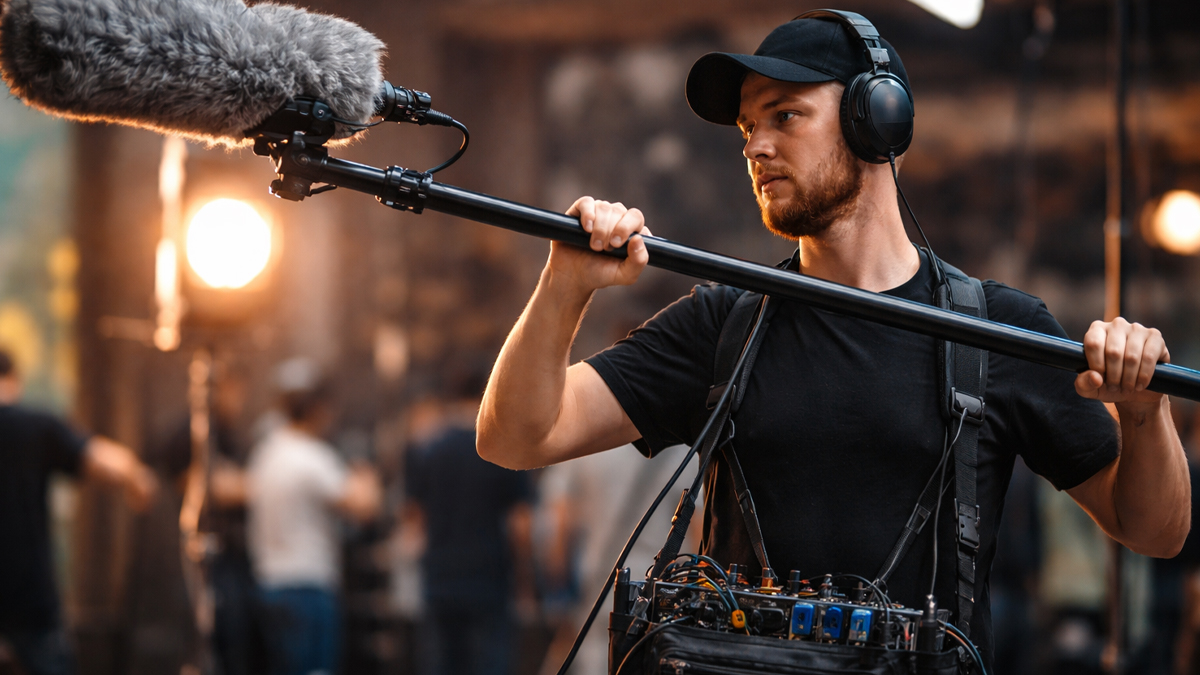
What is Boom Operator?
A boom operator is a sound crew professional in the cinema industry who captures clean, natural dialogue and usable on set sound using a boom microphone setup. The boom operator works close to the action but stays out of the camera frame, using skill, timing, and teamwork to place the microphone where it sounds best while remaining invisible to the audience.
In simple terms, the boom operator is the person who holds and aims the microphone above or below the actors so the audience can clearly hear what is being said. This job is physical, technical, and highly creative because every scene is different. A small change in actor position, head turn, or camera angle can affect how the dialogue sounds, so the boom operator must constantly adjust.
Primary purpose: To capture dialogue that sounds clear, consistent, and emotionally true to the performance.
Where it fits in the sound team: The boom operator usually works under the direction of the production sound mixer and collaborates closely with the utility sound technician and other audio crew.
Why it matters: Good boom work reduces noise, avoids hollow or distant sound, and helps the editor build a believable world without needing excessive re recording later.
How does Boom Operator Work?
Boom operating is a process that starts before the camera rolls and continues through rehearsal, takes, and scene changes. The work is not only about holding a pole. It is about understanding the scene, predicting movement, and managing audio quality while respecting camera, lighting, and actor performance.
Script and scene study: The boom operator reads the scene to understand who speaks, when they speak, how emotional the delivery is, and where actors move.
Blocking and rehearsal awareness: During rehearsal, the boom operator watches how actors walk, sit, stand, and turn. This helps plan microphone positions and movement paths.
Microphone placement decisions: The boom operator chooses whether to boom from above, below, or from the side based on the frame, lighting, set design, and the best sound.
Maintaining consistent distance: Dialogue quality changes when microphone distance changes. The boom operator tries to keep a steady distance from the speaking person, even when the camera moves.
Tracking the speaking actor: When multiple actors talk, the boom operator anticipates who will speak next and smoothly transitions the microphone to follow the dialogue.
Avoiding frame and shadows: The microphone and pole must stay outside the camera frame. The boom operator also avoids casting shadows on faces, walls, or set pieces.
Controlling handling noise: Movement of the pole can create bumps, squeaks, and cable noise. The boom operator uses controlled motion and proper grip to keep the audio clean.
Monitoring audio and taking direction: The boom operator listens on headphones when possible and follows feedback from the production sound mixer to improve placement or reduce noise.
Reset and continuity: Between takes, the boom operator resets position and checks that microphone placement remains consistent so the sound matches across edits.
What are the Components of Boom Operator
The components of boom operator work include both equipment and human skills. The job is a combination of tools, technique, and coordination with other departments.
Boom pole: A lightweight extendable pole, often carbon fiber or aluminum, used to place the microphone close to the actors while staying out of frame.
Boom microphone: A directional microphone, commonly a shotgun microphone or a hypercardioid microphone, chosen based on indoor or outdoor acoustics and the desired pickup pattern.
Shock mount: A mount that isolates the microphone from vibrations and handling noise created by pole movement.
Wind protection: Foam covers, softie style covers, and blimps with windjammers used to reduce wind noise outdoors or in breezy interiors.
Cables and connectors: High quality cables and secure connectors that carry the signal to the recorder or transmitter without crackle or dropouts.
Wireless transmitter system: In some setups, a transmitter is attached to the pole so the microphone signal is sent wirelessly to the sound mixer, reducing cable issues.
Headphones and monitoring chain: Monitoring helps the boom operator hear clothing rustle, traffic, air conditioning, hum, or room reflections and adjust placement.
Boom harness or support: For long takes and heavy setups, a harness or support system reduces fatigue and helps maintain steadiness.
Marks and reference tools: Tape marks on the floor, reference points on set, and knowledge of lens choices help the boom operator predict framing limits.
Crew communication: Hand signals, quiet verbal cues, and coordinated timing with camera and lighting keep the set running smoothly.
Physical technique: Strength, endurance, balance, and smooth movement are essential, especially for long takes, handheld camera work, and crowded sets.
Audio judgment: Understanding tone, proximity effect, room echo, and noise sources helps the boom operator choose the best position for natural dialogue.
What are the Types of Boom Operator
In cinema and screen production, boom operator roles can vary by crew size, production scale, and shooting style. Types here refer to common role variations and working contexts rather than completely different professions.
Primary boom operator: The main boom operator responsible for dialogue capture in most scenes, working directly with the production sound mixer.
Second boom operator: A supporting boom operator used on larger sets, multi camera shoots, or scenes with many actors where one boom cannot cover all dialogue cleanly.
Utility sound technician with boom duties: In smaller productions, the utility sound technician may also operate the boom, manage cables, set lavalier microphones, and assist the mixer.
Studio and stage boom operator: Works on controlled sets such as sound stages where lighting grids, controlled noise, and predictable blocking can allow very precise microphone placement.
Location boom operator: Works on real world locations where traffic, wind, crowds, and unpredictable acoustics require fast adaptation and strong noise control strategy.
Documentary style boom operator: Works in fast moving situations, often with minimal rehearsal, where the priority is capturing understandable dialogue while staying flexible and unobtrusive.
Multi camera television boom operator: Works with multiple frames at once, often needing higher placement, faster reactions, and careful coordination to avoid entering any camera angle.
What are the Applications of Boom Operator
The boom operator supports many audio needs on set, with dialogue capture being the most important. The work also helps build a complete sound palette for the scene.
Dialogue recording: Capturing clear speech with natural tone, minimal echo, and consistent volume.
Performance preservation: Recording subtle breaths, sighs, laughs, and emotional detail that gives the editor options and keeps the performance authentic.
Room tone and ambience support: Helping capture usable room tone, background presence, and transitions that make edits smoother.
Group scenes and ensembles: Covering scenes where many people speak, choosing the best angle and distance to keep voices intelligible.
Action and movement scenes: Capturing dialogue while actors run, fight, or move through complex blocking, often combining boom technique with lavalier support.
Interior scenes with challenging acoustics: Managing reflections and echo by positioning the microphone to reduce roominess and increase clarity.
Exterior scenes with wind and noise: Using wind protection and careful placement to minimize wind rumble, traffic, and environmental interference.
Vehicle and tight space scenes: Using special techniques such as booming from windows, hiding microphones safely, or coordinating plant microphone options when a boom cannot reach.
Improvised dialogue: Following spontaneous speech and overlapping lines, keeping coverage natural and editorially useful.
Low budget and small crew productions: Providing a reliable dialogue track when there are fewer resources for multiple microphones or heavy post production cleanup.
What is the Role of Boom Operator in Cinema Industry
The boom operator plays a direct role in how an audience experiences the story. Viewers may not notice good sound, but they immediately notice bad sound. The boom operator helps ensure that dialogue feels present, consistent, and believable across shots.
Protecting story clarity: When the audience can understand every word, the story flows without confusion.
Supporting emotional impact: Good sound captures intimacy and emotion. A soft line recorded clearly can be more powerful than a loud line recorded poorly.
Reducing dependence on re recording: Re recording dialogue later can be expensive and can lose the natural energy of the set performance. Good boom work reduces that need.
Maintaining sound continuity: Films are edited from multiple takes and angles. The boom operator helps keep sound tone and perspective consistent so cuts feel invisible.
Coordinating with camera: The boom operator adapts to lens changes, camera moves, and framing choices to stay out of shot while staying close to the actors.
Coordinating with lighting: Lights and flags can limit where the boom can go. The boom operator works with the gaffer team to avoid shadows and to find safe paths.
Working with actors respectfully: The boom operator stays close but must never distract the actors. Silent movement, calm presence, and predictable positioning help the performance.
Contributing to set efficiency: Efficient boom operation reduces retakes caused by audio problems, which saves time for the whole production.
Being part of problem solving: Sets are full of noise sources such as air conditioning, generators, refrigerators, and street traffic. The boom operator helps identify issues and supports solutions such as mic repositioning or requesting a quiet hold.
What are the Objectives of Boom Operator
A boom operator works toward clear objectives that guide every decision on set. These objectives combine audio quality, invisibility, and collaboration.
Capture clean dialogue: The first objective is dialogue that is intelligible, natural, and free from distortion, clipping, and excessive noise.
Stay out of frame: The microphone, pole, and operator must remain unseen by the camera, including reflections in mirrors, windows, and shiny objects.
Avoid shadows and interference: The boom operator prevents shadows on faces and set surfaces and avoids interfering with lighting setups.
Maintain consistent tone: Dialogue should match across angles, takes, and actor movement so editors can cut without obvious sound changes.
Minimize handling noise: Movements must be smooth, quiet, and controlled to avoid bumps, cable taps, and pole creaks.
Anticipate dialogue and movement: The boom operator predicts who will speak next and where actors will move, keeping transitions seamless.
Support the sound mixer plan: The boom operator follows the production sound mixer strategy, including microphone choice, placement preference, and coverage priorities.
Work safely: The boom pole can be long and sets can be crowded. Safety for actors, crew, and equipment is always an objective.
Respect performance and pace: The boom operator works quietly, stays focused, and adapts quickly so the set can maintain momentum.
Provide useful notes and feedback: When appropriate, the boom operator communicates issues such as clothing rustle, background noise, or mic limitations so the team can adjust.
What are the Benefits of Boom Operator
A skilled boom operator brings clear benefits to the production, post production, and final viewing experience.
Better dialogue quality: A properly placed boom microphone often provides a more natural and open sound than body worn microphones, with fewer clothing noise problems.
More realistic sound perspective: Boom capture can match camera perspective and room acoustics in a way that feels believable and cinematic.
Cleaner tracks for editing: Editors prefer clean dialogue with minimal noise because it cuts smoothly and requires less repair work.
Reduced costs in post: When on set audio is strong, the production spends less time and money on noise reduction, restoration, and re recording sessions.
Fewer retakes: Catching issues early, adjusting placement, and delivering stable sound reduces the need for additional takes caused by audio problems.
Improved actor comfort: Boom recording can reduce the need to hide microphones on costumes, which can be uncomfortable and time consuming.
Flexible coverage: The boom operator can follow whoever speaks, making it useful for scenes with shifting focus, overlapping dialogue, or changing blocking.
Higher overall production value: Sound quality is a major part of perceived quality. Good boom work makes a project feel more professional.
Stronger archival value: Clean production sound is valuable for future edits, alternate cuts, international versions, and remastering.
What are the Features of Boom Operator
The features of boom operator work are the qualities and capabilities that define excellence in this role. These features include technical skill, physical control, and artistic sensitivity.
Precision placement: The ability to position the microphone at the best spot for tone and clarity while remaining invisible.
Smooth movement: Controlled motion that tracks actors without creating handling noise or sudden tonal shifts.
Situational awareness: Awareness of camera frame, lens choice, light direction, actor movement, and set hazards.
Audio sensitivity: The ability to hear subtle problems such as hiss, hum, distant traffic, clothing rustle, and room echo.
Fast adaptation: Quick changes when the director alters blocking, the camera changes angle, or the set becomes noisier.
Team coordination: Clear, respectful collaboration with the production sound mixer, utility sound technician, camera crew, and assistant directors.
Endurance and stability: The physical ability to hold positions for long takes and repeat them consistently across multiple takes.
Quiet set behavior: Movement that is silent, non distracting, and respectful to the actors and crew.
Technical readiness: Checking cables, connectors, mounts, and wind protection so the setup performs reliably.
Creative problem solving: Finding alternate boom positions, using plant microphone options, or combining techniques to achieve clean dialogue in difficult situations.
What are the Examples of Boom Operator
Examples help show how boom operating works in real production situations. These examples focus on common scene types and the decisions a boom operator makes.
Two person dialogue at a table: The boom operator positions the microphone above the actors, angled to favor the person speaking, then smoothly shifts focus as lines alternate. The distance is kept consistent to avoid volume jumps.
Walking and talking down a hallway: The boom operator walks backward or sideways, matching actor pace while staying out of frame. The pole angle changes as the camera tracks, keeping the microphone pointed at the speaking actor without entering the shot.
Emotional close up: The microphone is placed very close to the actor while staying outside the tight frame. The boom operator uses small controlled adjustments to capture breath and subtle voice detail without creating noise.
Crowded group scene: The boom operator prioritizes the main speaker and may coordinate with a second boom operator or rely on additional microphones. The key is to keep primary dialogue clean while avoiding collisions and shadows.
Exterior scene in wind: The boom operator uses a blimp and windjammer and chooses an angle that reduces direct wind impact on the microphone. The operator also positions to reduce traffic noise pickup while maintaining voice clarity.
Car interior dialogue: The boom operator may boom through an open window between takes or coordinate the use of hidden microphones when the boom cannot fit. The aim is to capture clear dialogue without reflections and cramped movement noise.
Action scene with running: The boom operator keeps a safe distance while maintaining microphone focus on the speaking actor. The operator may coordinate with lavalier microphones for backup while still trying to capture the most natural boom track.
Improvised conversation: The boom operator listens closely to conversation flow and anticipates turn taking. Smooth shifts and steady distance are essential because the dialogue timing is unpredictable.
What is the Definition of Boom Operator
A boom operator is a cinema sound department professional responsible for placing and operating a boom microphone system to record clear on set dialogue and usable production sound while staying outside the camera frame and avoiding visual or lighting interference.
This definition includes three essential ideas.
Audio responsibility: Capturing clean speech and usable sound.
Visual invisibility: Remaining out of frame and avoiding shadows and reflections.
Collaboration: Working as part of a sound team and coordinating with other departments to support the scene.
What is the Meaning of Boom Operator
The meaning of boom operator goes beyond the literal act of holding a microphone. It represents a craft that protects the audience experience. A boom operator is a bridge between live performance and recorded storytelling.
Meaning in storytelling terms: The boom operator helps preserve the truth of a performance by capturing dialogue as it happens, in the space where the scene takes place.
Meaning in production terms: The boom operator enables efficient filmmaking by delivering audio that editors can use, reducing the need for extensive repairs or re recording.
Meaning in technical terms: The boom operator is an expert in microphone placement, directionality, and noise management under the practical limits of a film set.
Meaning in teamwork terms: The boom operator is a quiet collaborator who supports the creative choices of the director, the framing choices of the camera team, and the audio plan of the production sound mixer.
What is the Future of Boom Operator
The future of boom operator work will evolve with technology, but the core craft will remain essential. Cinema will continue to depend on clean dialogue and believable sound, and microphone placement skill will still matter even as tools improve.
Smarter wireless systems: Wireless transmitters and receivers are becoming more reliable, with better range and stronger resistance to interference. This can reduce cable limitations and improve mobility, especially in complex camera movement scenes.
Improved microphone design: Microphones continue to improve in off axis rejection, natural tone, and resistance to wind and humidity. Better microphones can make difficult locations more manageable, but placement skill will still be the deciding factor.
More complex camera movement: Drones, gimbals, and long continuous takes are common. This increases the challenge for boom operators, who must move with the camera while staying invisible. The role may become more athletic and choreography focused.
Virtual production and LED stages: LED wall stages can change acoustics and introduce new noise sources such as cooling systems and tracking equipment. Boom operators will adapt by learning how these environments affect reflections and microphone behavior.
Advanced monitoring and metadata: Better monitoring tools, timecode integration, and audio metadata can help track takes and microphone choices. Boom operators may work more closely with digital workflows to support editors and post teams.
AI assisted audio cleanup in post: Noise reduction and dialogue isolation tools are improving. This can help rescue difficult tracks, but it will not replace the value of clean capture. AI tools work best when the original recording is strong.
Training and specialization: As productions diversify across streaming, short form, documentary hybrids, and international crews, boom operators may specialize more by genre and workflow, while still keeping strong fundamentals.
Continued demand for human judgment: The key reason the job will stay relevant is that sound placement is a real time decision based on emotion, performance, and framing. Human judgment, timing, and collaboration are central to great boom work.
Summary
- A boom operator captures clear on set dialogue by positioning a directional microphone close to actors while staying out of the camera frame.
- The work combines preparation, rehearsal awareness, precise microphone placement, smooth movement, and close teamwork with the production sound mixer.
- Key components include the boom pole, boom microphone, shock mount, wind protection, cables or wireless systems, monitoring, and strong physical and listening skills.
- Common role types include primary boom operator, second boom operator, utility sound technician with boom duties, and specialists for stage, location, documentary, and multi camera work.
- Applications include dialogue recording, emotional detail capture, group scenes, action dialogue, difficult interiors, windy exteriors, tight spaces, and improvised moments.
- The boom operator role supports storytelling by keeping dialogue understandable, consistent, and emotionally truthful while reducing post production costs and re-recording needs.
- Core objectives include clean dialogue, invisibility to camera, shadow avoidance, consistent tone, minimal handling noise, safe operation, and effective collaboration.
- Benefits include natural sounding dialogue, cleaner editing tracks, fewer retakes, improved actor comfort, higher production value, and stronger long term audio assets.
- The future will include better wireless reliability, improved microphones, more complex camera movement, virtual production challenges, stronger metadata workflows, and AI cleanup support, while still relying on human placement skill and judgment.

