

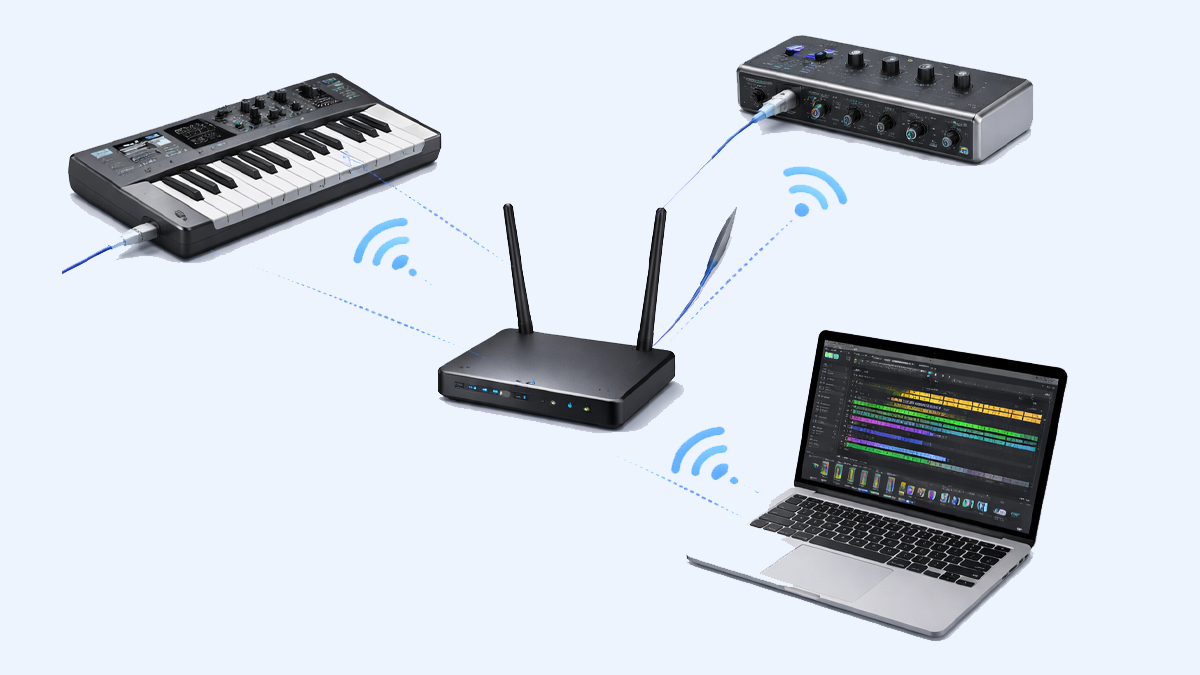
What is Network MIDI?
Network MIDI is a way to send MIDI data through a computer network instead of using only traditional MIDI cables. MIDI data is the digital language that musical instruments and music software use to communicate performance information such as which note was played, how hard it was played, when it started, when it stopped, and which control changes were moved. Network MIDI keeps the same core idea of MIDI, but changes the transport method from direct cable connections to network connections such as Wi Fi, Ethernet, or other IP based networking.
In the world of smart musical instruments, Network MIDI is especially useful because modern instruments often include advanced connectivity, onboard processors, companion apps, and cloud friendly workflows. A smart keyboard, smart drum kit, MIDI controller, digital guitar system, or modular synth setup can all benefit from sending MIDI across a network. This makes the studio more flexible, reduces cable clutter, and allows instruments, computers, tablets, and stage devices to connect in ways that were not practical with only traditional ports.
Network MIDI can be used in a simple home studio with one laptop and one instrument, or in large professional environments such as recording studios, theatre stages, broadcast rooms, and education labs where many devices must communicate at once. It supports both real time performance and complex routing. It can also help smart instruments integrate more smoothly with digital audio workstations, lighting systems, media servers, and interactive installations.
How does Network MIDI Work?
Network MIDI works by packaging MIDI messages and sending them over a network using standard networking methods. MIDI messages are small, fast, and frequent. When you play a chord, your instrument sends multiple note on messages, followed by note off messages when you release the keys. It can also send continuous controller messages such as modulation, expression, sustain pedal, pitch bend, aftertouch, and many other performance controls.
Transport method: The network connection carries these MIDI messages between devices. This connection can be wired Ethernet for stable, low latency communication, or wireless Wi Fi for flexibility and mobility. Devices on the same network can discover each other and create MIDI sessions, depending on the operating system and the Network MIDI implementation being used.
Session and routing: Many Network MIDI systems use a session concept. A session is a virtual connection where one device can send and receive MIDI from another device. Once a session is created, the system exposes virtual MIDI ports to music applications. Your DAW or instrument software sees the network connection like a normal MIDI interface. You select the network MIDI port as an input or output, and performance data flows as if a cable is connected.
Timing and stability: Network transmission introduces latency and jitter, which means small changes in timing. Good Network MIDI systems address this by using timestamps, buffering strategies, and efficient packet handling. Wired networks usually provide the best performance, while wireless networks can still work well if the signal is strong and the network is not crowded.
Multi device communication: A major advantage is that many devices can share MIDI across the same network. One keyboard can control multiple computers. One computer can send MIDI clock to many devices. A tablet can become a remote control surface for instruments and software running elsewhere. This is especially helpful for smart musical instruments because they often live in an ecosystem of apps, controllers, and audio tools.
What are the Components of Network MIDI?
MIDI message layer: This is the actual MIDI data such as note on, note off, control change, program change, pitch bend, channel pressure, polyphonic aftertouch, system exclusive, MIDI clock, and MIDI time code. Network MIDI does not change what MIDI is, it changes how it travels.
Network transport layer: This is the networking method that carries the MIDI packets. It may use IP networking over Ethernet or Wi Fi. The transport layer defines how packets are addressed, delivered, and managed across the network.
Session management: Many implementations include a way to create, name, and manage MIDI sessions. Session management helps devices find each other, connect, and maintain reliable communication. It may include discovery mechanisms so devices can appear automatically in a list.
Virtual MIDI ports: The system typically creates virtual MIDI inputs and outputs. These ports show up inside DAWs, synthesizers, and audio tools. The musician selects these ports just like selecting a physical MIDI interface.
Clock and timing support: Timing features are important for synchronization. A strong Network MIDI setup supports MIDI clock, start, stop, continue, and possibly MIDI time code routing where needed. Smart instrument rigs often depend on tight timing for arpeggiators, sequencers, drum machines, and tempo synced effects.
Router or host device: In many setups, a computer acts as the host that creates sessions and routes MIDI between applications. In other setups, dedicated hardware devices handle routing. In large systems, a network switch, router, or access point becomes an important part of performance quality.
Security and access controls: Because MIDI is traveling over a network, access matters. Good systems provide network isolation options such as separate VLANs, private Wi Fi networks, device whitelists, and password protected access points. This is important on stages, schools, and shared venues.
What are the Types of Network MIDI?
OS based Network MIDI: Many musicians use built in Network MIDI features available in certain operating systems. This type is convenient because it often requires no extra hardware. It creates virtual MIDI ports over the network and can be used with most DAWs.
App based Network MIDI: Some solutions are delivered through applications that run on computers, tablets, or phones. These apps create network MIDI connections and expose virtual ports to music software. They can include extra features such as MIDI filtering, routing presets, and touch control interfaces.
Hardware based Network MIDI: Dedicated devices can convert traditional MIDI to network MIDI and back. This is useful when you want to connect classic hardware synths, drum machines, or stage controllers into a modern network setup. Some hardware units provide multiple MIDI ports and advanced routing.
Wi Fi Network MIDI: This type uses wireless networking. It is popular for mobile performance, tablet integration, and rehearsal spaces where cables are inconvenient. It can be very effective with a strong access point and careful network setup.
Wired Ethernet Network MIDI: This type uses wired networking. It is typically the most stable and lowest latency approach. It is common in professional studios, stages, and installations where reliability is critical.
Hybrid Network MIDI: Many real world rigs use a mixture. For example, a wired backbone connects the main computers and hardware hubs, while tablets join over Wi Fi for remote control. Hybrid design offers both stability and flexibility.
What are the Applications of Network MIDI?
Studio production and composition: Network MIDI allows a keyboard in one room to control virtual instruments on a computer in another room. It also helps when producers use multiple computers for heavy projects, such as one computer for orchestral libraries and another for synths and effects. MIDI can travel between them without additional long cable runs.
Live performance rigs: On stage, Network MIDI can connect controllers, backup computers, hardware synths, and lighting systems. A single master controller can send performance data to multiple sound sources, and a master clock can keep everything synchronized.
Smart instrument companion apps: Many smart instruments use companion apps for sound design, preset browsing, practice feedback, and performance control. Network MIDI allows these apps to exchange MIDI data with computers and other instruments without needing a physical MIDI interface.
Music education labs: In a classroom, an instructor can send MIDI examples to student devices, monitor practice exercises, or route student performance to shared software tools. Network MIDI can support flexible setups where students use laptops and tablets.
Theatre and broadcast: Productions often require synchronized music cues, show control, and precise timing. Network MIDI can carry tempo, trigger cues, and communicate with automation systems. It reduces complexity compared to many point to point cable connections.
Interactive installations and museums: Many installations use sensors, cameras, and interactive controls that produce MIDI. Network MIDI can route this data to sound engines across a venue, enabling responsive audio experiences.
Remote collaboration and control: While audio streaming is a separate topic, network based MIDI control can help remote workflows inside a studio network. For example, a composer can control a computer in a machine room from a writing desk using a quiet laptop, while the powerful sound engine runs elsewhere.
What is the Role of Network MIDI in Music Industry?
Workflow flexibility: Network MIDI supports modern workflows where musicians combine hardware instruments, software instruments, mobile devices, and multiple computers. This flexibility is valuable in production, performance, and content creation.
Integration of smart musical instruments: Smart instruments often include USB, wireless features, app control, and embedded processing. Network MIDI acts as a bridge that connects these instruments into broader ecosystems including DAWs, synthesizers, control surfaces, and stage systems.
Scalable setups: The music industry often works at different scales, from bedroom studios to touring productions. Network MIDI scales well. A simple setup can be one laptop and one tablet. A large setup can include many MIDI endpoints across a network with organized routing.
Reduced cabling and faster setup: Traditional MIDI cabling can become messy in complex rigs. Network MIDI reduces physical cabling, especially when devices are already connected for other reasons such as file transfer, remote control, or internet access. This can reduce setup time and improve stage cleanliness.
Multi discipline control: Modern shows combine audio, video, lighting, and automation. MIDI is often used to trigger cues and control parameters. Network MIDI allows these signals to move across a shared network infrastructure, making integration smoother.
Support for modern production styles: Many producers use distributed computing, template based scoring, and large sound libraries. Network MIDI supports controlling multiple systems and keeping them synchronized, which fits modern production demands.
What are the Objectives of Network MIDI?
Connectivity objective: Provide a convenient way to connect MIDI devices without relying only on traditional cable lengths, port counts, and physical interface limitations.
Scalability objective: Allow musicians and engineers to expand a MIDI system to many devices without a complicated web of point to point connections.
Flexibility objective: Enable routing options such as one to many, many to one, and many to many MIDI communication, depending on creative and technical needs.
Mobility objective: Support wireless control for tablets, phones, and portable controllers, especially for smart instruments and modern performance setups.
Reliability objective: Provide stable MIDI communication suitable for professional use, with features that manage timing, session stability, and network behavior.
Integration objective: Make it easier for MIDI to interact with other network based systems such as remote control protocols, show control systems, and multi computer workflows.
What are the Benefits of Network MIDI?
Less cable clutter: A network connection can replace many MIDI cables, especially when multiple devices must communicate. This keeps studios and stages cleaner.
Long distance capability: Traditional MIDI cables have practical limits. Networks are designed to cover longer distances. Network MIDI can reach across rooms, floors, or venues when the network is properly designed.
Multi device routing: Network MIDI can support complex routing where one controller drives multiple instruments, or multiple controllers feed one sound engine, without constant rewiring.
Cost efficiency in some setups: If devices already have network connectivity, you may not need additional MIDI interface hardware. Virtual ports can reduce the need for extra cables and boxes.
Easy expansion: Adding a new device can be as simple as connecting it to the network and creating a session. This is helpful for smart instrument ecosystems that grow over time.
Better integration with software: Virtual MIDI ports fit naturally into DAWs and music software. You can save routing inside project templates and recall it quickly.
Remote control possibilities: You can control software instruments from a different location in the same building, which is useful when you want a quiet writing space and a separate machine room.
Supports modern smart instrument design: Many smart instruments are built around connectivity. Network MIDI matches that design philosophy and keeps the instrument connected to apps and platforms.
What are the Features of Network MIDI?
Virtual port creation: Network MIDI creates MIDI inputs and outputs that appear inside music applications, allowing easy selection and routing.
Session based connections: Many systems use sessions that can be named, saved, and reconnected. This reduces repetitive setup work.
Device discovery: Some implementations allow devices to find each other on the network automatically, making connection setup easier.
Multi channel MIDI support: Network MIDI still supports standard MIDI channels, allowing multiple instrument parts to travel over one connection.
System exclusive compatibility: Many Network MIDI systems can carry system exclusive data, which is important for hardware editors, patch transfers, and advanced control.
Clock and synchronization support: Many setups rely on MIDI clock, transport messages, and sync signals. Network MIDI can deliver these to keep devices aligned.
Routing and filtering: Some solutions include tools for filtering, mapping, and transforming MIDI messages. This helps when integrating different controllers and instruments.
Wired and wireless options: Network MIDI can operate over Ethernet for reliability or Wi Fi for convenience. This flexibility suits both studio and live environments.
Interoperability with traditional MIDI: With the right interfaces, Network MIDI can connect to classic MIDI DIN devices, keeping older hardware useful in modern rigs.
What are the Examples of Network MIDI?
Laptop to laptop control: A producer uses one computer as a master keyboard input station and another as a sound library server. Network MIDI sends note and control data to the server, while audio returns through an audio interface or audio network.
Tablet as a controller: A tablet runs a music control app that sends MIDI faders and buttons over Wi Fi to a DAW on a computer. The tablet becomes a wireless control surface for mixing or instrument control.
Smart keyboard with app integration: A smart keyboard connects to a home Wi Fi network and sends MIDI to a DAW while also communicating with its companion app for lesson feedback and preset management.
Stage rig with backup computer: A main computer hosts virtual instruments, while a backup computer mirrors the setup. Network MIDI helps distribute control data and keep systems aligned, while routing can be switched quickly if needed.
Hardware synth integration through a network bridge: A rack device converts MIDI DIN signals from classic synthesizers into network MIDI, allowing those synths to be triggered from software and controllers across the network.
Education lab routing: An instructor computer sends MIDI sequences to student devices. Students can play along with synchronized tempo and share their performances back to the instructor system.
What is the Definition of Network MIDI?
Network MIDI is the method of transmitting MIDI messages over a computer network so that musical instruments, controllers, computers, and music applications can exchange MIDI performance and control data through wired or wireless networking.
What is the Meaning of Network MIDI?
The meaning of Network MIDI is simple. It means MIDI over a network. Instead of connecting devices only with direct MIDI cables or USB connections, devices communicate through network pathways. This meaning also includes a shift in how musicians think about connectivity. A network is shared infrastructure. Once MIDI becomes part of that shared infrastructure, routing becomes more flexible, setups become easier to expand, and smart instrument ecosystems become more connected.
In practical terms, Network MIDI means that your keyboard can control a synth on another computer, your tablet can adjust parameters in your DAW without being plugged in, and your studio can scale without turning into a cable maze. It also means that MIDI can travel alongside other important data flows such as remote desktop control, file transfers, and show control signals, as long as the network is designed carefully.
What is the Future of Network MIDI?
Wider adoption in smart_toggle ecosystems: As smart musical instruments continue to include Wi Fi, Bluetooth, and app connectivity, Network MIDI will likely become a standard expectation. Musicians increasingly want instruments that connect quickly to computers and mobile devices without extra adapters.
Improved timing and reliability: The future will likely bring better latency management, smarter buffering, and more robust wireless performance. As Wi Fi standards improve and network hardware becomes more capable, wireless Network MIDI will become more dependable for live use.
Better cross platform interoperability: Musicians often work across multiple operating systems and devices. Future Network MIDI solutions may improve plug and play compatibility so that sessions are easier to create across different platforms.
Deeper integration with modern MIDI standards: The broader MIDI ecosystem continues to evolve. Network based transport aligns well with modern expectations such as higher resolution control and richer expressive messages. Future workflows may rely more on network transport to carry advanced MIDI data between smart instruments and software.
Growth of network centric studios and stages: More studios are using multiple computers for heavy projects, and more stages are using complex show control. Network MIDI fits these trends and may become a normal part of professional infrastructure, similar to how network audio and remote control are now common in many environments.
Smarter routing and automation: Future tools may include automatic device recognition, profile based mapping, and intelligent routing suggestions. A smart instrument could announce its capabilities, and the network MIDI manager could route it to the correct software instrument automatically.
Security awareness: As more musical control flows happen over networks, secure networking practices will become more important. Expect more built in security features and easier ways to keep performance networks isolated from public traffic.
Summary
- Network MIDI sends MIDI performance and control messages over wired or wireless networks instead of only using traditional MIDI cables.
- It supports flexible routing, multi device communication, and cleaner setups for studios, stages, and education environments.
- Key components include MIDI message handling, network transport, session management, virtual ports, and timing support.
- Common types include OS based, app based, hardware based, wired Ethernet, wireless Wi Fi, and hybrid Network MIDI setups.
- Major benefits include scalability, long distance connectivity, reduced cable clutter, and strong integration with smart musical instruments and DAWs.
- The future points toward better reliability, stronger cross platform support, smarter routing, and deeper integration with evolving MIDI capabilities.

