

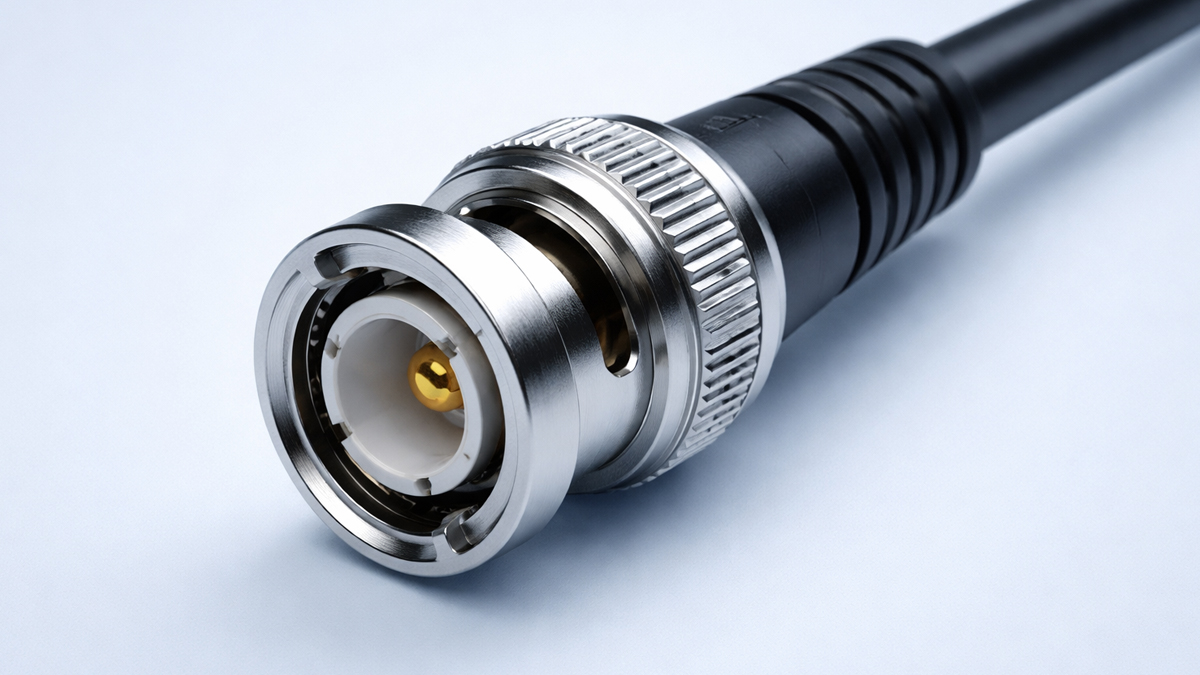
What is BNC Connector?
A BNC connector is a small, rugged coaxial cable connector used to carry radio frequency signals and high bandwidth video signals with stable impedance and reliable shielding. BNC is widely associated with 50 ohm and 75 ohm coaxial systems, which makes it useful across broadcast, test equipment, networking history, and many forms of professional video. In cinematic electronics and cinema industry workflows, BNC connectors are strongly linked with serial digital video, reference signals, timecode distribution, and various monitoring or routing paths where signal integrity and quick, repeatable connections matter.
Core idea: A BNC connector is built to join a coaxial cable to a device port in a way that keeps the cable shield continuous, keeps impedance controlled, and provides a quick locking mechanism that does not easily loosen during movement.
Why it matters: Coaxial signals can degrade quickly if the connection is unstable, poorly shielded, or mismatched in impedance. A BNC connector addresses these risks by providing a well-defined mechanical and electrical interface that can be used across many professional devices.
How does BNC Connector Work?
A BNC connector works by forming a coaxial continuation from the cable into the equipment jack. Coaxial means there is a center conductor carrying the signal, an insulating dielectric around it, and an outer conductor that acts as a shield and return path. The connector is designed so the center pin mates with the jack contact while the outer body mates with the jack shell, keeping geometry consistent and minimizing reflections.
Signal path: The center conductor of the coax cable is terminated to a center pin in the BNC plug. When inserted into the BNC jack, that pin makes contact with the jack receptacle, carrying the signal forward.
Shield path: The outer braid or foil shield of the coax is clamped or crimped to the connector body. When the connector locks into the jack, the connector body contacts the jack shell, completing the shield and return path with low resistance.
Locking mechanism: BNC uses a bayonet style coupling. You push the plug onto the jack, then rotate it slightly so locking lugs engage. This creates a secure connection that resists vibration and accidental pull, while still allowing fast connect and disconnect.
Impedance continuity: Many BNC connectors are engineered to maintain a consistent impedance across the connection. This matters for high frequency or high data rate video, where discontinuities create reflections that can cause jitter, eye pattern collapse, or visible artifacts.
What are the Components of BNC Connector?
A BNC connector includes mechanical and electrical parts that together create a stable coaxial interface.
Center contact: The center pin or center contact connects to the coax center conductor. It is usually precision machined or stamped, then plated to reduce oxidation and contact resistance.
Dielectric insulator: A dielectric separates the center contact from the outer body. It keeps spacing consistent, which helps maintain impedance and prevents short circuits.
Outer body or shell: The connector body is electrically tied to the cable shield and acts as the outer conductor. It also provides mechanical strength and houses the bayonet features.
Bayonet coupling ring: The coupling ring and its lugs provide the twist lock action. This lets crews connect cables quickly on set, in machine rooms, or in projection booths.
Cable termination system: Most common are crimp, compression, or solder terminations. Some designs use a crimp ferrule over the braid, while the center pin may be crimped or soldered to the center conductor.
Strain relief: Many BNC plugs include a boot or a mechanical clamping method to reduce stress at the cable exit. This helps prevent intermittent faults that are hard to diagnose.
Plating and materials: Contacts are often plated with nickel, gold, or other finishes depending on durability needs. The body is often brass with plating, while some versions use stainless steel for harsh environments.
What are the Types of BNC Connector?
BNC connectors come in types based on impedance, termination style, mounting style, and signal use case.
Impedance versions: Common options are 50 ohm and 75 ohm. 50 ohm is typical for RF and many test applications. 75 ohm is common for video distribution and digital video interfaces in broadcast and cinema related infrastructure.
Plug versus jack: A plug usually goes on the cable end. A jack is the receptacle on a device or panel. Jacks can be bulkhead mounted on panels, on circuit boards, or integrated into equipment housings.
Crimp type: Crimp BNC uses a crimp ferrule to clamp the braid to the connector body and a crimped center pin. This is popular for consistent results and field assembly speed.
Compression type: Compression BNC uses a compression sleeve that provides strong mechanical retention and good shielding. Many technicians prefer it for repeatability in video cabling.
Solder type: Solder BNC uses solder for the center conductor and sometimes for the shield connection. It can be reliable but depends heavily on workmanship and heat control.
Rear twist or twist on type: These are faster but usually less consistent for high performance video. They can be useful for temporary setups, but are less favored in critical paths.
Right angle versions: Right angle BNC plugs and jacks are used where space is tight behind equipment racks, monitors, or patch panels.
Isolated or insulated bulkhead: Some bulkhead BNC jacks include insulation to isolate the connector body from the panel, useful in specific grounding schemes.
High density mini versions: There are smaller variants used for dense routing panels, but they may require special tooling and careful handling.
What are the Applications of BNC Connector?
BNC connectors are used wherever a coaxial signal must be connected quickly and reliably.
Professional video transport: Coax with BNC is widely used for SDI video, including many production and post workflows. BNC cabling supports long runs and robust locking connections.
Reference and sync distribution: Facilities distribute reference signals for timing, including black burst in legacy setups and tri level sync in HD environments. These often use BNC.
Timecode distribution: Many timecode systems use BNC connectors to distribute timecode across cameras, recorders, and sync generators, depending on gear and standards.
Test and measurement: Oscilloscopes, waveform monitors, signal generators, and analyzers commonly use BNC for RF and video measurements.
Broadcast routing and patching: Patch panels and routing matrices often present BNC interfaces for fast repatching of signals.
RF and antenna systems: Many RF systems use BNC in certain frequency ranges, especially where a bayonet lock is valued and connectors are frequently swapped.
Security and surveillance: Some analog and HD over coax camera systems use BNC connectors for video transport and power injection arrangements, depending on design.
Cinema and live event infrastructure: Temporary or touring setups often use BNC for routing camera feeds, monitoring lines, and sync signals.
What is the Role of BNC Connector in Cinema Industry?
In the cinema industry, BNC connectors often sit quietly in the background, yet they support the reliability and timing discipline that professional images and sound workflows depend on. Modern cinema production includes cameras, monitors, video village systems, wireless video receivers, routers, recorders, and test gear. Many of these devices either use BNC directly or interface through converters and distribution boxes that use BNC.
On set signal integrity: A stable video feed to director monitors and focus puller displays needs clean transport. BNC locking reduces accidental disconnects during fast movement, handheld shots, or crowded camera rigs.
Timing and synchronization: Multi camera shoots, virtual production stages, and motion control scenes rely on consistent timing. Sync generators and distribution amplifiers often use BNC to deliver reference signals that keep devices aligned.
Quality control and troubleshooting: Cinematic electronics teams use waveform monitors and signal analyzers to verify exposure, color, and signal health. BNC ports provide a convenient standardized interface for test points.
Infrastructure and scalability: When a set grows, coax with BNC can be routed through patch panels and distribution systems that scale cleanly. This helps the crew expand monitoring, add record feeds, or create redundant paths without reinventing cabling standards.
Post and dailies ecosystems: While many post workflows use file based transfers, the capture and review chain can still involve BNC connections for SDI monitoring and grading displays, especially in professional environments where signal discipline and calibration are critical.
Projection and booth integration: In some cinema venues, BNC appears in auxiliary monitoring paths, test points, or legacy signal distribution inside technical rooms.
What are the Objectives of BNC Connector?
The objectives of a BNC connector can be understood as practical goals that improve signal reliability and operational efficiency.
Provide a secure connection: The bayonet lock objective is to avoid accidental disconnection while keeping the connect process fast.
Preserve signal integrity: A core objective is to maintain coaxial geometry and consistent impedance through the connector, reducing reflections and transmission loss.
Maintain shielding continuity: BNC aims to keep the shield continuous from cable to equipment, reducing electromagnetic interference pickup and limiting emissions that could affect nearby electronics.
Support repeatable field assembly: Many BNC designs are optimized for crimp or compression termination so technicians can build consistent cables with predictable performance.
Enable fast routing changes: In production, broadcast, and cinema infrastructure, crews often need to swap lines quickly. BNC supports rapid reconfiguration.
Provide a common interface: A connector is also a standard. BNC has become a familiar interface across many signal types, which lowers training effort and reduces mistakes in high pressure environments.
What are the Benefits of BNC Connector?
BNC provides benefits that align well with professional cinematic electronics needs.
Reliable locking: The bayonet lock helps prevent intermittent video glitches caused by partially seated connectors. This is especially helpful on moving rigs, carts, and crowded monitoring stations.
Strong shielding: Coax plus a well-terminated BNC offers excellent shielding, which helps in environments packed with wireless systems, motors, LED walls, and power distribution.
Consistent performance: When the correct impedance version and proper termination are used, BNC connections can deliver stable performance for high bandwidth video and reference signals over long distances.
Fast workflow: Crews can connect and disconnect quickly without thread wear or slow tightening, which improves speed during setup and strike.
Durability: BNC connectors are typically robust and tolerate many mating cycles. This is valuable for rental gear and touring kits that see heavy use.
Ecosystem compatibility: Many devices and accessories accept BNC, making it easier to build interoperable kits with routers, monitors, recorders, converters, and test equipment.
Serviceability: Faulty cables can often be repaired by replacing the connector end, reducing waste and downtime.
What are the Features of BNC Connector?
BNC connectors include characteristic features that explain why they remain common in professional environments.
Bayonet coupling: A quarter turn lock provides secure retention and quick handling.
Coaxial structure: The connector preserves a coaxial signal path with a defined center contact and outer shield interface.
Impedance options: BNC is available in 50 ohm and 75 ohm designs, supporting different signal families.
Termination choices: Crimp, compression, and solder variants allow selection based on tooling, field conditions, and performance requirements.
Panel and rack integration: Bulkhead and rear mount versions make BNC ideal for patch panels, distribution panels, and router frames.
Wide accessory support: Adapters, barrels, T connectors, attenuators, and terminators exist for BNC, enabling flexible system design and testing.
High mating cycle design: Many BNC parts are engineered for repeated connect and disconnect without rapid degradation.
Clear tactile feedback: The lock action gives physical confirmation that the connector is engaged, reducing uncertainty during fast setups.
What are the Examples of BNC Connector?
Examples help connect the connector concept to real cinema related workflows and cinematic electronics gear.
Camera to monitor feed: A cinema camera outputs SDI over a BNC port, routed via coax to a director monitor or a video village distribution box.
Wireless video receiver output: A wireless receiver provides an SDI output on BNC that feeds a monitor, recorder, or router on the cart.
Video router patching: A rack mounted router uses BNC jacks on the rear, while a patch panel with BNC lets engineers reroute signals quickly during live production or complex set operations.
Reference signal distribution: A sync generator outputs tri level sync on BNC, distributed through a reference distribution amplifier to multiple devices on set.
Waveform monitoring: A waveform monitor accepts SDI input via BNC so the imaging technician can check exposure, gamut, and signal legal levels.
Test pattern generation: A portable generator with BNC output sends calibration patterns to monitors for setup and troubleshooting.
Timecode distribution box: Some systems use BNC or adapt to BNC to distribute timecode where robust locking and standard coax cabling are desired.
Bulkhead through wall: A studio stage may use BNC bulkhead connectors in wall plates to route signals between stage floor, control rooms, and equipment racks.
What is the Definition of BNC Connector?
A BNC connector is defined as a bayonet locking coaxial connector designed to terminate and mate coaxial cables to compatible jacks, providing a controlled electrical interface for RF and high frequency video signals while maintaining shielding and, in appropriate designs, a defined impedance such as 50 ohm or 75 ohm.
Functional definition: It is a connector that preserves coaxial signal transmission properties while providing quick connect and secure retention.
Engineering definition: It is a connector family with standardized mechanical mating geometry and electrical characteristics used across many professional signal systems.
What is the Meaning of BNC Connector?
The meaning of BNC connector, in practical terms, is a dependable way to carry sensitive, high bandwidth signals between devices without losing quality or stability. For cinematic electronics, the meaning extends beyond a physical plug. It represents a standard method of signal transport that supports predictable system behavior.
Operational meaning: When a crew sees a BNC port, they know it is typically a coaxial signal interface, often for SDI, sync, or measurement.
Workflow meaning: BNC suggests speed and reliability. You can patch quickly, lock securely, and trust that the shielding is intact if the connector is correctly built.
Quality meaning: A properly matched and well-terminated BNC link is a sign of disciplined signal engineering, which is essential for consistent monitoring and synchronization.
What is the Future of BNC Connector?
The future of BNC connectors in the cinema industry and cinematic electronics is shaped by two parallel trends: rising data rates and growing use of IP based transport, while legacy and practical realities keep coax relevant.
Higher bandwidth coax: As video standards evolve, coax systems and connectors continue to be refined. Better materials, improved manufacturing tolerances, and optimized dielectric designs help BNC remain viable for high data rate video in many real-world distances.
Continued presence in hybrid systems: Even when a production uses IP video on set or in facilities, there are often gateways, monitoring taps, and measurement points that still use SDI over BNC. Hybrid setups are common because they balance flexibility with reliability.
More emphasis on cable quality and installation: As data rates increase, the connector becomes only one part of the chain. The future will reward careful selection of coax type, correct impedance matching, precise termination, and thorough testing.
Tooling and training improvements: Compression and precision crimp systems are becoming more standardized. This improves consistency across crews and rental houses, reducing intermittent faults.
Integration with compact and ruggedized gear: Cinema rigs keep getting smaller and more modular. BNC will likely coexist with smaller connector families, with BNC retaining a strong role in rugged external cabling, cart systems, and infrastructure.
Long lifecycle in installed environments: Studios, stages, and post facilities often keep infrastructure for many years. BNC based cabling will remain in these spaces because it is serviceable, well understood, and cost effective to maintain.
Summary
- BNC connector is a bayonet locking coaxial connector designed for reliable RF and professional video signal connections.
- It works by mating a center contact and an outer shield path while preserving coax geometry for stable signal transmission.
- Key components include the center contact, dielectric, outer body, coupling mechanism, termination system, and strain relief.
- Common types include 50 ohm and 75 ohm versions, plus crimp, compression, solder, bulkhead, and right angle styles.
- Applications include SDI video transport, sync distribution, timecode paths, test equipment, routing, and patching.
- In the cinema industry, BNC supports stable monitoring, secure on set connections, synchronization, and practical troubleshooting.
- Objectives include secure retention, impedance and shielding continuity, repeatable assembly, and fast workflow changes.
- Benefits include durability, fast connect, strong shielding, ecosystem compatibility, and serviceability.
- Features include bayonet locking, impedance options, multiple termination styles, and strong support for panels and accessories.
- The future of BNC is hybrid, remaining important alongside IP workflows due to reliability, installed base, and continued refinement.

