

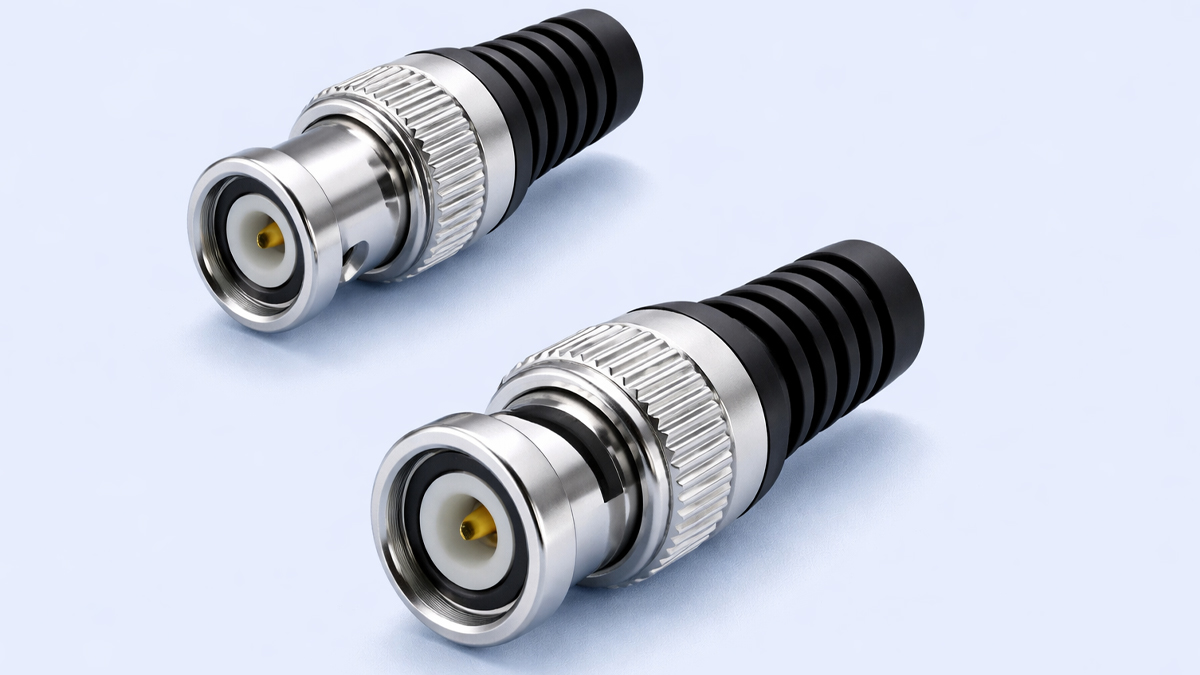
What is Mini BNC Connector?
Mini BNC Connector is a compact version of the classic BNC connector that is used to connect coaxial cables for carrying high frequency signals. It is designed for situations where equipment size is smaller, connector density is higher, and the available panel space is limited. While the traditional BNC connector is common in broadcast and general video systems, the mini BNC connector becomes especially useful when modern devices require many signal connections in a tight space.
Purpose in cinematic electronics: In cinema industry environments, signal connections must be stable, repeatable, and resistant to accidental disconnection. Mini BNC connectors support these needs while allowing smaller cameras, compact monitors, wireless video systems, and lightweight rigs to stay practical and organized.
Why size matters: Cinematic devices increasingly focus on portability, modular builds, and high channel count. A smaller connector can reduce clutter, improve cable routing, and help crews build cleaner rigs without sacrificing signal integrity.
Signal type focus: Mini BNC connectors are typically used with coaxial cable signals, including serial digital video and other RF or timing signals, depending on the system design.
Reliability expectation: In production and post production, crews expect connectors to lock securely, hold consistent impedance, and maintain low signal loss. Mini BNC connectors are built with these expectations while occupying less space than standard BNC.
How does Mini BNC Connector Work?
Mini BNC Connector works by creating a controlled electrical path between a coaxial cable and a device port while keeping the signal shielded from external noise. It uses a mechanical locking method that helps prevent the connector from pulling out accidentally during movement, vibration, or cable strain.
Coaxial signal flow: A coaxial cable has a center conductor that carries the main signal and an outer shield that protects the signal and serves as a return ground path. The mini BNC connector keeps the center conductor aligned with a matching contact in the device port, while the shield connects to a surrounding conductive shell.
Locking mechanism: Mini BNC usually uses a bayonet style coupling concept, similar in spirit to BNC, where the connector seats onto the mating jack and is secured with a short twist. This locking action keeps the connection stable even when cables are bumped or the rig is repositioned.
Impedance stability: Many video standards rely on a consistent characteristic impedance, commonly 75 ohms for video coax systems. Mini BNC connectors are engineered so the geometry of the internal dielectric and metal parts keeps impedance consistent across the connection point. This helps reduce reflections, signal loss, and waveform distortion.
Shielding behavior: The metal outer body and the shield connection create a continuous barrier that limits electromagnetic interference. This is especially important around cinema sets where power distribution, wireless systems, motors, and lighting equipment can create noise.
Practical handling: Mini BNC connectors are built for frequent connect and disconnect cycles. A well-made connector provides a smooth mating action, clear seating feel, and a secure lock without excessive force.
What are the Components of Mini BNC Connector?
Mini BNC Connector includes mechanical and electrical elements that work together to carry the signal, maintain shielding, and provide a secure connection. Understanding its components helps technicians choose the right connector quality and troubleshoot failures.
Center contact: This is the part that mates with the center conductor of the coaxial cable and the center pin or socket of the device jack. It must be precisely shaped to maintain stable contact pressure and low resistance.
Dielectric insulator: This internal insulating material separates the center contact from the outer body. Its geometry strongly influences impedance control and signal consistency. High quality dielectric materials help reduce loss and maintain performance at higher frequencies.
Outer conductor and shell: This metal body connects to the cable shield and forms the external shielding structure. It also provides the mechanical interface that mates with the device port.
Coupling system: This is the locking feature that secures the connector to the mating jack. It is designed to resist accidental pull and to maintain consistent pressure during use.
Cable termination section: This area is where the connector attaches to the coaxial cable. Depending on the connector style, termination might involve crimping, compression, or soldering. Proper termination is critical because poor termination can introduce reflections, noise pickup, or intermittent contact.
Strain relief: Many mini BNC assemblies include strain relief elements that reduce stress at the cable entry point. This helps prevent conductor breakage and shield separation caused by bending and repeated movement.
Sealing and protective parts: Some connectors include gaskets or environmental features for use in harsh conditions. In cinema industry use, protection may be important for outdoor shoots, dusty locations, and high humidity environments.
What are the Types of Mini BNC Connector?
Mini BNC Connector types vary based on termination method, mounting style, impedance rating, and application needs. Choosing the right type ensures performance, durability, and compatibility with cinematic workflows.
Cable plug type: This is the connector installed on the end of a coaxial cable. It mates with a panel jack or device jack. Cable plug versions are common in patch cables and custom camera cables.
Panel mount jack type: This type is mounted through a device panel, rack plate, or patch panel. It provides a stable fixed port for repeated connections. It is common on interface boxes, distribution panels, and specialized cinema accessories.
Bulkhead type: A bulkhead mini BNC connector passes through a panel and provides connectors on both sides. It is useful for patching, panel extensions, and custom rig plates.
Crimp termination type: This type uses a crimp tool and crimp sleeves to secure the connector onto the cable. It is widely used because it can be fast, consistent, and durable when done with correct tooling.
Compression termination type: This type uses a compression process to seal and secure the connector onto the cable. It can provide excellent mechanical strength and improved weather resistance, depending on design.
Solder termination type: This type uses soldering for the center contact and sometimes for shield connections. It can be reliable but depends heavily on technician skill and temperature control.
75 ohm video type: Many mini BNC connectors are designed for 75 ohm coax systems that carry SDI video signals, including HD-SDI and 3G-SDI, and in some cases higher rate SDI depending on cable and connector specification.
50 ohm RF type: Some mini BNC variants exist for 50 ohm RF systems. In cinema industry work, 75 ohm is more typical for video, but RF systems and test equipment may use 50 ohm.
Right angle and low profile variants: Some connectors and adapters are shaped to reduce protrusion from the device. This helps in tight camera builds, gimbal work, and compact monitor setups.
What are the Applications of Mini BNC Connector?
Mini BNC Connector is used whenever a compact, secure coaxial connection is required. Its applications span production, broadcast style workflows, testing, and specialized cinematic electronics.
Camera video output connections: Mini BNC can be used on compact cinema cameras or camera accessories where a full size BNC would take too much space. It helps maintain professional locking behavior in a smaller footprint.
On set monitoring: Monitor inputs and outputs, video assist systems, and compact monitoring modules may use mini BNC to provide robust connectivity while keeping device size manageable.
Wireless video systems: Some wireless transmitters, receivers, and related accessories use mini BNC for SDI input or output, especially when the enclosure is compact.
Distribution and routing: Small distribution amplifiers, mini converters, and routing devices can use mini BNC to increase port density. This is helpful in carts, racks, and portable DIT setups.
Patch panels and breakout boxes: Custom cinema carts and production trucks may include patching solutions where mini BNC provides more ports per panel width.
Timecode and sync related routing: In some systems, coaxial connectors are used for reference signals. Mini BNC can appear in compact sync boxes or specialized timing accessories, depending on the design.
Test and measurement: Technicians may use mini BNC adapters and cables for waveform monitoring, signal testing, and troubleshooting in engineering environments connected to cinema workflows.
Studio and virtual production: Dense wiring environments, such as LED volume control rooms, camera tracking systems, and monitoring matrices, may benefit from smaller connector formats to manage many links cleanly.
What is the Role of Mini BNC Connector in Cinema Industry?
Mini BNC Connector plays a practical and reliability focused role in the cinema industry by enabling stable video and signal connections in compact devices without sacrificing professional locking and shielding behavior. Modern filmmaking depends on a chain of electronics, and a single weak connection can cause major delays, lost takes, and troubleshooting time.
Signal integrity support: Cinema workflows often rely on SDI because it is reliable, long range, and less fragile than many consumer style connections. Mini BNC extends that SDI style reliability into smaller form factors.
Rig compactness and balance: Camera builds for handheld, gimbal, drone, and car rigs require reduced weight and reduced cable bulk. Mini BNC can help keep connectors smaller and reduce snag points.
High density connectivity: Digital imaging technicians and video assist teams often route multiple feeds, returns, and monitoring outputs. Mini BNC can increase the number of ports on small converters and distribution tools.
Field reliability: Sets are busy environments with constant movement. Mini BNC locking behavior reduces accidental disconnects, which protects continuity for video village, focus pullers, and remote monitoring teams.
Modularity: Many cinema systems use modular accessories such as cages, top plates, side modules, and expansion units. Mini BNC enables these modules to include professional grade coax ports without redesigning the entire device around larger connectors.
Professional workflow compatibility: Even though mini BNC is smaller, it can integrate with standard BNC ecosystems using adapters and tailored cables. This allows crews to keep using familiar routing and patching methods.
What are the Objectives of Mini BNC Connector?
Mini BNC Connector is designed with clear objectives that align with demanding cinematic electronics requirements. These objectives explain why this connector exists and why it is chosen over other options in many professional setups.
Space efficiency objective: Provide a coaxial connector that fits into smaller housings and enables more ports per panel area.
Secure connection objective: Offer a locking connection that resists accidental removal during production movement, cable tension, and rig handling.
Signal quality objective: Maintain controlled impedance and shielding to support clean high frequency signal transmission suitable for professional video and related signals.
Durability objective: Withstand repeated connect and disconnect cycles and survive real world set use where cables are frequently reconfigured.
Compatibility objective: Support professional coaxial workflows and allow integration with standard BNC systems through adapters, patching, and cable assemblies.
Ease of handling objective: Provide a connector that crews can connect quickly, feel the lock engagement, and trust during time sensitive production conditions.
Reduced clutter objective: Help simplify dense cabling areas by reducing connector size while keeping professional level performance.
What are the Benefits of Mini BNC Connector?
Mini BNC Connector provides benefits that directly address production challenges such as reliability, compactness, and signal integrity. These benefits are both technical and practical.
Compact professional connectivity: It delivers a professional coax connection in a smaller footprint, which helps device makers design compact modules without losing locking behavior.
Better port density: More connectors can fit into a panel, which is valuable for monitoring racks, distribution gear, and portable cart systems.
Secure locking in motion: The locking action reduces the chance of disconnection during handheld moves, gimbal operation, or cable management changes.
Strong shielding performance: The coaxial design and metal body help reduce interference, which is useful in environments with lighting dimmers, motors, and wireless devices.
Consistent video performance: When matched with proper coax cable and correct impedance specification, mini BNC can support stable SDI video transfer with predictable results.
Cleaner rig ergonomics: Smaller connectors can reduce snag points and help cables route closer to the body of the camera or accessory, improving handling.
Professional serviceability: Mini BNC is a known connector family, so replacement parts, tools, and expertise are available in professional electronics and broadcast related support channels.
What are the Features of Mini BNC Connector?
Mini BNC Connector includes design features that support performance, reliability, and usability in cinematic electronics. These features can vary by manufacturer and quality level, but the core expectations are consistent.
Miniature form factor: The connector body is smaller than standard BNC, supporting compact devices and higher connector density.
Coaxial geometry: The internal layout supports coaxial impedance behavior to reduce reflections and support high frequency signals.
Locking interface: The connector locks to the mating jack, helping prevent accidental unplugging and improving reliability on set.
Metal shielding body: The outer shell provides electromagnetic shielding and physical protection.
Multiple termination options: Mini BNC connectors can be crimp, compression, or solder terminated depending on the cable type and installation preference.
Support for professional video signals: Many mini BNC connectors are designed for 75 ohm video paths, aligning with SDI workflows common in cinema production.
Mechanical durability: Quality connectors are made to withstand repeated connections, cable flexing near the termination area, and mild impacts typical in field use.
Accessory ecosystem: Adapters, right angle connectors, and custom cable assemblies are widely used, allowing mini BNC to fit into many practical builds.
What are the Examples of Mini BNC Connector?
Mini BNC Connector examples can be described through real world cinema and production scenarios where this connector format is used to solve space and reliability challenges.
Compact cinema camera SDI port: A small form factor cinema camera or camera module may include a mini BNC SDI output to keep the body slim while still offering a locking coax connection for monitor feeds.
Wireless transmitter SDI input: A compact wireless video transmitter mounted on a camera cage may use mini BNC for SDI input to reduce bulk and keep the connector from sticking out too far.
DIT cart converter unit: A small SDI converter or distribution amplifier used on a DIT cart may include multiple mini BNC ports to increase the number of available connections in a limited rack width.
Patch panel breakout: A custom patch panel on a production cart might use mini BNC bulkhead connectors so that many SDI lines can be routed through a single compact panel.
Monitor back panel connector: A compact on camera monitor or viewfinder related accessory may use mini BNC for SDI input and output to keep the device thin and lightweight.
Adapter chain for compatibility: A crew might use mini BNC to BNC adapter cables when a device uses mini BNC but the rest of the system uses standard BNC patching.
What is the Definition of Mini BNC Connector?
Mini BNC Connector is defined as a compact coaxial connector designed to transmit high frequency signals through coaxial cable while providing a secure locking connection and consistent electrical performance. It is a smaller format connector that preserves key functional characteristics associated with BNC style coax connections, including shielding and reliable mating.
Technical definition focus: It is a coaxial connector interface that joins a coaxial cable to equipment, maintaining the signal path of center conductor and outer shield with controlled impedance behavior based on the connector design.
Practical definition focus: It is a space saving coax connector that helps professional video and signal systems remain dependable in compact cinematic devices.
What is the Meaning of Mini BNC Connector?
Mini BNC Connector meaning can be understood by looking at what it represents in real production life. It means professional grade signal connection in a smaller physical package. For crews, it often means fewer accidental disconnects, cleaner builds, and easier handling of dense wiring systems.
Meaning for camera teams: It means the camera can stay compact while still providing a locking coax output suitable for reliable monitoring and recording chains.
Meaning for technicians: It means more ports in less space and a connector type that supports professional impedance and shielding expectations.
Meaning for workflow stability: It means the signal chain is less likely to fail due to loose plugs, especially in active shooting conditions.
Meaning in cinematic electronics design: It means manufacturers can build smaller accessories while still meeting the rugged expectations of cinema sets.
What is the Future of Mini BNC Connector?
Mini BNC Connector future is tied to two trends in the cinema industry: increasing device compactness and increasing demand for reliable high bandwidth signal paths. As camera bodies, wireless systems, and monitoring tools continue to shrink, the need for high performance connectors that take less space will remain strong.
Continued use in compact SDI ecosystems: SDI remains important in professional environments because it is robust and predictable. Mini BNC will likely continue as a compact SDI connector option where manufacturers want a locking coax port without a full size footprint.
Growth in high density systems: Virtual production, multi camera studios, and complex on set monitoring involve many simultaneous feeds. Mini BNC can support denser patching and routing hardware.
Improved connector engineering: Manufacturers are likely to keep refining mini BNC designs to support higher data rates, lower loss, and better mechanical life. Better materials, tighter tolerances, and improved termination systems can raise reliability further.
More integrated cable solutions: The industry is moving toward smarter cabling, better strain relief, and modular cable kits. Mini BNC will remain relevant as part of these kits, especially where weight and space matter.
Coexistence with other interfaces: Some workflows use IP based video, HDMI variants, and optical fiber. Mini BNC is not likely to replace those, but it will continue to serve wherever coax is the best balance of reliability, distance, and simplicity.
Training and standardization: As more devices adopt mini BNC, crew familiarity will increase. This will reduce setup errors and encourage standard cable labeling and patching practices for smoother production days.
Summary
- Mini BNC Connector is a compact coaxial connector designed for secure, shielded, high frequency signal connections in tight spaces.
- It supports reliable signal flow by connecting the coax center conductor and shield while maintaining controlled impedance.
- Key components include the center contact, dielectric insulator, outer shell, locking system, termination area, and strain relief.
- Common types include cable plugs, panel mount jacks, bulkhead versions, and crimp, compression, or solder termination styles.
- Applications include SDI video links for cameras, monitors, wireless systems, converters, distribution gear, and patch panels.
- In the cinema industry, it helps keep rigs compact, reduces accidental disconnects, and improves port density in production setups.
- Its objectives focus on space saving design, secure locking, strong shielding, stable signal quality, and field durability.
- Benefits include cleaner cable routing, dependable connectivity during movement, and professional compatibility through adapters and custom cables.
- Features include miniature size, coaxial geometry, locking interface, strong shielding, and multiple termination options.
- The future of mini BNC is supported by ongoing miniaturization of cinema gear and continued demand for robust high bandwidth connections.

