

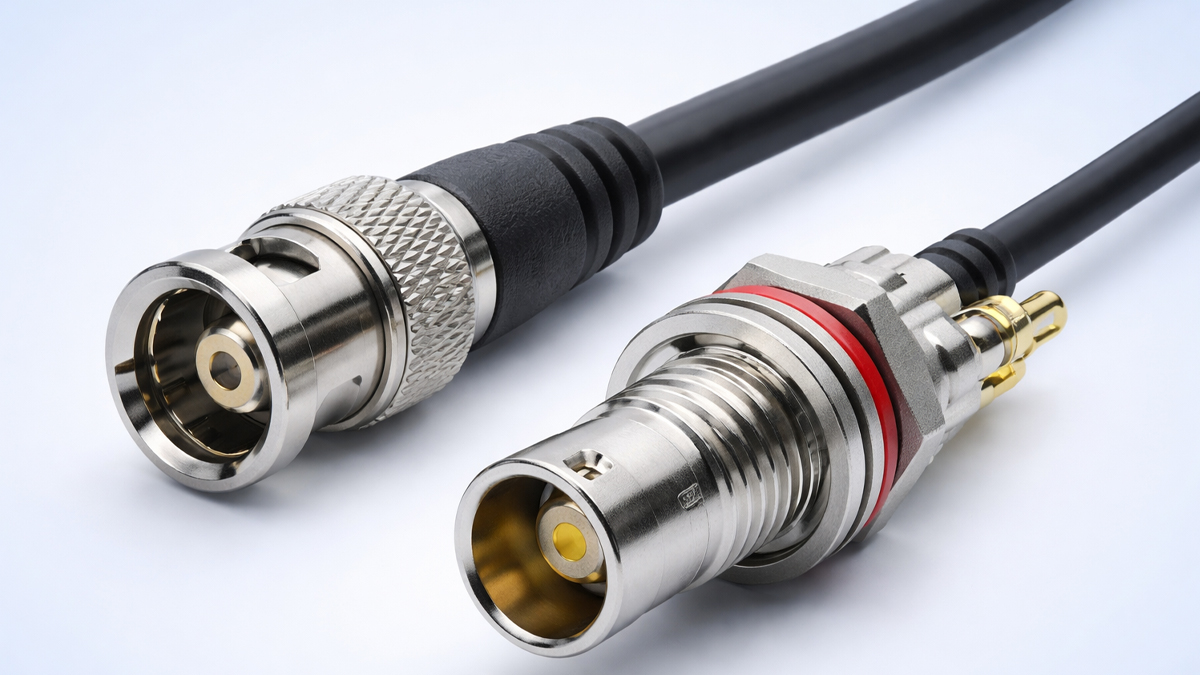
What is HD SDI Connector?
An HD SDI connector is the physical connector used to carry HD SDI video signals through a coaxial cable. HD SDI stands for High Definition Serial Digital Interface. It is a professional digital video standard used to move uncompressed video and embedded audio in a reliable way across production environments. In simple words, the HD SDI connector is the end piece that lets a coax cable lock into cameras, monitors, switchers, recorders, routing panels, and cinema and broadcast gear so the HD SDI signal can travel with minimal loss and strong noise resistance.
Core idea: HD SDI is the signal standard, and the HD SDI connector is the hardware interface that helps that signal move from one device to another.
Why it matters: In cinema industry workflows, crews often need stable video transport for monitoring, live switching, on set recording, video assist, and post production ingest. HD SDI is trusted because it is designed for professional conditions where cables are moved, coiled, stepped on, and used over longer distances than typical consumer video connections.
Where you see it: The most common physical connector used for HD SDI is the BNC connector, usually a 75 ohm BNC. Many people casually say SDI connector when they mean a 75 ohm BNC connector that is rated for HD SDI bandwidth.
How does HD SDI Connector Work?
An HD SDI connector works by creating a controlled impedance connection between a coaxial cable and the device port so the digital SDI waveform stays clean. HD SDI is a high speed serial digital signal. At these data rates, the shape of the signal is sensitive to impedance changes, poor shielding, loose termination, and mechanical instability. The connector solves these problems through a few key actions.
Signal path: The coaxial cable has a center conductor that carries the signal and an outer shield that acts as ground and shielding. The connector keeps that geometry consistent right up to the device input or output, reducing reflections that can corrupt the digital bit stream.
Locking action: A BNC style HD SDI connector uses a bayonet locking mechanism. You push the connector onto the port and twist to lock it. This helps prevent accidental disconnection during shooting or when cables get tugged.
Electrical integrity: The connector uses precision contact surfaces and dielectric materials to maintain the 75 ohm impedance. This is important because SDI systems depend on impedance matching to avoid signal reflections.
Noise control: The outer metal body and shield connection help block electromagnetic interference. On busy sets with wireless systems, motors, lighting power runs, and multiple devices, good shielding helps protect the signal.
Practical workflow: When a camera outputs HD SDI, the signal travels through the coax cable, passes through the connector contacts, enters the receiving device, and is then equalized, reclocked, and decoded by the device electronics. The connector is a small part, but it is the gateway that must stay stable for the entire chain to work.
What are the Components of HD SDI Connector?
An HD SDI connector has mechanical and electrical parts that work together to keep the signal stable and the connection secure.
Center contact: This is the pin or socket that mates with the center conductor of the coax cable. It carries the digital SDI signal.
Dielectric insulator: This is the insulating material that holds the center contact in place and keeps it separated from the outer shield. Its material and shape strongly influence impedance.
Outer conductor and shield contact: This part connects to the cable shield and to the device ground reference, completing the coax structure and providing shielding.
Connector body: Typically metal, it provides mechanical strength and electromagnetic shielding. It also forms the outer conductor path.
Locking mechanism: For BNC style connectors, a bayonet coupling ring locks onto the device port. This prevents pull out and reduces micro movement that can introduce intermittent issues.
Strain relief: Many cable end connectors include a clamp, boot, or crimp area that grips the cable jacket. This reduces stress on the internal contacts when cables are bent or pulled.
Crimp or compression ferrule: In common field assemblies, a ferrule is crimped or compressed over the cable braid and jacket to create a firm, repeatable shield connection.
Precision geometry: High quality HD SDI connectors are built with tight tolerances so the 75 ohm impedance is maintained through the connector transition.
What are the Types of HD SDI Connector?
HD SDI connectors can be discussed by physical form factor, installation style, and performance rating. In most cinema and broadcast cases, the signal is HD SDI and the physical connector is a 75 ohm BNC, but there are variations worth knowing.
Standard 75 ohm BNC: This is the most common connector for HD SDI. It uses bayonet locking and is available in many cable and panel variants.
Mini BNC: A smaller version often used where space is limited, such as high density routing panels, compact devices, and some camera accessories. It still aims for 75 ohm performance but requires matching adapters or dedicated ports.
DIN 1.0/2.3: A compact, high density connector seen in broadcast racks and routing equipment. It supports secure locking and tight panel spacing.
HD BNC: A newer, higher bandwidth BNC variant designed for very high data rates and improved return loss performance. It can be used in advanced SDI environments and is more common in modern broadcast installations.
Panel mount connectors: These are chassis connectors installed on equipment panels or patch bays. They provide stable ports for repeated plugging.
Cable end connectors: These are installed on coax cable ends and are used to connect devices on set.
Adapters and barrels: BNC couplers, gender changers, right angle adapters, and pass through barrels are not ideal in high performance paths but are often used to solve routing issues. Each extra junction can increase loss and reflections, so good quality parts matter.
Performance rated variants: Some connectors are specifically rated for HD SDI or higher, based on return loss and frequency performance. In real workflows, choosing connectors rated for the needed bandwidth helps reduce dropouts and marginal links.
What are the Applications of HD SDI Connector?
HD SDI connectors are used wherever professional uncompressed video needs to move reliably through coax infrastructure.
On set camera to monitor: A camera can send HD SDI to a director monitor, focus puller monitor, or video village distribution amplifier.
Video assist systems: Video assist often uses SDI feeds for recording takes, playback, timecode burn in, and multi camera management.
Live switching and multi camera productions: Switchers, routers, and multiviewers frequently accept SDI inputs and outputs. Connectors support fast patching and stable routing.
Recording and playback: External recorders and playback servers may use SDI I O for capture and output.
Transmission over longer runs: Coax SDI can handle longer distances than many consumer connections, especially with quality cable and equalization. HD SDI connectors are essential for those runs.
Studio infrastructure: Patch panels, routing frames, and distribution amplifiers rely on SDI connectors for modular wiring.
Post production ingest and monitoring: SDI connections are used to feed reference monitors, capture devices, and grading displays, especially where consistent signal and low latency are required.
Broadcast trucks and mobile units: SDI remains a standard for rugged, field deployable signal chains in outside broadcast and event coverage, which overlaps with cinema adjacent work.
What is the Role of HD SDI Connector in Cinema Industry?
In cinema industry workflows, the HD SDI connector plays a quiet but critical role because it supports dependable video transport between devices that must work under pressure.
Set reliability: Film sets move fast. Crews rewire monitors, swap cameras, reposition video village, and reroute signals around lights and rigging. A locking SDI connection reduces accidental disconnects and provides more confidence than loose consumer plugs.
Low latency monitoring: HD SDI is commonly used for direct monitoring because it is uncompressed and typically low latency. This benefits focus pulling, framing, lighting checks, and director viewing.
Clean signal for evaluation: When the goal is judging exposure, focus, and image integrity, uncompressed SDI monitoring is valuable. The connector is part of the chain that keeps that signal stable.
Integration with professional gear: Many cinema and broadcast devices use SDI as a standard interface. The connector makes it possible to connect cameras to routers, wireless video systems, converters, and multiviewers using a common language.
Rugged physical handling: Coax cables get dragged, taped, coiled, and sometimes stressed. A good connector design with strain relief and robust shielding helps maintain performance despite handling.
Standardization on set: Using SDI connectors across departments makes it easier to plan cabling, carry spares, troubleshoot quickly, and keep the workflow consistent from pre production to shooting to post.
What are the Objectives of HD SDI Connector?
The objectives of an HD SDI connector are practical and focused on signal integrity and dependable operation.
Signal integrity objective: Maintain a 75 ohm impedance path to minimize reflections and preserve the digital eye pattern.
Reliability objective: Provide a secure, repeatable connection that does not loosen easily during movement and vibration.
Shielding objective: Protect the signal from electromagnetic interference through proper grounding and braid connection.
Compatibility objective: Offer a standardized connection that works across many professional devices and accessories.
Serviceability objective: Allow fast connection and disconnection, easy cable replacement, and straightforward troubleshooting.
Durability objective: Withstand repeated mating cycles and field handling without significant wear or performance drift.
Distance objective: Support longer cable runs by minimizing insertion loss and maintaining return loss characteristics that keep links stable.
Workflow objective: Enable modular routing through patch panels, distribution amplifiers, and converters so crews can build flexible monitoring and recording chains.
What are the Benefits of HD SDI Connector?
HD SDI connectors provide benefits that are especially valuable in professional production environments.
Stable locking connection: The bayonet lock on common BNC connectors reduces accidental unplugging and maintains contact pressure.
High quality signal transport: When paired with proper 75 ohm cable, the connector helps preserve uncompressed video quality over practical distances.
Noise resistance: Coax shielding and connector metal bodies reduce susceptibility to interference compared with many unshielded or lightly shielded consumer cables.
Field friendly workflow: SDI cabling is familiar to many crews. Connectors are quick to connect, and spare parts are widely available.
Scalable infrastructure: Patch bays and routers can be built around SDI connectors, making it easier to expand monitoring and distribution as the project grows.
Embedded audio and metadata support: SDI can carry embedded audio, timecode, and ancillary data depending on equipment and standards. A solid connector helps keep the link stable so these embedded elements do not drop.
Compatibility with converters: SDI to HDMI, SDI to fiber, SDI to IP converters are common. The connector serves as the bridge to these systems.
Predictable troubleshooting: A coax SDI line can be tested with known tools, and connector issues are often identifiable through visual inspection, wiggle tests, and cable tests.
What are the Features of HD SDI Connector?
The features of an HD SDI connector reflect what is required to carry high speed digital signals in real production conditions.
Impedance control: Designed to maintain 75 ohm characteristic impedance through the connector transition.
Low return loss: Good connectors reduce reflections. This is critical for SDI at higher data rates.
Secure coupling: Many SDI connectors use bayonet locking, and other variants use push pull or latch mechanisms.
Robust shielding: Full metal shells and solid shield termination help block interference.
High mating cycle capability: Professional connectors are built to be plugged and unplugged many times without failure.
Multiple termination methods: Available in crimp, compression, solder, and field install styles depending on cable type and workflow.
Cable compatibility range: Connectors exist for different coax diameters and constructions, from thin flexible cables used on rigs to thicker cables used for long runs.
Panel and cable variants: The same SDI interface can exist as a chassis port, a cable end, or a feedthrough on a patch panel.
Bandwidth rating: Many connectors are rated for specific frequency performance to support HD SDI and beyond in demanding systems.
What are the Examples of HD SDI Connector?
Common examples of HD SDI connector usage include real world device pairings and cable assemblies seen in cinema and broadcast environments.
Camera SDI output to director monitor SDI input using a 75 ohm BNC cable.
Camera to wireless video transmitter using a short flexible coax with BNC connectors for rig mounting.
Video assist cart distribution amplifier receiving one SDI feed and sending multiple SDI outputs to monitors, each output using a BNC connector.
SDI patch panel where camera feeds are patched to different destinations, using panel mount BNC connectors.
SDI to HDMI converter taking an SDI input through a BNC connector to feed a consumer display.
Router or multiviewer in a control room using high density SDI connectors like DIN 1.0/2.3 or mini BNC on the backplane to save space.
Long run coax feed from stage to control room terminated with BNC connectors at both ends, sometimes through a wall plate.
Timecode and reference distribution equipment that shares similar coax connector styles, reinforcing the value of consistent connector standards on set.
What is the Definition of HD SDI Connector?
The definition of an HD SDI connector is a precision coaxial connector, typically 75 ohm, designed to terminate and interface coaxial cable with equipment ports for transporting HD SDI serial digital video signals, supporting reliable mechanical coupling and maintaining electrical characteristics necessary for high speed uncompressed digital video transmission.
What is the Meaning of HD SDI Connector?
The meaning of an HD SDI connector, in everyday production terms, is the professional plug and port system that lets HD SDI video travel on coax cable between devices in a way that stays locked, clean, and dependable. It represents a commitment to professional signal transport where stability and predictability matter more than convenience.
Operational meaning: It is the difference between a monitoring feed that stays solid all day and a feed that cuts out when someone bumps the cable.
Workflow meaning: It is a standardized connector choice that helps crews move quickly, share gear across departments, and maintain consistent cabling practices.
Quality meaning: It supports uncompressed video and embedded data, which helps teams make accurate creative decisions during capture and review.
What is the Future of HD SDI Connector?
The future of the HD SDI connector is shaped by how production workflows evolve. Even as IP video, fiber, and wireless systems grow, coax SDI remains attractive because it is simple, low latency, and widely supported. The connector itself will likely continue to exist, but its role may shift depending on where SDI is used most.
Continued relevance in hybrid workflows: Many sets and facilities now mix SDI with IP and fiber. SDI connectors will remain in use at the edges where cameras, monitors, and converters connect.
Higher bandwidth demands: As SDI standards move to higher data rates, connector performance requirements become stricter. This encourages the adoption of better rated connectors, improved return loss designs, and modern variants like HD BNC or high density locking formats in fixed installations.
More compact equipment: As devices become smaller and denser, compact connector types like mini BNC and DIN 1.0/2.3 can become more common in racks and compact routers, while standard BNC remains common on set devices for ease of handling.
Better cable management and ruggedization: Future connector designs may emphasize improved strain relief, weather resistance, and more consistent field termination methods, especially for production environments that travel.
Coexistence with fiber and IP: Fiber and IP systems solve long distance and routing flexibility challenges, but SDI connectors will likely remain a practical choice for short to medium runs, quick setup, and dependable point to point monitoring.
Training and standard practice: The installed base of SDI tools and crew familiarity are strong forces. As long as SDI remains a core interface, the connectors that support it will keep their place in cinema and broadcast toolkits.
Summary
- HD SDI connector is the physical coax connector interface used to carry HD SDI serial digital video signals, most commonly a 75 ohm BNC connector.
- It works by maintaining a stable 75 ohm impedance path, locking securely, and protecting the signal with strong shielding.
- Key components include the center contact, dielectric insulator, outer shield contact, connector body, locking mechanism, and strain relief.
- Common types include standard 75 ohm BNC, mini BNC, DIN 1.0/2.3, HD BNC, plus panel mount and cable end variants.
- Applications include on set monitoring, video assist, live switching, recording, routing, patch panels, and post production monitoring chains.
- In the cinema industry, it supports low latency, reliable, uncompressed monitoring and fast, standardized cabling across departments.
- Main objectives are signal integrity, reliable locking, strong shielding, broad compatibility, durability, and practical serviceability.
- Benefits include dependable connections, noise resistance, scalable infrastructure, predictable troubleshooting, and integration with professional gear.
- Future direction includes hybrid SDI and IP workflows, higher bandwidth connector requirements, more compact connector formats, and continued on set usefulness.

