
What is 3 Axis Linear Slider?
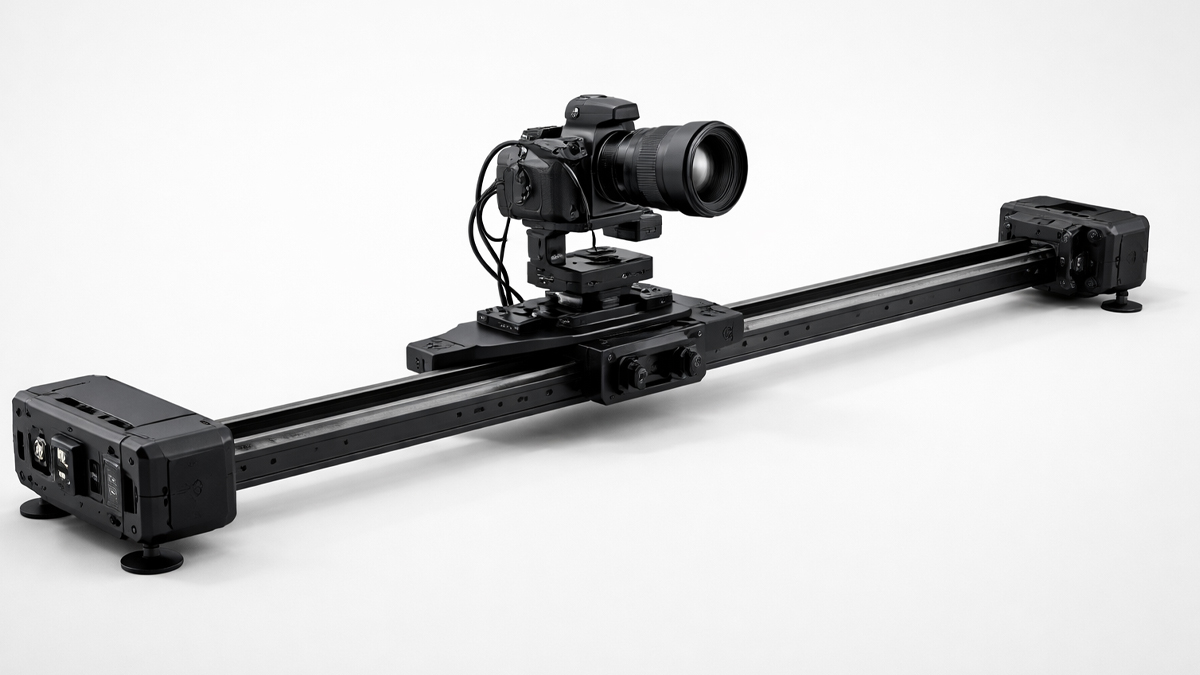
A 3 Axis Linear Slider is a motorized camera motion system used in robotic camera rigs to create controlled, repeatable, and smooth movement for cinematic shots. In cinema workflows, the phrase usually refers to a slider based system that provides three coordinated axes of motion for the camera, most commonly:
- One linear axis that moves the camera carriage along a rail (the slider movement)
- Two additional axes that control camera orientation, typically pan and tilt using a motorized head
Some systems also use three linear axes (X, Y, and Z) for studio and product work, where the camera can move forward and backward, left and right, and up and down on a compact gantry. In the cinema industry, however, the most common practical meaning is a linear slider plus a two axis motorized head, because that combination covers many cinematic moves with a relatively portable setup.
The purpose of a 3 Axis Linear Slider is not only to move the camera, but to move it in a way that feels intentional and cinematic. It helps filmmakers create elegant reveals, parallax motion, push ins, pull outs, and perfectly repeatable takes for visual effects, time lapse, product cinematography, and multi pass compositing.
How does 3 Axis Linear Slider Work?
A 3 Axis Linear Slider works by coordinating motors, mechanical drive parts, and a controller that calculates how each axis should move over time. The system translates creative input into precise motion.
Motion control concept: The slider follows a programmed path where position, speed, and acceleration are managed to avoid jerks and vibrations. Smoothness comes from controlling acceleration ramps rather than only setting a speed.
Axis coordination: The controller synchronizes the linear slide with pan and tilt so the camera can maintain framing while it moves. For example, the camera can slide sideways while panning to keep a subject centered, creating strong parallax between foreground and background.
Keyframing and path planning: Many systems allow keyframes. You set a start pose and an end pose, and sometimes multiple poses in between. The controller interpolates the movement to create a continuous path.
Repeatability: Because the motion is motor driven and measured, the same move can be repeated. That is essential for visual effects, stop motion, and shots that require multiple passes such as clean plate, foreground pass, and background pass.
Feedback and stabilization: Higher end rigs use encoders to measure motor rotation and carriage position. Some include inertial sensors to help maintain smoothness or to support advanced features like keeping the horizon level.
Power and control options: The system can be run from batteries or mains power. Control may be done via an onboard interface, a handheld controller, an app, or integration with larger motion control ecosystems and camera trigger systems.
What are the Components of 3 Axis Linear Slider?
A 3 Axis Linear Slider is a combination of mechanical structure, motion hardware, electronics, and mounting accessories. The exact design varies, but the core components are consistent.
Slider rail and support: The rail is the main track, usually made from aluminum or carbon fiber. It must be rigid to prevent flex. Support can include tripod stands, light stands, combo stands, or a dedicated support system with spreaders.
Carriage or dolly: The carriage rides along the rail on wheels or linear bearings. It includes mounting points for the pan tilt head and sometimes quick release plates. It must minimize play so the camera does not wobble.
Drive mechanism: The carriage is moved by a drive system. Common options include belt drive, lead screw, ball screw, or rack and pinion. The drive mechanism affects speed, noise, and precision.
Motors: Stepper motors are common because they provide precise incremental motion. Servo motors are used in higher end systems for smoother performance and better feedback. Separate motors typically power slide, pan, and tilt.
Motorized head: The head provides pan and tilt axes. It includes gears, bearings, and motor mounts. It must handle camera payload safely and maintain stiffness to avoid drift.
Controller or motion brain: This unit manages timing, axis synchronization, keyframes, speed profiles, and optional camera triggering. It is the system that turns creative commands into motor signals.
Encoders and sensors: Encoders measure actual motion. Limit switches prevent the carriage from crashing into ends. Some rigs include sensors for calibration and homing.
Power system: Batteries, battery plates, power distribution cables, and voltage regulation are needed. Stable power matters because voltage dips can cause stutters.
Mounting hardware: Tripod plates, clamps, cheese plates, rods, and quick release systems help integrate the slider with cinema support gear.
Cables and cable management: Motor cables, control cables, and camera trigger cables must be routed cleanly. Cable drag can ruin smooth motion, so many rigs include cable guides.
Software or app interface: Many modern sliders use an app for programming moves, saving presets, and controlling timelapse and stop motion features.
What are the Types of 3 Axis Linear Slider?
There are multiple types, and the best choice depends on the production style, payload, and shot requirements.
Portable cinema slider with pan tilt head: This is the most common on location. It is designed for speed of setup and travel. It typically has one rail and a compact motorized head.
Heavy duty cinema slider for larger payloads: Built for heavier cameras and cinema lenses. These prioritize rigidity, stronger motors, and higher stability, often requiring sturdier stands.
Gantry style three linear axis system: This type moves in X, Y, and Z. It is often used in studios, tabletop product cinematography, and repeatable commercial setups. It can mimic small robotic systems while staying relatively compact.
Belt driven slider systems: Belt drive is popular for faster moves and lighter loads. It is usually quieter and simpler, but may be slightly less precise than screw based systems in some cases.
Screw driven slider systems: Lead screw or ball screw designs can offer high precision and strong holding torque, useful for micro moves and repeatability. They can be slower and may generate more mechanical noise.
Rack and pinion slider systems: Often used when higher torque and robustness are needed. It can be a good middle ground for certain payload ranges.
Modular motion control systems: These allow users to add axes over time, such as adding a second linear axis, a turntable, or focus control. They fit well into evolving production needs.
Studio motion control rigs integrated with camera triggering: These systems are designed for multi pass shots and visual effects. They often include advanced programming, lens control, and data export for post production workflows.
What are the Applications of 3 Axis Linear Slider?
A 3 Axis Linear Slider has a wide range of uses across cinema, advertising, and content production.
Cinematic parallax shots: By sliding while maintaining framing using pan and tilt, the camera creates depth and separation between subject and background. This is a signature cinematic look.
Product cinematography: Controlled moves around a product create premium visuals. The repeatability helps match shots across a campaign.
Timelapse and hyperlapse style motion: The system can move incrementally between frames while triggering the camera. This produces motion timelapse with a strong sense of scale.
Visual effects and compositing: Repeatable moves allow multiple passes. You can capture clean plates, effects elements, and foreground takes with identical motion for compositing.
Stop motion and animation: Incremental, frame accurate movement can support stop motion, especially when combined with programmable keyframes.
Interviews and controlled storytelling: Subtle slider moves add life to static setups. The ability to keep a subject centered while moving can make interviews feel more dynamic.
B roll and establishing shots: Smooth controlled moves help produce high end b roll quickly, especially for corporate films and documentaries.
Virtual production support: In some virtual production setups, repeatable camera movement helps align practical camera motion with virtual environments and tracking workflows.
Macro and close up shots: When working close, even tiny vibrations become visible. Precise speed ramps and stable mechanics help create clean close up movement.
What is the Role of 3 Axis Linear Slider in Cinema Industry?
In the cinema industry, a 3 Axis Linear Slider is a practical bridge between simple camera support gear and full sized robotic arms. It delivers robotic style repeatability and smoothness without the logistical overhead of larger systems.
Enhancing visual language: Motion is a storytelling tool. A controlled push in can increase intimacy, a lateral slide can reveal information, and a precise move can create tension. Three axis control expands the range of these moves while keeping them smooth.
Consistency across takes: Cinema often requires matching action across multiple takes. A motorized repeatable move helps maintain continuity, especially when lighting, actor performance, or effects elements must align.
Efficiency on set: Once programmed, the move can be repeated quickly. That reduces the time spent trying to manually replicate a move with a handheld slider or improvised rigging.
Supporting modern production styles: Content today often needs both cinematic quality and fast turnaround. A 3 axis slider helps small teams achieve polished results with fewer crew members.
Expanding creative control for operators: The operator can focus on composition and storytelling instead of physically pushing a slider and trying to pan smoothly at the same time. The system can handle the mechanics while the operator handles the creative intent.
Integrating with cinematic technologies: These sliders often connect to camera triggering, timelapse control, and sometimes lens control. That puts them firmly inside the cinematic technologies toolkit, alongside gimbals, cranes, drones, and robotic arms.
What are the Objectives of 3 Axis Linear Slider?
The objectives of a 3 Axis Linear Slider can be understood as both creative goals and technical goals.
Creative objectives: The system aims to produce smooth, intentional camera movement that supports the story, enhances mood, and increases production value.
Precision objectives: It aims to move with accurate positioning so that the camera hits marks reliably. This is essential for repeatable moves, VFX, and product work.
Repeatability objectives: It aims to replicate the exact same move multiple times. Repeatability reduces mismatch problems in post production and enables multi pass workflows.
Stability objectives: It aims to reduce micro vibrations, wobble, and mechanical play that would be visible on camera, especially with longer focal lengths.
Workflow objectives: It aims to speed up production by allowing rapid setup, saved presets, and predictable results, reducing trial and error.
Safety objectives: It aims to carry camera payloads securely, with limits, controlled acceleration, and stable support, reducing the risk of gear damage.
What are the Benefits of 3 Axis Linear Slider?
A 3 Axis Linear Slider provides benefits that are practical, creative, and economic.
Cinematic smoothness: Motor control with acceleration ramps produces movement that feels refined and professional, especially compared to inconsistent manual pushes.
Complex moves made easy: Sliding while panning and tilting smoothly is difficult manually. A three axis system can do it consistently, even at very slow speeds.
Repeatable takes: For visual effects, stop motion, and matching shots, repeatability is a major advantage that saves time and reduces post production headaches.
Better framing control: Pan and tilt can keep a subject locked while the camera moves, improving composition and making the shot feel intentional.
Reduced crew strain: A small crew can achieve sophisticated motion without needing a large dolly team or complex rigging.
More usable footage: Because the motion is stable, more takes are usable. That reduces reshoots and helps editors work faster.
Versatility: One system can cover slow dramatic pushes, fast slides, subtle interview movement, and timelapse sequences.
Improved creative confidence: When you know the move will execute cleanly, you can design shots more boldly and focus on story.
What are the Features of 3 Axis Linear Slider?
Features vary by manufacturer and production class, but these are common features that define a capable system.
Multi axis synchronization: Slide, pan, and tilt can be coordinated so the camera keeps a subject framed or follows a programmed target.
Keyframe programming: Users can set multiple poses and let the system interpolate smooth paths through them.
Speed and acceleration control: Fine control over speed ramps prevents jerky starts and stops and supports both slow cinematic moves and faster transitions.
Timelapse modes: The system can trigger the camera at intervals and move between frames for motion timelapse.
Looping and repeat modes: Useful for product turntable style sequences, rehearsals, and consistent background motion.
Save and recall presets: Moves can be stored and reused, helping maintain style consistency across a project.
Payload tuning: Some systems allow motor strength and smoothness settings to be adjusted for different camera weights.
Manual override and joystick control: Operators can drive the rig live for improvisational moves, then record or refine them.
Homing and calibration: The system can establish a known starting point so repeatability remains accurate.
Remote control options: App based control or wired controllers help when the slider is mounted in hard to reach places.
Mounting flexibility: Multiple mounting points and support options allow low angle setups, vertical or angled motion, and integration with tripods and stands.
What are the Examples of 3 Axis Linear Slider?
Examples can be described by typical setups used in real productions. The goal here is to show what the system looks like in practice, not to restrict it to one brand or model.
Indie narrative slider setup: A compact rail on two tripods with a motorized pan tilt head carrying a mirrorless camera. Used for slow push ins during dialogue scenes and reveal shots in tight locations.
Commercial product setup: A gantry style three linear axis system over a tabletop with controlled lighting. The camera moves in precise arcs and straight lines for consistent product hero shots.
Timelapse landscape setup: A portable slider mounted low to the ground with weather protected power. The camera moves a few millimeters per frame to create a drifting timelapse of a skyline or mountain range.
Visual effects plate setup: A heavy duty slider on strong stands with encoded axes. The move is repeated for multiple passes such as background, foreground, and clean plate.
Music video motion motif: A programmed move that loops, creating rhythmic camera motion matched to beats, then repeated across different lighting setups to maintain a consistent style.
Interview enhancement setup: A subtle continuous slide with gentle pan correction to keep the subject centered, adding polish without distracting movement.
What is the Definition of 3 Axis Linear Slider?
A clear definition is helpful for education and technical communication.
A 3 Axis Linear Slider is a motorized camera motion device that combines a slider based linear translation with additional controlled axes, typically pan and tilt, enabling synchronized, programmable, and repeatable cinematic camera movement for filming, timelapse, and visual effects workflows.
This definition emphasizes four essential ideas: it is motorized, it is multi axis, it is coordinated, and it is repeatable.
What is the Meaning of 3 Axis Linear Slider?
Meaning is slightly different from definition. Meaning explains what the term implies in practical filmmaking terms.
In practical cinema use, the meaning of 3 Axis Linear Slider is a compact robotic camera movement tool that lets filmmakers move the camera through space while controlling where it points, in a way that looks smooth, intentional, and can be repeated exactly. It means you can design a camera move like a small choreography, execute it consistently, and focus on storytelling rather than physical pushing and manual head operation.
It also suggests a place in the broader cinematic technologies ecosystem. It sits between manual sliders and full robotic arms, giving smaller crews access to robotic precision without the complexity of large systems.
What is the Future of 3 Axis Linear Slider?
The future of 3 Axis Linear Slider technology is likely to move toward smarter automation, better integration, and higher reliability in smaller packages.
Smarter subject tracking: Future systems will likely use improved computer vision to track subjects more reliably, keeping framing locked while the slider moves. This will help solo operators and small crews.
Better lens and camera integration: Deeper integration with cinema cameras and lens motors can allow coordinated focus pulls, iris changes, and zoom moves that are synchronized with slide, pan, and tilt.
More silent operation: Quieter motors, improved drive designs, and better damping will make these rigs more usable in dialogue scenes where sound matters.
Higher payload in compact bodies: Materials and engineering improvements can increase rigidity and payload while keeping the system portable.
Enhanced safety and fault handling: Expect more robust limit handling, soft stops, smarter calibration, and error recovery so rigs behave predictably even under challenging conditions.
Data driven workflows: Motion data export can improve post production and VFX, allowing easier match moving and integration with 3D scenes.
Easier creative programming: Interfaces will likely become more visual, with path previews, simulated camera framing, and simpler keyframe editing so filmmakers can plan moves quickly.
Hybrid systems with modular expansion: The line between sliders and small robotic arms may blur. Modular add ons could provide additional axes when needed while keeping the base system lightweight.
Summary
- A 3 Axis Linear Slider is a motorized camera movement system that typically combines a linear slide with pan and tilt control for cinematic shots.
- It enables smooth motion through controlled acceleration, synchronized axes, and programmable keyframes.
- Core components include the rail, carriage, drive mechanism, motors, motorized head, controller, power system, and mounting hardware.
- Types range from portable slider plus head setups to heavy duty encoded rigs and gantry style three linear axis studio systems.
- Applications include parallax moves, product cinematography, motion timelapse, visual effects multi pass work, stop motion, interviews, and b roll.
- In the cinema industry it improves storytelling, increases consistency across takes, reduces setup time, and brings robotic precision to smaller crews.
- Objectives focus on cinematic smoothness, precision, repeatability, stability, workflow efficiency, and safe payload handling.
- Benefits include better framing control, more usable footage, versatile shot options, and reliable repetition for complex production needs.
- The future points toward smarter tracking, quieter operation, deeper camera and lens integration, improved interfaces, and stronger data driven pipelines.

