

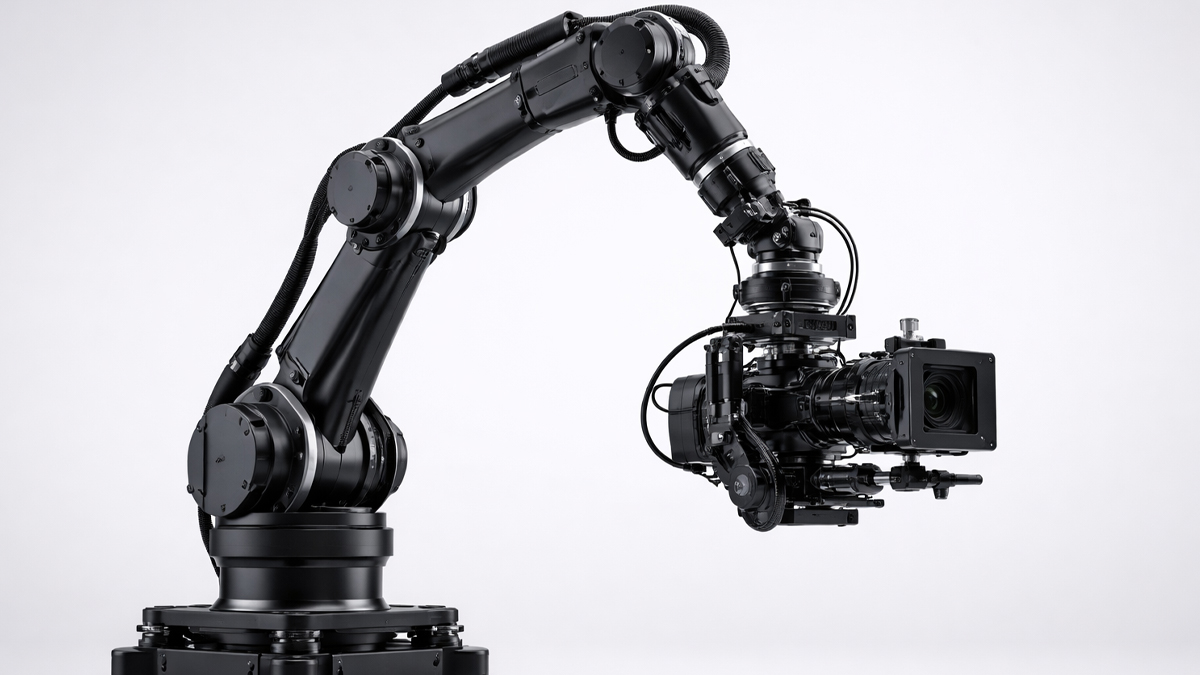
What is 6 Axis Robotic Arm?
A 6 axis robotic arm is a programmable mechanical arm that can move in six independent directions, allowing it to position and orient a tool or camera with high precision. In simple terms, it is a robot arm that can reach a point in space and also rotate to face the exact direction needed. The six axes typically combine three movements for positioning and three movements for orientation, which together create the kind of flexible motion that looks similar to a human arm, but with greater repeatability and control.
In cinematic technologies, a 6 axis robotic arm is often used as the motion engine inside robotic camera rigs. These rigs are designed to move a cinema camera along complex paths, repeat the same move again and again, and create shots that are difficult or impossible to achieve with handheld, tripod, dolly, or even some traditional motion control systems. The value is not only speed or strength. The real value is controllable motion, repeatable motion, and the ability to blend physical movement with digital planning and visual effects workflows.
How does 6 Axis Robotic Arm Work?
A 6 axis robotic arm works by combining mechanical joints, motors, sensors, and a control system that calculates how each joint must move to place the end of the arm in the desired position and orientation. The end of the arm is commonly called the end effector. In cinema, the end effector might be a camera mount, a stabilized head, a remote pan tilt unit, or a custom plate that holds the camera and accessories.
Kinematics: The system uses kinematics to translate a desired camera pose into joint movements. Forward kinematics calculates where the camera will be based on known joint angles. Inverse kinematics does the opposite by calculating the joint angles needed to reach a target pose.
Motion planning: The controller plans a path from the current pose to the next pose. This path can be a simple straight line, a smooth curve, or a complex spline that matches creative intent. In filmmaking, motion planning often prioritizes smooth acceleration and deceleration so the camera move looks natural and cinematic.
Servo control: Motors at each joint follow the planned motion using servo loops. Sensors measure actual position and speed, then the controller corrects any difference from the commanded motion. This is one reason robotic arms can repeat moves with very tight consistency.
Synchronization: For robotic camera rigs, the arm frequently synchronizes with focus, iris, zoom, shutter timing, lighting cues, turntables, LED volumes, and visual effects triggers. This is how a single camera move can be repeated across multiple passes for compositing, or matched precisely to a virtual camera in post production.
Safety logic: Because a moving robotic arm can be powerful, the system typically includes speed limits, safe zones, collision detection options, emergency stop circuits, and operational modes. In cinema environments, safety is not optional because crews work near the rig and camera payloads can be expensive.
What are the Components of 6 Axis Robotic Arm?
A 6 axis robotic arm is made of several core components that work together to create accurate, repeatable movement, especially when adapted for robotic camera rigs.
Base: The base anchors the robot and often contains the first axis. In cinema setups, the base may be bolted to a platform, mounted on a track, installed on a pedestal, or integrated into a vehicle rig.
Joints and links: The arm is built from rigid links connected by joints. Each joint is an axis of rotation, sometimes designed with high torque to carry payloads such as cameras, lenses, matte boxes, wireless transmitters, and stabilization heads.
Actuators and motors: Each axis uses an actuator, commonly a servo motor, paired with a drive system such as harmonic drives, planetary gearboxes, or direct drive mechanisms. The choice affects smoothness, backlash, maintenance, and noise.
Encoders and sensors: Encoders measure joint position and sometimes velocity. Additional sensors can include torque sensors, accelerometers, temperature sensors, and limit switches. For cinema work, accurate feedback helps keep moves stable and repeatable.
Robot controller: The controller is the brain that runs motion algorithms, interprets commands, and communicates with other systems. In camera rigs, the controller may interface with motion control software, virtual production systems, and remote operator consoles.
Power and drive electronics: Drives regulate how much current goes to motors and manage precise motor control. Power systems may be single phase or three phase, and cinema deployments often require careful power planning to avoid noise and ensure reliability on set.
End effector and camera mounting interface: This is the tool mounting point. For cinema, the interface can be a quick release plate, a stabilized gimbal mount, a pan tilt head, or a custom bracket. Good mechanical design here is critical because any flex can show up as camera shake.
Cable management and slip rings: Cameras need power, video, data, and lens control connections. Cable routing must allow full range motion without snagging. Slip rings may be used to allow continuous rotation on certain axes.
Software and user interface: Operators need a way to program moves, preview paths, set keyframes, and adjust parameters like speed and easing. Cinema oriented software typically focuses on shot building, repeatability, and integration with camera departments.
Safety systems: Emergency stop buttons, safety relays, light curtains in studio settings, and software defined safe zones reduce risk. In film production, additional physical barriers and set protocols are often added.
What are the Types of 6 Axis Robotic Arm?
There are several types of 6 axis robotic arms, and the best choice for cinema depends on payload, speed, required smoothness, and integration needs.
Articulated industrial robots: These are the most common 6 axis arms used in automation. In cinema, they are often adapted into robotic camera rigs due to strong payload capacity and high repeatability.
Collaborative robotic arms: Collaborative arms are designed to work closer to people by limiting force and speed and using built in safety features. In cinema, they can be useful for smaller camera payloads, studio product shoots, and controlled environments where close crew proximity is needed.
High precision lightweight arms: Some arms are designed for high precision with lower payloads. These can be good for smaller cameras, virtual production witness cameras, or repeatable tabletop work.
Heavy payload robotic arms: These arms are built to carry significant weight, which can be helpful when the camera package includes large cinema lenses, heavy stabilization systems, and additional accessories. They are also relevant when the arm is used as part of a larger multi axis rig.
Robotic arms integrated with external axes: While the arm itself is 6 axis, cinema rigs often add extra motion like a track, turntable, lift column, or crane base. This effectively creates 7 axis, 8 axis, or more, but the core arm remains a 6 axis unit.
What are the Applications of 6 Axis Robotic Arm?
A 6 axis robotic arm has broad applications across many industries, and cinematic uses benefit from the same strengths that factories and laboratories rely on.
Manufacturing and assembly: Robots perform precise placement, fastening, and handling tasks. The same precision principles help in cinema for consistent camera positioning.
Welding and machining support: Accurate motion paths matter for weld seams and machining operations. In filmmaking, accurate motion paths matter for smooth camera moves and repeatable takes.
Quality inspection and metrology: Robots position sensors and cameras to inspect objects. In film production, they position cinema cameras for controlled product shots and VFX plates.
Medical and laboratory automation: Robots handle delicate movements and repeat procedures. The cinema parallel is repeatable motion control for multi pass shots.
Education and research: Robotics training often uses 6 axis arms to teach kinematics and automation. In cinema, training focuses on safe operation, shot programming, and integration with camera systems.
Robotic camera rigs and motion control: In the cinema industry, a major application is controlling cameras for repeatable, programmable, and complex shots. This includes high speed moves, precise arcs, programmable parallax, and synchronized motion with props or talent marks.
Virtual production and LED volume work: When virtual backgrounds are rendered in real time, camera movement must be tracked accurately. Robotic arms can contribute by providing predictable motion and repeatable camera paths that match virtual camera data.
What is the Role of 6 Axis Robotic Arm in Cinema Industry?
In the cinema industry, a 6 axis robotic arm plays the role of a highly precise camera movement system. It becomes a creative tool that translates a shot concept into physical motion with repeatability and control. It is not just about moving a camera. It is about moving a camera in a way that can be planned, repeated, adjusted, and synchronized with everything else happening in the shot.
Repeatable motion control for visual effects: When a scene requires multiple passes, such as clean plates, foreground elements, background elements, and lighting variations, the robotic arm can repeat the same move with extremely small variation. This consistency helps compositors align layers and reduces post production complexity.
High energy commercial and music video shots: Many modern commercial shots demand rapid, dynamic movement that still looks stable and intentional. A robotic arm can accelerate quickly, stop precisely, and follow aggressive paths while maintaining repeatable timing.
Product cinematography: For tabletop and product films, tiny changes in angle and distance can dramatically change how a product looks. A robotic arm allows exact positioning and smooth micro movements, creating premium looking reveals and controlled parallax.
Stunt and safety separation: Some shots involve hazards such as explosions, debris, water blasts, heat, or close proximity to moving machinery. A robotic arm can operate in spaces where it is safer to keep crew at a distance, using remote operation and planned moves.
Complex camera orientation: Traditional rigs may move the camera through space but can be limited in orientation control. A 6 axis arm can roll, pitch, and yaw with precision, enabling shots that rotate around a subject while maintaining focus on the point of interest.
Integration with lens and camera control: Robotic camera rigs often integrate follow focus, zoom, and iris control. When combined with the arm motion, the system can execute coordinated moves like zooming while arcing around a subject, or pulling focus at exact moments repeatedly across takes.
What are the Objectives of 6 Axis Robotic Arm?
In cinematic technologies, the objectives of using a 6 axis robotic arm are practical, creative, and workflow focused.
Precision: Achieve exact camera placement and orientation to match a storyboard, previs, or VFX requirement.
Repeatability: Reproduce the same camera move across multiple takes or multiple passes, supporting compositing and continuity.
Smoothness: Deliver controlled acceleration, deceleration, and path curvature so the movement looks cinematic rather than mechanical.
Efficiency: Reduce time spent resetting complex moves, especially when a shot requires many takes, lighting changes, or variations in performance.
Safety: Enable camera movement in risky environments while allowing remote control and defined safe zones.
Programmability: Allow operators to build moves with keyframes, trajectories, and timing adjustments, and store them for later use.
Synchronization: Align camera motion with other systems such as turntables, motion bases, lighting effects, and virtual production rendering cues.
Creative freedom: Provide directors and cinematographers with new motion possibilities, including moves that would be physically difficult for human operators or traditional rigs.
What are the Benefits of 6 Axis Robotic Arm?
A 6 axis robotic arm brings several benefits to robotic camera rigs and the broader cinema industry.
Consistent results: Once a move is designed, the arm can repeat it reliably. This improves continuity and supports demanding post production workflows.
High precision framing: The camera can return to the exact same frame, which is extremely useful for pick up shots, reshoots, and VFX plate matching.
Complex motion in tight spaces: The articulated structure can weave through sets, pass through windows, move around props, and create intricate arcs without requiring large track layouts.
Time savings on set: Programming a move can take effort, but once programmed it can save time across repeated takes, especially when multiple departments depend on identical motion timing.
Reduced physical strain: Some shots require long takes or repeated high energy movement. A robotic arm can handle the motion without operator fatigue, helping maintain shot quality.
Better integration with digital pipelines: Robotic motion data can be used for matchmoving, camera tracking, and previs alignment. This can shorten post production troubleshooting.
Scalable performance: Different arms support different payloads and speeds. Productions can scale from small camera setups to large cinema payloads.
Reliable motion for slow and fast shots: A robotic arm can execute very slow, subtle moves for dramatic scenes, and also perform fast moves for action driven visuals, depending on the system design and safety limits.
What are the Features of 6 Axis Robotic Arm?
A 6 axis robotic arm used in cinema typically offers features that support both engineering accuracy and filmmaking usability.
Six degrees of freedom: The arm can control position and orientation, enabling sophisticated camera placement.
High repeatability: Many systems are designed to return to the same pose with extremely small deviation, which is central to motion control work.
Programmable paths: Operators can create paths through keyframes, waypoints, or recorded manual moves, then refine timing and easing.
Speed and acceleration control: Motion profiles can be tuned for cinematic smoothness, avoiding jerky starts or stops.
Payload capacity options: Different models support different camera weights. Cinema rigs often consider not only camera weight but also dynamic forces during rapid motion.
Integration interfaces: Many systems support communication protocols and control links that allow integration with lens controllers, timecode, and external triggers.
Safety controls: Emergency stops, speed limits, restricted zones, and operational modes help manage risk on set.
Calibration and referencing: Accurate home positions and calibration procedures ensure the arm knows its exact joint positions, which is vital for repeatability and for matching digital camera data.
Motion data output: Some rigs can export motion data for visual effects and virtual production workflows, supporting tracking and alignment.
What are the Examples of 6 Axis Robotic Arm?
In real world use, many robotic camera rigs are built using well known 6 axis industrial or collaborative robotic arms, often paired with cinema specific control software and camera mounting solutions.
Industrial robot brands used as motion platforms: Some cinematic motion control systems are built around industrial arms from major robotics manufacturers, chosen for payload, reliability, and repeatability.
Collaborative robot arms for smaller setups: Collaborative arms are sometimes used for lighter cameras, controlled studio work, and educational production environments, especially where built in safety features are valuable.
Purpose built cinematic robotic rigs that use a 6 axis arm architecture: Some vendors deliver complete systems designed specifically for film and advertising production, combining an arm, controller, software, and camera integration into a single package.
Custom studio builds: Larger studios sometimes build custom rigs that combine a 6 axis arm with track systems, lift columns, and turntables, creating multi axis stages for product shots, vehicle cinematography, and repeatable VFX motion control.
What is the Definition of 6 Axis Robotic Arm?
A 6 axis robotic arm is defined as a robotic manipulator with six independently controlled axes of movement, typically implemented as six rotary joints, that enable full control of an end effector position and orientation within a reachable workspace. In the context of cinematic technologies, it is defined as a motion control platform capable of moving and aiming a camera through programmable, repeatable trajectories for filmmaking and content production.
What is the Meaning of 6 Axis Robotic Arm?
The meaning of a 6 axis robotic arm is practical and conceptual.
Practical meaning: It is a machine that can place a camera or tool where you want it and point it how you want it, with consistent repeatability.
Creative meaning in cinema: It is a way to turn a camera move into a designed performance. Instead of relying only on manual operation, the movement can be choreographed, stored, repeated, and refined like an animation. This is especially meaningful for shots where timing, precision, and repetition directly affect the final visual impact.
Workflow meaning: It represents a bridge between physical production and digital production. The camera move can be planned in previs, executed on set, and then supported in post production with consistent motion data.
What is the Future of 6 Axis Robotic Arm?
The future of 6 axis robotic arms in the cinema industry is likely to be shaped by better usability, smarter automation, safer collaboration, and tighter integration with virtual production and post production pipelines.
Smarter programming tools: Interfaces are moving toward more visual shot building, where operators can design moves using graphical timelines, virtual camera previews, and intuitive controls instead of complex industrial programming.
AI assisted motion design: Systems may suggest smooth paths, avoid collisions, and generate camera moves based on framing goals. For example, you can set a subject and define the desired screen position, then the system proposes a path that maintains composition while moving through space.
Improved safety and collaboration: More rigs may adopt collaborative features like force sensing, adaptive speed control, and better crew aware safety modes. This can expand robotic use to more sets and tighter environments.
Higher fidelity motion for stabilization: Future arms and controllers can reduce vibration and improve micro smoothness, especially when paired with stabilized heads. This will be important as high resolution cameras reveal small motion flaws more easily.
Integration with real time rendering: Virtual production demands accurate camera tracking and predictable motion. Robotic arms may integrate more tightly with camera tracking systems and real time engines so that physical motion and virtual imagery stay perfectly aligned.
Modular multi axis stages: More productions will use hybrid systems where a 6 axis arm rides on a track, lift, or vehicle platform, creating complex moves that remain repeatable. This will become more accessible as control software standardizes.
Remote and networked operation: With better networking, a robotics operator can supervise motion control from a safe station, and teams can share move presets across stages and locations, improving consistency for global productions.
Broader adoption in mid budget production: As tools become easier to use and safer to deploy, 6 axis robotic camera rigs may become common not only in high end commercials and major films but also in smaller studios, brand content production, and streaming workflows.
Summary
- A 6 axis robotic arm is a programmable robot arm with six independent movements that allow precise control of position and orientation.
- In robotic camera rigs, it enables repeatable, smooth, and highly controlled camera motion for cinema and commercial production.
- Core components include the base, joints and links, motors, encoders, controller, power electronics, end effector mount, software interface, and safety systems.
- Common types include articulated industrial arms, collaborative arms, lightweight precision arms, heavy payload arms, and arms combined with external axes.
- Key applications include motion control cinematography, product filming, VFX multi pass work, virtual production support, and hazardous environment shooting.
- Main objectives are precision, repeatability, smoothness, efficiency, safety, programmability, synchronization, and creative freedom.
- Benefits include consistent results, exact framing, complex movement in tight spaces, time savings, reduced operator strain, and better digital pipeline integration.
- The future points toward easier programming, AI assisted shot design, improved safety, higher smoothness, deeper virtual production integration, and wider adoption.

