

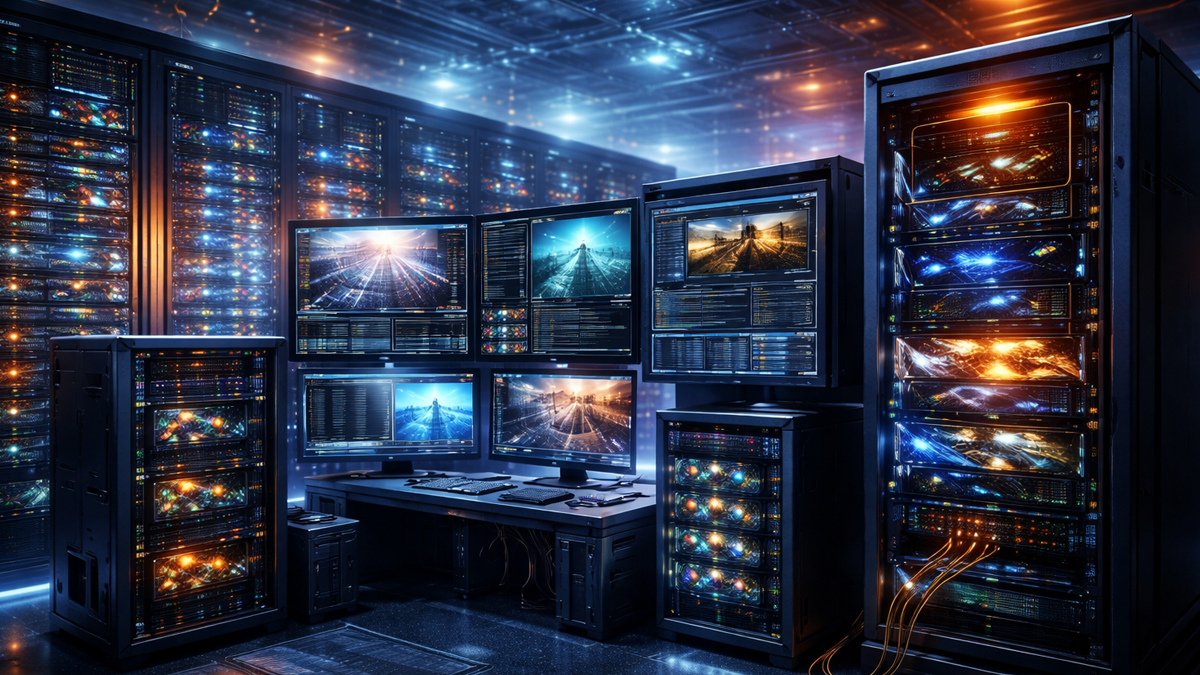
What is Bare Metal Cloud Instance?
Core idea: A Bare Metal Cloud Instance is a dedicated physical server delivered through a cloud-style service model. Instead of sharing CPU, memory, and I/O with other customers through a hypervisor, you get the whole machine for your workload, provisioned on demand through a portal, API, or automation tools.
How it differs from standard virtual machines: In a typical virtual machine setup, many customers share the same physical host, and a virtualization layer allocates slices of compute and memory to each VM. With bare metal, there is no resource sharing at the server level. You are allocated the full hardware, which helps when you need consistent performance, direct access to hardware features, or strict isolation.
Why it is called cloud: The word cloud here does not mean the server is virtual. It means the experience is cloud-like. You can provision quickly, scale by adding or removing servers, integrate with cloud storage and networking, monitor usage, and pay in a flexible way compared to traditional hardware procurement.
Where it fits in cloud-based collaboration and rendering: In cinematic technologies, bare metal instances often support heavy rendering, simulation, compositing, encoding, color processing, and pipeline services where predictable throughput and low latency matter, especially when multiple teams collaborate across locations.
How does Bare Metal Cloud Instance Work?
Provisioning workflow: A cloud provider maintains racks of physical servers in data centers. When you request a bare metal instance, the provider assigns an available server that matches your chosen configuration. The server is then prepared for you, usually by securely wiping the disks, applying firmware and baseline settings, and installing your selected operating system image.
Control and access: You typically access the server through secure remote methods such as SSH for Linux or remote desktop for Windows. Many providers also offer out-of-band management features that let you view console logs, reboot, mount images, or troubleshoot network settings even if the operating system is not responding.
Networking and integration: Once provisioned, the server connects to virtual networks, subnets, security groups, and routing rules similar to virtual machines. This makes it easy to integrate bare metal compute with cloud storage, render queue managers, asset management systems, and collaboration tools.
Security and isolation: Since the server is dedicated to one tenant during the lease period, the isolation boundary is simpler than multi-tenant hosts. Providers still apply data center security, hardware lifecycle controls, and secure erasure procedures between tenants.
Automation in pipelines: In cinema pipelines, bare metal instances are often created and destroyed automatically based on job queues. For example, a render manager can trigger additional servers during peak frames, then release them when the queue drops, while still preserving predictable performance per node.
What are the Components of Bare Metal Cloud Instances
Physical compute hardware: The core component is the server itself, including CPU sockets, memory channels, motherboard, and chipset. High core counts and high memory bandwidth are important for CPU rendering, simulation, caching, and large scene assemblies.
Storage subsystem: Bare metal instances may offer local NVMe SSDs for very high IOPS and low latency, which is valuable for texture-heavy workflows, large EXR sequences, and intermediate caches. Some configurations use RAID options for resilience and throughput, while others rely on distributed storage and keep local disks for scratch.
Networking and connectivity: High-speed network interfaces, sometimes 10 GbE, 25 GbE, 50 GbE, 100 GbE or higher, matter when moving plates, caches, and renders between nodes and storage. Low latency networking improves collaboration tools, render queue coordination, and real-time review experiences.
Operating system and images: You select an OS image such as Linux or Windows and often a baseline image that includes drivers, security hardening, and pipeline tools. In cinematic use cases, this frequently includes GPU drivers, color pipeline components, and render engine dependencies.
Management plane: A cloud control plane provides APIs, dashboards, identity controls, logging, monitoring, and tagging. This is what turns a physical server into a cloud consumable, enabling fast provisioning, cost tracking, and automation.
Security controls: Components include identity and access management, key management, network segmentation, security groups or firewall rules, audit logs, and secure wipe procedures. For studios, these controls support IP protection for unreleased content and sensitive vendor deliveries.
What are the Types of Bare Metal Cloud Instances
General purpose bare metal: These configurations balance CPU, memory, and network. They suit pipeline services, collaboration platforms, transcoding, and mixed workloads that need stable performance without specialized acceleration.
Compute optimized bare metal: These focus on high CPU core counts and strong per-core performance. They are useful for CPU rendering, physics simulation, procedural generation, and batch processing where you want consistent throughput per node.
Memory optimized bare metal: These provide very large RAM capacity. They fit scene assembly, large caches, high-resolution comp workflows, complex simulations, and databases that store metadata, versions, and production tracking information.
Storage optimized bare metal: These prioritize local NVMe capacity and IOPS. They are useful for intermediate caching, nearline render output staging, and workflows that repeatedly read large assets with low latency.
GPU accelerated bare metal: Some bare metal offerings include professional GPUs to run GPU renderers, AI denoisers, upscalers, segmentation, rotoscoping assistance, and certain real-time or near real-time workloads. Dedicated GPU access can reduce contention and improve predictable render times.
Specialized or custom bare metal: Some providers support custom shapes, dedicated host clusters, or specialized network fabrics. Studios might choose these for high-performance storage backends, license servers, or security-sensitive workloads requiring strict control.
What are the Applications of Bare Metal Cloud Instances
High performance rendering: Bare metal is widely used for render farms when consistent frame times are required. CPU and GPU render engines can benefit from full hardware access and stable performance without noisy neighbors.
Simulation and technical effects: Fluid, smoke, crowd, destruction, and cloth simulation can be extremely compute intensive and often requires high I/O for caches. Bare metal helps maintain predictable runtimes and consistent cache writing performance.
Compositing and image processing: While many comp tasks run on workstations, studios also run batch comp, reformatting, plate processing, and multi-shot automation on servers. Bare metal can handle heavy EXR pipelines, high bit-depth processing, and stable disk throughput.
Transcoding and packaging: Deliverables such as dailies, proxies, editorial exports, and streaming packages can demand high CPU throughput, stable disk performance, and predictable networking. Bare metal is often used for large volume, deadline-driven encoding.
Data-intensive asset workflows: Asset libraries, texture repositories, and cache systems may use bare metal for high-performance storage servers, metadata databases, and indexing services that support search and retrieval across large productions.
Security-sensitive services: License servers, key management services, secure jump hosts, and isolated review gateways can run on bare metal to simplify isolation, reduce virtualization complexity, and meet certain compliance or customer security requirements.
What is the Role of Bare Metal Cloud Instances in Cinema Industry
Enabling scalable render capacity: Productions regularly face peak compute demand near delivery milestones. Bare metal instances let a studio scale render capacity rapidly without purchasing permanent hardware, while still receiving dedicated performance per node.
Supporting cloud-based collaboration: When teams are distributed across cities or countries, they rely on shared storage, review systems, and pipeline services accessible over secure networks. Bare metal can host collaboration backends with stable latency and consistent throughput, which helps when many artists connect simultaneously.
Improving predictability for schedules: In cinema, predictability matters as much as raw speed. A stable per-frame render time helps producers forecast completion dates and plan iterations. Dedicated hardware reduces variability caused by shared host contention.
Handling heavy I/O workflows: Modern productions generate massive data volumes, including plates, EXR sequences, geometry caches, and simulation outputs. Bare metal systems with local NVMe and fast networking can accelerate cache reads and writes, reduce bottlenecks, and keep artists moving.
Meeting security and IP protection needs: Studios must protect unreleased content, vendor exchanges, and contractual obligations. Bare metal can form a straightforward isolation boundary for sensitive workloads, alongside encryption and strict network segmentation.
Bridging on-prem and cloud pipelines: Many studios run hybrid workflows, keeping core systems on-prem while bursting to the cloud for peak demand. Bare metal instances integrate well in this model as dedicated nodes that behave similarly to on-prem render blades and servers.
What are the Objectives of Bare Metal Cloud Instances
Deliver dedicated performance: One objective is to provide consistent compute, memory, and I/O performance that is not affected by other tenants on the same physical host, which is important for time-critical rendering and simulation.
Provide hardware-level access: Some workloads require direct access to CPU features, high-performance NIC capabilities, local NVMe characteristics, or GPU exclusivity. Bare metal supports these requirements more naturally than shared virtualization.
Increase operational agility: Traditional servers can take weeks to procure, rack, and configure. Bare metal cloud aims to deliver similar hardware quickly through automation, enabling studios to respond to schedule spikes and creative iteration loops.
Maintain security isolation: Dedicated tenancy at the server level reduces certain multi-tenant risk concerns and helps some teams feel more confident when hosting sensitive assets, especially when combined with encrypted storage and private networking.
Support cost control under heavy workloads: For sustained high utilization, bare metal can be more cost-effective than premium virtual machines, especially when performance needs would otherwise require larger VM sizes or overprovisioning.
Simplify certain licensing and compliance needs: Some software licensing models align better with dedicated servers or specific CPU counts. Bare metal can help studios map licenses to hardware more clearly and avoid ambiguity around shared hosts.
What are the Benefits of Bare Metal Cloud Instances
Performance consistency: Dedicated hardware reduces variability and helps maintain stable frame times for rendering. This is valuable when you want reliable estimates for throughput, deadlines, and iterative creative reviews.
Higher sustained throughput: Many cinematic workloads run at high utilization for long periods. Bare metal instances can sustain heavy CPU and I/O loads without competing with other customers on the same host.
Low latency and fast I/O: Local NVMe and high-speed networking can significantly reduce time spent reading textures, writing caches, and moving frames to storage or review systems, which shortens pipelines end to end.
Stronger isolation: Dedicated tenancy at the server level supports security and governance goals. For productions with strict IP protection requirements, this can be a practical advantage in addition to encryption and access controls.
Flexibility compared to owned hardware: You can scale up quickly for a crunch period, then scale down when the workload drops. This reduces the risk of owning underused hardware between projects.
Better alignment with certain technical requirements: Some renderers, GPU workflows, and specialized network configurations benefit from direct access or a simpler stack. Bare metal reduces abstraction layers and can make performance tuning easier.
What are the Features of Bare Metal Cloud Instances
Dedicated single-tenant servers: The defining feature is that the physical machine is reserved for one customer during the instance lifetime, which supports predictable performance and isolation.
Cloud-style provisioning and APIs: Bare metal instances can be created through portals, command line tools, or APIs, making them suitable for automation in render farms and pipeline orchestration.
Customizable hardware profiles: Many providers offer different CPU families, memory sizes, storage options, and network bandwidth tiers. This lets studios pick shapes for CPU rendering, GPU acceleration, or cache-heavy simulation.
Advanced networking options: Features often include private networking, VLAN or VPC integration, security groups, high bandwidth NICs, and sometimes specialized network fabrics for high throughput pipelines.
Image management and configuration automation: Studios can maintain golden images with preinstalled render engines, plugins, and pipeline tools. Configuration management systems can further standardize environment setup across hundreds of nodes.
Monitoring and cost tagging: Cloud monitoring, logging, and tagging support production accounting, show-level cost breakdowns, and performance tracking across sequences or departments.
Secure lifecycle handling: Providers typically include secure disk wipe procedures, hardware re-provisioning controls, and operational policies that reduce the risk of data remanence between tenants.
What are the Examples of Bare Metal Cloud Instances
Major cloud provider bare metal instances: Several major cloud providers offer dedicated bare metal compute options that deliver full physical servers through cloud provisioning tools. These are commonly used for high performance and isolation needs.
Bare metal servers from cloud infrastructure platforms: Some platforms focus heavily on bare metal for performance workloads, providing fast provisioning, flexible networking, and high I/O configurations suitable for render farms.
Dedicated GPU bare metal nodes: Certain offerings provide servers with dedicated GPUs, designed for GPU rendering, AI-based denoising, and accelerated image processing workloads common in modern cinematic pipelines.
Bare Metal Solution style offerings: Some providers also offer managed bare metal environments that integrate with cloud networking and services. These can be used when studios want dedicated hardware while still leveraging cloud storage, monitoring, and security services.
Cinema-oriented deployment examples: A studio might use CPU compute optimized bare metal nodes for overnight rendering, GPU nodes for denoise and lookdev acceleration, and storage optimized nodes as cache servers near the render fleet, all connected to secure project storage and a review platform.
What is the Definition of Bare Metal Cloud Instances
Formal definition: Bare Metal Cloud Instances are dedicated physical servers provisioned and managed through a cloud service model, offering full access to hardware resources with cloud-like capabilities such as rapid provisioning, API control, integrated networking, and usage-based billing.
Key elements of the definition: The definition includes dedicated tenancy at the server level, on-demand or automated provisioning, integration with broader cloud services, and operational management that reduces the manual overhead of traditional hardware hosting.
Why the definition matters in cinema: In cinematic technologies, definitions are not academic. They affect how teams plan security boundaries, estimate performance, map licenses, and design hybrid pipelines that mix on-prem and cloud resources.
What is the Meaning of Bare Metal Cloud Instances
Practical meaning for teams: In everyday production terms, bare metal cloud means you can rent a whole server for your show, spin it up quickly, run your pipeline tools without shared host interference, and release it when you are done.
Meaning for performance planning: It means render times and cache performance are easier to predict. When your daily schedule depends on frames finishing overnight, predictability is a creative enabler because artists can iterate with confidence.
Meaning for collaboration: It means collaboration services can run on stable backends that do not slow down during peak logins or heavy file activity. Review sessions, remote editorial, and synchronized asset workflows benefit from consistent server response.
Meaning for security and governance: It means you can design a simpler isolation boundary. Combined with encryption and strict access control, it helps protect production IP, vendor deliveries, and unreleased content.
What is the Future of Bare Metal Cloud Instances
Convergence with cloud-native automation: The future is likely to bring even tighter integration between bare metal performance and cloud-native orchestration. Studios will increasingly treat bare metal nodes as elastic fleet members managed by render queue systems and infrastructure-as-code tools.
More specialized cinematic configurations: Providers may offer more profiles tuned for media workloads, such as high core count CPU nodes for offline rendering, dense GPU nodes for AI and real-time tasks, and storage heavy nodes for cache and intermediate frame staging.
Improved security and confidential computing approaches: As security demands rise, more features will focus on stronger isolation, better auditing, and hardware-based security capabilities. This can help studios satisfy stricter partner requirements and reduce risk in distributed production.
Better hybrid pipeline connectivity: Many studios will continue using hybrid architectures. Expect smoother networking, identity integration, and data mobility between on-prem facilities and cloud bare metal fleets, reducing friction when teams burst to cloud compute.
Efficiency and sustainability pressure: Power and cost considerations will push better utilization, smarter scheduling, and right-sizing. Bare metal may be used selectively where its performance and predictability deliver clear value, while other tasks remain on virtualized compute for flexibility.
Growing use in AI-assisted post production: AI denoising, upscaling, segmentation, and editorial assistance are expanding. Dedicated GPU bare metal nodes can support high throughput AI pipelines integrated with rendering and compositing workflows.
Summary
- Bare Metal Cloud Instances are dedicated physical servers delivered with cloud-style provisioning, automation, and billing.
- They reduce performance variability by avoiding shared host contention, which helps with predictable rendering and simulation timelines.
- Key components include dedicated CPU and memory, high-speed networking, local NVMe storage options, management APIs, and strong security controls.
- Common types include general purpose, compute optimized, memory optimized, storage optimized, and GPU accelerated bare metal configurations.
- In the cinema industry, they support render farms, simulation, heavy I/O pipelines, collaboration backends, secure services, and hybrid cloud bursting.
- The future points toward deeper automation, more media-tuned hardware profiles, stronger security features, better hybrid connectivity, and expanded AI-driven workloads.

