

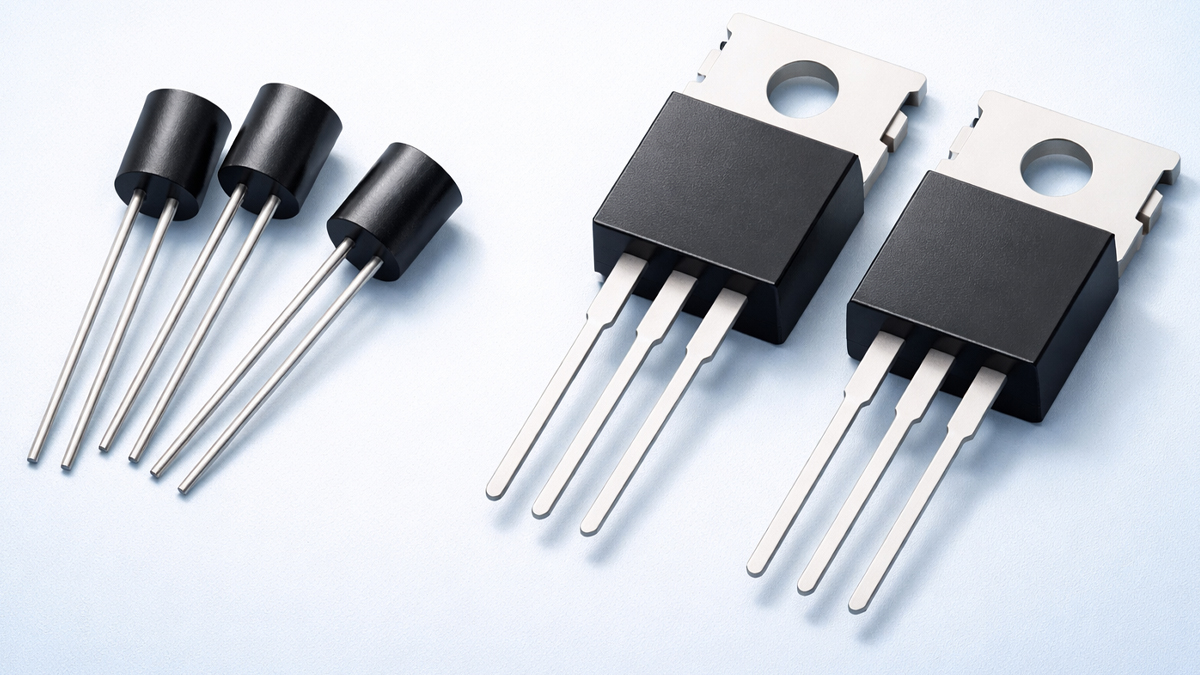
What is Bipolar Junction Transistor?
A Bipolar Junction Transistor, often shortened to BJT, is a semiconductor device that can control a large electric current using a much smaller electric current. In simple terms, it works as a controllable valve for electricity. Because of this ability, it is widely used for amplification and switching, which are two core jobs in electronics.
In the world of music electronics, amplification is essential. A microphone produces a very small signal. A guitar pickup also produces a small signal. These signals are too weak to drive headphones, speakers, recording interfaces, or many processing circuits directly. A BJT helps boost these weak signals so they can be shaped, processed, and finally delivered with enough power and clarity to be heard.
A BJT is called bipolar because it uses two kinds of charge carriers inside the semiconductor material: electrons and holes. This is different from some other transistor families that rely mainly on one carrier type. This bipolar behavior influences how BJTs respond to signals, how they produce distortion when pushed, and how they behave in analog audio circuits.
Core idea: A small base current controls a larger collector current, enabling signal amplification and electronic switching.
How does Bipolar Junction Transistor Work?
A BJT has three terminals: emitter, base, and collector. The base is the control terminal. The emitter supplies charge carriers, and the collector gathers them. When a small current flows into the base, it allows a much larger current to flow from collector to emitter, depending on the circuit configuration.
Base control principle: The base current acts as a control input that regulates the collector to emitter current flow.
Forward bias behavior: For many common BJTs made from silicon, the base to emitter junction begins conducting significantly when the base is about 0.6 to 0.7 volts higher than the emitter in an NPN transistor. This is not a fixed rule for every condition, but it is a useful practical guideline in circuit design.
Active region operation: In amplification, engineers often run a BJT in the active region. In this region, a small change in base current creates a proportional change in collector current. This is what makes analog amplification possible.
Cutoff and saturation: In switching applications, a BJT is often driven between cutoff and saturation. In cutoff, the transistor is off, and very little current flows. In saturation, it is strongly on, and the collector to emitter voltage becomes low, allowing it to act as a closed switch.
Signal shaping effect: In audio circuits, how a BJT is biased and how hard it is driven affects harmonics and distortion. When pushed, a BJT can produce soft or firm clipping depending on the surrounding circuit, which matters in guitar pedals, preamps, and certain compressor stages.
What are the Components of Bipolar Junction Transistor?
A BJT is built from semiconductor layers arranged into two junctions. It also includes physical regions and terminals that connect it to a circuit.
Emitter region: The emitter is designed to inject charge carriers into the base. It is typically heavily doped to provide a strong supply of carriers.
Base region: The base is very thin compared to the emitter and collector regions. It is lightly doped and acts as the control gate area. Because it is thin, most carriers injected by the emitter pass through it rather than recombining inside it.
Collector region: The collector is designed to collect carriers coming through the base. It is built to handle higher voltages and dissipate heat. In many devices, the collector region is physically larger to manage power.
Two PN junctions: A BJT contains two semiconductor junctions. One junction is between base and emitter, and the other is between base and collector. The biasing of these junctions determines whether the transistor is amplifying or switching.
Terminals and packaging: BJTs come in many packages, from tiny surface mount parts used in compact pedals and interfaces, to larger power packages for amplifiers and power supplies. The package helps with handling, mounting, and heat dissipation.
Supporting structures: In practical use, the transistor usually needs resistors, capacitors, and sometimes diodes around it to set operating points, stabilize temperature behavior, reduce noise, and shape frequency response.
What are the Types of Bipolar Junction Transistor?
BJTs are commonly grouped by how their semiconductor layers are arranged and by their intended use.
NPN type: In an NPN transistor, a thin P type base region is sandwiched between two N type regions. A small positive base to emitter voltage allows current to flow from collector to emitter. NPN devices are extremely common in audio circuits because they often fit well with typical power supply arrangements and can offer strong performance.
PNP type: In a PNP transistor, a thin N type base is between two P type regions. It operates with opposite polarities compared to NPN. PNP devices are often used in complementary pairs with NPN devices, especially in push pull output stages and certain symmetrical audio designs.
Small signal BJTs: These are designed for low current and low power applications, such as microphone preamp stages, tone control amplifiers, buffer stages, and signal conditioning circuits.
Power BJTs: These are designed to handle higher current and dissipate more heat. They can be used in power amplifier stages, power regulation, and driver circuits.
Low noise BJTs: Some BJTs are optimized for low noise, which is crucial in preamps, especially where signals are very small, such as moving coil microphone stages or sensitive instrument inputs.
High frequency BJTs: These are designed to respond well at higher frequencies. In music electronics, high frequency behavior matters because it influences stability, clarity, and the way a circuit handles fast transients, even if the main audio band is limited.
Matched pair BJTs: Some applications, such as differential amplifiers in input stages of mixers and interfaces, benefit from matched transistors that have closely similar characteristics for better balance and lower distortion.
What are the Applications of Bipolar Junction Transistor?
BJTs appear in many systems because they are versatile, cost effective, and well understood.
Audio amplification: A BJT can amplify voltage, current, or both, depending on circuit topology. This is used in preamps, gain stages in pedals, and driver stages in larger amplifiers.
Switching and muting: BJTs can act as electronic switches for muting circuits, channel switching, signal routing, and protection circuits that prevent pops and thumps.
Oscillators and tone generation: While many modern designs use digital methods, BJTs still appear in analog oscillator circuits, noise generators, and certain synthesizer modules.
Buffers and impedance conversion: A BJT stage can act as a buffer that prevents one part of a circuit from loading another. This is important for keeping tone consistent, especially with passive pickups and vintage style circuits.
Current sources and bias networks: Many analog circuits require stable currents. BJTs can form current sources that help stabilize gain and reduce distortion.
Power regulation support: In some power supply designs, BJTs provide pass elements or control functions for voltage regulators and protection features.
Signal conditioning: BJTs are used to shape frequency response with surrounding components, allowing designers to create filters, treble boosters, bass shaping stages, and dynamic response circuits.
What is the Role of Bipolar Junction Transistor in Music Industry?
The music industry depends on reliable sound capture, processing, amplification, and playback. BJTs support these goals in both professional and consumer equipment.
Microphone preamplification: Many microphone preamps use transistor stages either alone or combined with other devices. BJTs can deliver clean gain when designed properly, helping quiet sources become recordable without excessive noise.
Guitar pedals and analog effects: Overdrive, fuzz, boost, and certain compressor circuits often rely on BJTs for their characteristic response. A transistor driven into nonlinear regions can produce harmonics that musicians perceive as warmth, grit, or bite. The exact character depends on the bias point, feedback, and filtering around the transistor.
Mixers and consoles: Input stages, buffering, and routing sections of mixers often include transistor based circuits. Even when integrated circuits are used, BJTs can appear as supporting devices for switching, protection, or discrete input designs.
Power amplification and speaker driving: While many modern power amplifiers use complex architectures, BJTs remain part of many output stages and driver sections, especially in designs that use complementary transistor pairs.
Noise and reliability considerations: In professional audio, noise is a major concern. The choice of transistor and operating conditions affects hiss, hum sensitivity, and stability. BJTs, when carefully selected and biased, can deliver low noise performance that supports high quality recordings.
Manufacturing and service ecosystem: BJTs are widely available and have a long history. This makes it easier to manufacture gear at scale and to repair and service equipment in studios, venues, and touring environments.
Creative sound design: The nonlinear behavior of BJTs is also used creatively. Designers intentionally shape distortion curves, compression effects, and dynamic response in analog circuits. This supports signature tones in guitar gear and certain studio tools.
What are the Objectives of Bipolar Junction Transistor?
A BJT is used to achieve specific design goals in an electronic system, especially in analog audio.
Amplify weak signals: One key objective is to increase the amplitude of a small audio signal so it can be processed or delivered to the next stage without losing detail.
Enable controlled switching: Another objective is to turn circuits on and off quickly and reliably, which supports muting, routing, channel switching, and protection behaviors.
Maintain signal integrity: In well designed circuits, a BJT helps preserve frequency response, reduce unwanted loading, and keep distortion within acceptable limits.
Shape tone intentionally: In music electronics, designers may intentionally use BJT behavior to create musically pleasing distortion, compression, or saturation.
Improve drive capability: A BJT stage can provide current gain so a signal source can drive a heavier load, such as a tone stack, long cable runs inside equipment, or additional processing stages.
Support stable biasing: Many analog systems require consistent operating points. A BJT, together with resistors and feedback networks, can help maintain stability across temperature and manufacturing variations.
Balance cost and performance: BJTs often meet performance requirements at a reasonable cost, which is a practical objective for manufacturing music gear at different price levels.
What are the Benefits of Bipolar Junction Transistor?
BJTs remain popular because they deliver several practical benefits.
High current gain: A small base current can control a much larger collector current, enabling efficient amplification and driving capability.
Strong analog performance: BJTs can provide smooth amplification and predictable behavior when properly biased, which suits audio signal paths.
Wide availability: BJTs are produced by many manufacturers and come in many variants, making sourcing easier for production and repairs.
Cost effectiveness: Many common BJTs are inexpensive, which supports affordable music electronics without sacrificing core functionality.
Good linearity with feedback: When combined with negative feedback, BJT stages can achieve low distortion and consistent gain.
Useful nonlinear character: When pushed beyond linear operation, BJTs can generate harmonics that are useful for musical effects, especially in pedals and certain preamp designs.
Robust switching: BJTs can be used as reliable switches in control sections, helping reduce mechanical wear compared to physical switches in some designs.
Design flexibility: A BJT can be configured in multiple amplifier topologies, allowing designers to optimize for gain, impedance, headroom, or tone shaping.
What are the Features of Bipolar Junction Transistor?
A BJT has characteristics that designers consider when building music electronics.
Three terminal control: The emitter, base, and collector structure makes it possible to control output current using an input current.
Current controlled device behavior: Compared to some other transistor families, BJTs are often described as current controlled devices because base current plays a direct role in setting collector current.
Gain parameter relationships: BJTs are often characterized by current gain, sometimes represented as beta or hFE. This value varies by device, operating current, and temperature, so circuits are designed to tolerate variation.
Transconductance behavior: BJTs convert changes in base emitter voltage into changes in collector current, giving them strong transconductance, which supports amplification.
Temperature sensitivity: BJT junction voltage changes with temperature. Designers use bias networks, emitter resistors, and feedback to keep circuits stable.
Noise characteristics: Some BJTs are quiet and suitable for low level audio, while others are noisier. Input stage transistor choice can strongly influence hiss and clarity.
Frequency response limits: BJTs have high frequency limits influenced by internal capacitances. In audio, these capacitances can influence stability and high end response, especially in high gain circuits.
Power dissipation constraints: Every transistor has maximum ratings for current, voltage, and power dissipation. Audio designs must keep operation within safe limits, particularly in power stages.
Multiple configurations: Common amplifier configurations include common emitter for voltage gain, emitter follower for buffering, and common base for specialized uses. Each configuration serves different objectives in music electronics.
What are the Examples of Bipolar Junction Transistor?
Examples can mean both specific device families and real world uses inside music related equipment.
Common small signal NPN parts: Examples include general purpose NPN transistors used in buffers, switching, and basic gain stages. Many widely used part numbers exist across manufacturers, and designers choose based on noise, gain range, and voltage handling.
Common small signal PNP parts: These are used for complementary stages and for circuits that require opposite polarity behavior, including some biasing networks and push pull arrangements.
Audio preamp transistor examples: Some designs use low noise transistor types for the first stage of a microphone preamp, where the signal is tiny and noise performance matters most.
Fuzz and overdrive circuit examples: Classic fuzz designs often use BJTs in a way that emphasizes clipping and sustain. Small changes in transistor gain and bias can noticeably alter the tone, which is why builders sometimes measure and sort transistors for these circuits.
Mixer channel strip examples: Discrete transistor input stages may be used in certain analog consoles. Even when integrated amplifiers are present, BJTs can appear as muting switches, clip indicators drivers, or phantom power control elements.
Amplifier driver examples: In many power amplifiers, BJTs are used as driver transistors that prepare and control current delivered to output devices.
Protection circuit examples: Speaker protection relays are often controlled by BJT switching circuits that delay turn on or shut down quickly when a fault is detected.
Synth and drum machine examples: Some analog synthesizer modules use BJTs in noise sources, envelope generators, and discrete amplification stages.
What is the Definition of Bipolar Junction Transistor?
A Bipolar Junction Transistor is a three terminal semiconductor device formed by two PN junctions, in which a small base current controls a larger current between collector and emitter, enabling amplification and switching.
Formal definition focus: It is a bipolar device because both electrons and holes participate in conduction, and it is a junction device because its behavior is based on semiconductor junctions.
Practical definition focus: It is an electronic component that helps take a small signal and make it stronger, or helps turn a larger signal path on and off using a smaller control signal.
What is the Meaning of Bipolar Junction Transistor?
The meaning of the name explains the device:
Bipolar meaning: The device uses two types of charge carriers, electrons and holes, as part of its conduction process.
Junction meaning: The device is built using junctions between P type and N type semiconductor materials. These junctions are responsible for the diode like behavior between base and emitter and between base and collector.
Transistor meaning: The device transfers or controls a signal. In everyday use, it means it can amplify signals or act as a switch, depending on how it is connected and biased.
Meaning in music electronics: It means a foundational building block that supports sound capture, tone shaping, amplification, and control features in equipment that musicians, studios, and audiences rely on.
What is the Future of Bipolar Junction Transistor?
BJTs have been used for decades, and they continue to matter even as digital processing grows.
Continued role in analog audio: Many musicians and engineers still prefer analog front ends for certain tasks. BJTs will likely remain present in preamps, pedals, and hybrid devices because they provide reliable analog gain and familiar tonal behavior.
Hybrid designs growth: Modern music devices often combine analog and digital sections. In such designs, BJTs may handle input conditioning, impedance buffering, switching, and protection, while digital processors handle effects, modeling, and control logic.
Improved manufacturing and consistency: Semiconductor manufacturing continues to improve. This can lead to more consistent transistor parameters, lower noise options, and better matching in pairs, which benefits audio fidelity and repeatability in production.
Sustainability and repair culture: There is a growing interest in repairable gear and long life equipment. Since BJTs are common and well understood, they fit well in designs that can be serviced over time.
Specialized audio components: Some manufacturers may continue producing BJTs optimized for low noise or audio friendly performance, especially for professional equipment where input stages demand excellent noise characteristics.
Educational importance: BJTs will remain important in learning electronics. Many music technologists and audio engineers start by understanding transistor gain stages and biasing, which makes BJTs a continuing foundation in education.
Future outlook in the music industry: BJTs will not disappear. Their role will evolve toward being part of carefully designed analog front ends, reliable control circuits, and character driven analog effects that complement digital systems.
Summary
- A Bipolar Junction Transistor is a three terminal semiconductor device that uses a small base current to control a larger collector to emitter current.
- BJTs are used for both amplification and switching, which makes them essential building blocks in many electronic designs.
- The main internal regions are emitter, base, and collector, arranged to form two PN junctions that define how the transistor behaves.
- The most common types are NPN and PNP, along with categories such as small signal, power, low noise, and matched pair devices.
- In music electronics, BJTs support microphone preamps, guitar pedals, mixers, routing, muting, and amplifier driver stages.
- Good biasing and circuit design help BJTs deliver clean gain, while intentional overdrive can produce musically useful harmonics.
- Key benefits include high current gain, strong analog performance, wide availability, cost effectiveness, and flexible circuit configurations.
- The future of BJTs in the music industry is stable, especially in analog and hybrid designs where reliable signal conditioning and characterful tone shaping are valued.

