

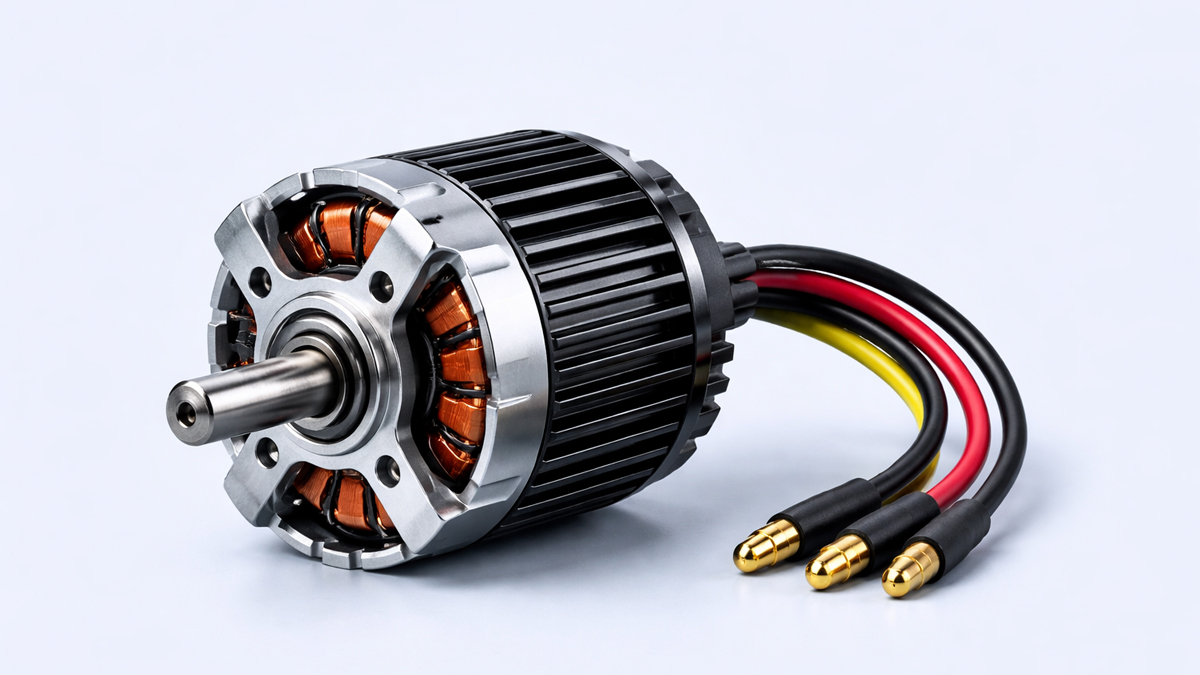
What is Brushless DC Motor?
A Brushless DC Motor, often shortened as BLDC motor, is an electric motor that converts electrical energy into rotating mechanical motion without using brushes to transfer current to the rotating part. Instead of brushes and a mechanical commutator, a BLDC motor uses electronic switching to energize motor windings in a controlled sequence. This makes the motor efficient, quiet, long-lasting, and very suitable for precise motion tasks.
In simple terms, a BLDC motor spins because magnetic fields are created and shifted in a planned pattern. The motor controller energizes specific coils, the magnetic field pulls or pushes the rotor, and the rotor rotates smoothly. This design avoids the friction and wear that normally happen in brushed motors, so the motor can run longer with less maintenance.
BLDC motors have become common in many modern systems because they provide high efficiency, high power density, fast response, and reliable speed control. In cinematic electronics within the cinema industry, these qualities matter because many film and theater systems require smooth motion, low noise, accurate repeatability, and stable performance over long shooting days.
How does Brushless DC Motor Work?
A BLDC motor works by electronically controlling the current in the stator windings to create a rotating magnetic field. The rotor, which usually contains permanent magnets, follows this rotating field. The key is timing. The motor controller must energize the correct windings at the correct moment, so the magnetic field keeps pulling the rotor forward in a continuous rotation.
Commutation concept: In a brushed motor, commutation is done mechanically using brushes and a commutator. In a BLDC motor, commutation is done electronically using a controller. The controller decides which coils should be powered based on rotor position.
Rotor position sensing: To switch currents at the right time, the controller needs to know rotor position. This can be achieved using sensors such as Hall effect sensors, or without sensors using electrical feedback like back electromotive force.
Electromagnetic interaction: When current flows through a stator winding, it creates a magnetic field. The rotor magnets are attracted to the energized stator poles. As the controller switches which windings are energized, the location of the magnetic field shifts, and the rotor keeps turning to align with it.
Speed and torque control: The controller adjusts motor speed by changing how fast it commutates and by using techniques such as pulse width modulation to regulate the average voltage and current delivered to the windings. Torque is primarily controlled by current. Higher current generally produces higher torque, within safe thermal limits.
Smooth motion for cinema systems: In cinema-related equipment like camera gimbals, focus motors, motion-control rigs, and quiet airflow systems, the ability to precisely control speed and torque is critical. A well-tuned BLDC system can deliver stable rotation, low vibration, and predictable response, which directly supports image stability and sound cleanliness.
What are the Components of Brushless DC Motor?
A BLDC motor system is usually more than just the motor body. It typically includes the motor, sensors if used, and an electronic controller. Each part plays a specific role in making the motor efficient and controllable.
Stator: The stator is the stationary part of the motor that contains windings. When energized in sequence, these windings produce a rotating magnetic field. The stator design affects torque, efficiency, heat dissipation, and smoothness.
Rotor: The rotor is the rotating part. In many BLDC motors, the rotor uses permanent magnets. These magnets interact with the stator magnetic field to create rotation. Rotor magnet quality and arrangement impact torque density and cogging behavior.
Electronic speed controller: The controller is the brain of the BLDC system. It switches current through the stator windings in the proper sequence. It often includes power electronics, control logic, protection circuits, and communication interfaces.
Power electronic switches: Inside the controller are switching devices such as MOSFETs or IGBTs. These devices rapidly switch current to create the desired waveform and control the motor precisely.
Position sensors: Some BLDC motors use Hall sensors or encoders. Hall sensors provide simple rotor position feedback. Encoders provide high-resolution feedback for precision control, which is useful in cinema rigs that require accurate repeatable movement.
Back electromotive force detection circuitry: In sensorless BLDC systems, the controller estimates rotor position by measuring the back electromotive force generated by the spinning motor. This reduces wiring and cost, but may be less reliable at very low speed unless advanced control is used.
Bearings: Bearings support the rotor and allow smooth rotation. Bearing quality strongly influences noise, vibration, and lifespan. For cinematic tools, low-noise bearings can be important because microphones can capture subtle mechanical sounds.
Shaft and housing: The shaft transmits torque to the load. The housing provides structural support and heat dissipation. In professional cinema gear, housing design can also reduce resonance and protect the motor from dust or impacts.
Wiring and connectors: A BLDC setup often uses three-phase power leads and additional sensor leads if present. In production environments, robust connectors reduce downtime and improve reliability.
What are the Types of Brushless DC Motor?
BLDC motors can be classified in different ways based on construction, commutation waveform, rotor placement, and intended application. Understanding these types helps in selecting the right motor for cinematic electronics.
Inner rotor BLDC: In this type, the rotor is inside the stator. Inner rotor motors often handle higher speeds and are compact. They are common in devices requiring fast response and efficient rotation.
Outer rotor BLDC: In this type, the rotor is outside the stator, like a rotating shell. Outer rotor motors often produce higher torque at lower speeds because of the larger rotor radius. Many gimbals and stabilization systems prefer outer rotor designs for smooth torque delivery.
Trapezoidal commutation BLDC: Some BLDC systems use trapezoidal back electromotive force and six-step commutation. This approach is simpler and cost-effective. It can produce more torque ripple compared to sinusoidal control, which may matter for ultra-smooth motion.
Sinusoidal commutation BLDC: This approach drives the motor with smoother waveforms, often called field oriented control or sinusoidal control. It reduces torque ripple and can make the motor quieter and smoother. This is highly valuable for cinematic motion systems.
Sensor-based BLDC: These motors use Hall sensors or encoders for rotor position feedback. They can provide reliable low-speed operation and precise control, which is useful for focus pulls, zoom control, and motion-control robotics.
Sensorless BLDC: These motors estimate rotor position using back electromotive force or advanced observers. Sensorless systems reduce complexity and wiring but may struggle at very low speeds without specialized control methods.
High torque low speed BLDC: These motors are designed for applications requiring strong torque at low speed, often paired with gearboxes or direct drive designs. Examples include camera sliders, pan-tilt heads, and robotic arms.
High speed BLDC: These motors are designed for high rotational speeds and may be used in tools like compact blowers, cooling systems, or specialized cinematic equipment that requires rapid airflow or spinning mechanisms.
What are the Applications of Brushless DC Motor?
BLDC motors are used widely because they combine efficiency, controllability, and reliability. Their applications span consumer products, industrial systems, medical devices, robotics, and cinema technology.
Camera stabilization systems: Gimbals and stabilizers use BLDC motors to keep cameras steady. Smooth torque and fast response help counteract hand movement and vibrations.
Motion-control rigs: Film productions use motion-control systems for repeatable camera moves. BLDC motors drive sliders, pan-tilt heads, dollies, and robotic arms, enabling precise repeated motion for visual effects and compositing.
Focus, zoom, and iris control: Motorized lens control systems use compact motors for precise adjustments. BLDC motors paired with encoders can deliver accurate positioning with minimal backlash, especially when combined with proper gearing.
Drones and aerial cinematography: Many drones use BLDC motors for propulsion because they are efficient and powerful. In cinematic drone systems, BLDC motors also help stabilize gimbals and payloads.
Quiet cooling systems: Cinema cameras, projectors, servers, and LED walls generate heat. BLDC fans and blowers provide cooling with lower noise, which reduces problems during sound recording.
Projector mechanisms: Some projectors and cinema equipment include moving parts for cooling, lens shifting, or mechanical adjustments. BLDC motors can provide consistent performance with reduced maintenance.
Stage automation and theater systems: In live performance environments, BLDC motors can drive quiet motion for moving lights, automated curtains, stage lifts, rotating platforms, and set pieces where smoothness and reliability matter.
Robotics and animatronics: For film production and theme entertainment, robots and animatronics often need precise motion and high reliability. BLDC motors help deliver controlled movement with less wear.
Audio and studio equipment: In some studio systems, quiet BLDC-driven fans and motion components reduce noise pollution and vibration near microphones.
What is the Role of Brushless DC Motor in Cinema Industry?
In the cinema industry, the best technology is the one that disappears into the background. A BLDC motor supports this idea because it can deliver motion and airflow that feel smooth, quiet, and predictable. Cinematic electronics include many systems where motion is essential, but noise, vibration, and inconsistency can ruin a shot.
Stabilization and image quality: Camera shake is a major enemy of professional footage. BLDC motors in gimbals constantly correct orientation. Their fast response and fine control help maintain stable framing, which reduces the need for heavy post-stabilization and preserves natural motion.
Repeatable movement for visual effects: Motion-control shots require the same camera move repeated multiple times, sometimes with different lighting passes or actors. BLDC-driven rigs can execute programmed motion paths accurately. This repeatability improves compositing workflows and reduces retakes.
Precision lens control: Pulling focus is an art, but modern productions often use remote systems. With BLDC motors and feedback sensors, focus and zoom can be adjusted smoothly, reducing stepping artifacts and improving operator control. This matters in high-resolution cinema cameras where tiny focus errors are obvious.
Quiet operation for sound recording: Film sets prioritize clean audio. Brushless systems avoid brush noise and reduce mechanical friction. This helps keep motors from being heard on set, especially in quiet scenes or when microphones are close.
Efficient power use in mobile setups: Many productions rely on battery-powered equipment. BLDC motors are efficient, so they help extend battery life in gimbals, sliders, portable lights, wireless follow focus systems, and field cooling equipment.
Thermal management for reliable electronics: Overheating can cause camera shutdowns, projector instability, or LED wall performance issues. BLDC fans and blowers provide strong airflow with better efficiency and lower noise, supporting stable operation during long takes or extended screening periods.
Compact design in tight rigs: Cinematic electronics often need compact motors that deliver high torque. BLDC motors provide high power density. This helps designers create lighter gimbals, smaller rigging, and more portable devices without sacrificing performance.
Reduced maintenance and downtime: Production time is expensive. BLDC motors reduce wear compared to brushed motors. Fewer failures and less maintenance can translate into smoother production schedules.
What are the Objectives of Brushless DC Motor?
The objectives of a BLDC motor in any system are connected to performance, efficiency, reliability, and controllability. In cinematic electronics, these objectives become more specific because image and sound quality are directly affected by motor behavior.
Efficient energy conversion: One objective is to convert electrical energy into mechanical motion with minimal losses. High efficiency reduces heat and extends battery runtime, both important on set.
Precise speed control: Many cinema tools need stable speed, whether it is a slider move, a turntable rotation, or a fan speed inside a camera housing. BLDC motors aim to deliver consistent speed under changing loads.
Accurate position control: In follow focus systems, robotic heads, and motion-control rigs, accuracy is key. BLDC motors paired with encoders or sensors aim to provide precise position control and repeatability.
Smooth torque delivery: The objective is to minimize torque ripple and vibrations that can show up as micro-jitters in footage. Advanced control methods help BLDC motors provide smooth movement.
Low noise and low vibration: On a film set, even small noises can cause retakes. BLDC motor systems aim to operate quietly, especially when used near microphones or on camera rigs.
Long operational life: Another objective is durability. Removing brushes eliminates a major wear component. This helps the motor last longer in professional gear that runs many hours.
High reliability under demanding conditions: Productions can involve heat, dust, transport shocks, and long working hours. BLDC motors aim to maintain stable performance across these conditions.
Compact and lightweight design: Cinematic rigs must be portable. BLDC motors aim to deliver high torque and power density while keeping size and weight reasonable.
What are the Benefits of Brushless DC Motor?
BLDC motors provide a bundle of benefits that align strongly with the needs of cinematic electronics. These benefits are not just technical details. They often translate into better footage, cleaner audio, and smoother workflows.
Higher efficiency: BLDC motors typically operate with higher efficiency than brushed motors, meaning less wasted energy. This supports longer battery life and lower heat generation.
Lower maintenance: Without brushes, there is less mechanical wear. This reduces downtime and maintenance cost, especially for equipment used daily.
Better speed control: Electronic commutation and modern controllers allow very fine speed regulation. This is crucial for smooth camera moves and stable cooling performance.
Improved reliability: Fewer wear parts can lead to fewer failures, which matters in high-pressure production environments.
Higher power density: BLDC motors can deliver strong performance in a compact form. This helps reduce rig weight and improves portability.
Lower electrical noise from brushing: Removing brushes eliminates arcing associated with brush contact. This can reduce interference issues in sensitive electronics setups.
Quieter operation potential: With good mechanical design and control methods, BLDC motors can be very quiet. This is valuable on set and in theaters.
Better dynamic response: BLDC systems can accelerate and decelerate quickly. This helps in stabilization systems that must react instantly to movement.
Flexible control integration: Controllers can communicate with other systems, enabling automation, presets, and programmable motion, which are common in modern cinematic workflows.
What are the Features of Brushless DC Motor?
The features of a BLDC motor include both construction characteristics and performance characteristics. For cinema industry use, certain features stand out as especially important.
Electronic commutation: The motor uses a controller to switch currents instead of brushes. This enables advanced control algorithms and smooth performance.
Three-phase winding structure: Most BLDC motors are three-phase, supporting efficient torque production and stable operation.
Permanent magnet rotor: Many BLDC motors use permanent magnets in the rotor, enabling high torque density and efficient conversion.
High controllability: With the right controller, the motor can be controlled for speed, torque, and position with high precision.
Compatibility with feedback sensors: BLDC systems can integrate Hall sensors or encoders for accurate low-speed and position control.
Low mechanical wear: Since brushes are removed, wear is reduced and service life can improve.
Wide speed range: BLDC motors can operate efficiently across a wide speed range, from slow controlled motion to high-speed rotation, depending on design and control.
Thermal efficiency: Higher efficiency means less heat, and many designs also optimize airflow and conduction paths for better cooling.
Support for advanced control methods: Modern BLDC controllers can use sinusoidal commutation or field oriented control for smoother torque and reduced noise.
Scalability: BLDC motors exist in many sizes, from tiny motors in compact lens systems to larger motors in stage automation and robotic rigs.
What are the Examples of Brushless DC Motor?
Examples of BLDC motors in real-world cinema industry contexts often show up as parts of systems rather than as standalone motors. The motor is usually inside a tool you already recognize.
Gimbal motors: The direct-drive motors used to stabilize camera pitch, roll, and yaw are often BLDC motors, commonly outer rotor types for smooth torque.
Wireless follow focus motors: Many professional follow focus systems use compact motors with feedback control for precise lens movement.
Camera slider drive motors: Motorized sliders often use BLDC motors to create smooth and programmable camera travel.
Pan-tilt head motors: Remote heads used on cranes and tripods often use BLDC motors for smooth panning and tilting.
Motion-control robot actuators: Robotic arms and motion-control systems may use BLDC motors with encoders for repeatable cinematic moves.
Quiet cooling fans in cinema cameras: Many modern cinema cameras use BLDC fans to manage heat while keeping noise low.
Projector cooling systems: Cinema projectors can use BLDC blowers for efficient cooling during long screenings.
LED wall and server cooling: Virtual production stages rely on high-performance computing and LED panels that generate heat. BLDC fans help keep systems stable without excessive noise.
Moving stage lights: Automated lighting fixtures can use BLDC motors for smooth, fast, and accurate motion, supporting complex lighting cues.
What is the Definition of Brushless DC Motor?
Definition: A Brushless DC Motor is an electric motor that uses electronic commutation to control current in the stator windings, producing a rotating magnetic field that drives a permanent magnet or magnetized rotor, without the use of brushes and a mechanical commutator.
What is the Meaning of Brushless DC Motor?
Meaning: Brushless DC Motor means a direct-current motor system where the switching of current required for rotation is handled electronically rather than mechanically. The motor achieves rotation by controlling electromagnetic fields in the stator while the rotor follows using permanent magnets, which reduces wear and improves controllability.
What is the Future of Brushless DC Motor?
The future of BLDC motors is strongly tied to trends in efficiency, automation, robotics, and precision motion. In the cinema industry, the future is also shaped by virtual production, lightweight rigs, smarter stabilization, and quieter equipment that supports clean audio capture.
Smarter motor control: Controllers are becoming more advanced, with better algorithms for smoothness, torque control, and sensorless low-speed operation. This will make BLDC motors even more suitable for ultra-smooth cinematic motion.
More integrated systems: More products will integrate motor, controller, and sensors into compact modules. This reduces wiring complexity and improves reliability in field setups.
Better noise and vibration optimization: As productions demand cleaner audio and higher resolution images, motor vibration and acoustic noise become more noticeable. Future BLDC designs will focus on reducing cogging torque, improving bearing technology, and refining control waveforms.
Higher efficiency and lower heat: Continuous improvements in magnetic materials, winding design, and power electronics will increase efficiency. This supports smaller cooling systems and longer battery runtimes.
Growth in virtual production: Virtual production stages rely on moving cameras, tracking systems, robotic rigs, and powerful computing with thermal demands. BLDC motors will continue to expand in both motion systems and quiet cooling solutions.
More robotics in filmmaking: Robotic camera moves, automated focus systems, and programmable lighting are increasing. BLDC motors with high-resolution feedback will be a major building block for these systems.
Improved portability: Lighter drones, smaller gimbals, compact sliders, and travel-friendly rigs will push demand for high torque density motors. BLDC technology is well positioned for this.
Sustainability and energy focus: As industries push for energy efficiency and reduced waste, BLDC motors align well because they are efficient and typically require less frequent replacement than brushed motors.
Summary
- Brushless DC Motor is an electric motor that uses electronic commutation instead of brushes and a mechanical commutator.
- BLDC motors create rotation by energizing stator windings in sequence to generate a rotating magnetic field.
- Key components include stator windings, a permanent magnet rotor, an electronic controller, power switches, and optional position sensors.
- Common types include inner rotor and outer rotor designs, sensor-based and sensorless systems, and trapezoidal or sinusoidal commutation approaches.
- Applications include gimbals, follow focus systems, motion-control rigs, drones, stage automation, robotics, and quiet cooling solutions.
- In the cinema industry, BLDC motors support smooth camera movement, repeatable motion for visual effects, precise lens control, low noise, and efficient thermal management.
- Objectives include efficient operation, precise speed and position control, smooth torque, low vibration, long life, and high reliability.
- Benefits include higher efficiency, longer lifespan, reduced maintenance, strong controllability, compact size, and potential for very quiet operation.
- Features include electronic commutation, high power density, wide speed range, sensor integration, and support for advanced control methods like field oriented control.
- The future of BLDC motors includes smarter controllers, quieter motion, better integration, expanded robotics, and strong growth in virtual production and energy-efficient cinema technology.

