
What is CableCam Robot?
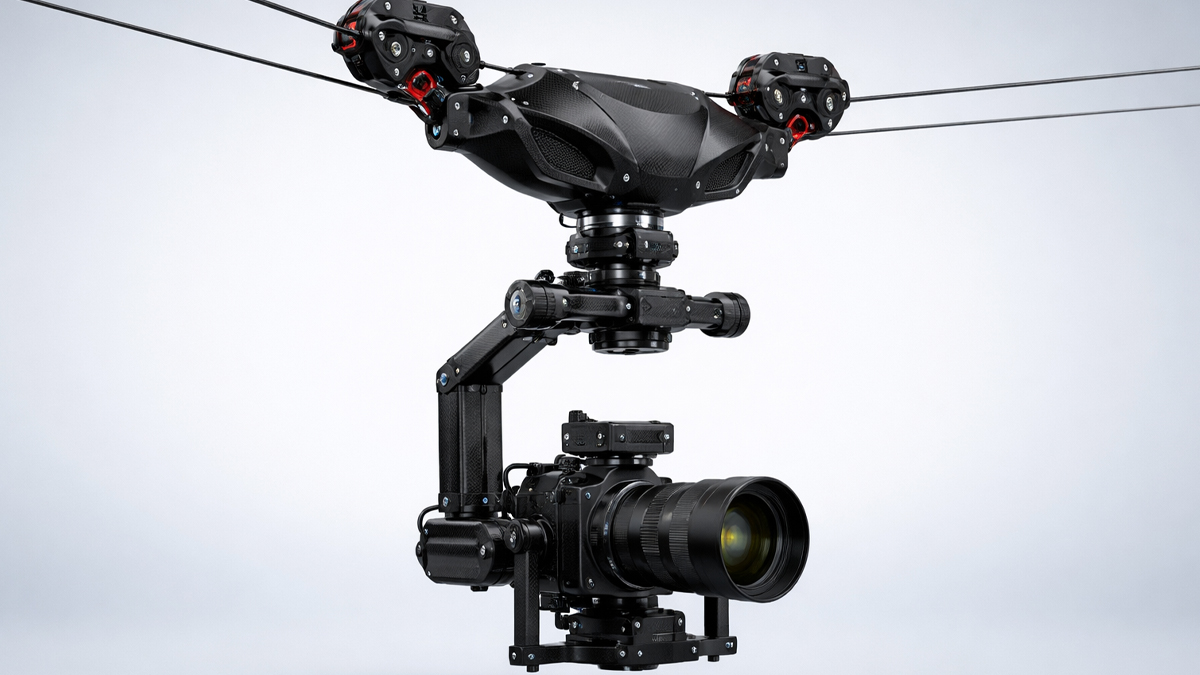
A CableCam Robot is a cable suspended robotic camera rig that moves a camera payload along taut cables stretched across a venue, set, landscape, or studio volume. Instead of running on the ground like a dolly or flying freely like a drone, it travels on a controlled line system, using motors and sensors to glide smoothly through the air while keeping the camera stable and precisely framed. The result is a fast, repeatable, and cinematic moving viewpoint that can pass over people, vehicles, terrain, water, or set pieces without placing a crane, track, or crew in the shot.
Purpose and identity: CableCam Robot exists to deliver dynamic aerial style shots with high safety and high repeatability. It is designed to carry professional cinema cameras, stabilized gimbals, lenses, wireless video links, and control electronics while remaining predictable and programmable.
Where it sits in cinematic technologies: CableCam Robot belongs to Robotic Camera Rigs because it combines mechanical motion, automation, stabilization, and remote operation into one system. It is cinematic because it can produce controlled movement arcs, speed ramps, and perfectly repeatable paths that match the language of modern filmmaking.
Why it is called a robot: CableCam Robot earns the robot label because it can execute motion with automation features such as waypoint paths, speed curves, position feedback, safety interlocks, remote piloting, and sometimes integration with virtual production tracking. It is not only a cable and a trolley. It is a mechatronic system with sensing, control logic, and programmable movement.
How does CableCam Robot Work?
A CableCam Robot works by tensioning one or more high strength cables between anchor points and driving a motorized carriage along those cables while stabilizing and controlling the camera payload. The system continuously measures position and speed, maintains tension, and applies controlled motor power so that the camera travels smoothly, stops accurately, and remains stable during acceleration, braking, and direction changes.
Cable tensioning concept: The cables are tensioned to reduce sag and vibration. Higher tension generally improves rigidity and shot quality, but it also increases structural loads at anchor points. The crew balances tension, span length, payload weight, and safety margins to match the shot requirements.
Carriage motion principle: A motorized carriage grips or rides on the cable via wheels, pulleys, or traction mechanisms. When motors rotate the drive wheels or drum systems, the carriage moves along the cable. For systems with multiple cables, motion can be controlled in more than one direction by varying tension and cable lengths, allowing two dimensional or three dimensional positioning.
Stabilization and camera control: A stabilized gimbal or stabilized head is often mounted under the carriage. This isolates camera orientation from cable vibration and motion bumps. Operators can pan, tilt, roll, and sometimes zoom and focus remotely, while another operator pilots the carriage.
Control and feedback loop: Sensors such as encoders, inertial measurement units, and sometimes GPS or optical tracking feed position and motion data into a controller. The controller uses that feedback to maintain smooth velocity, follow programmed paths, and enforce speed limits, geofences, and emergency stop behavior.
Safety workflow: The system includes redundant mechanical safety lines, braking, emergency stops, and load rated rigging. A safety plan typically defines minimum distances from cast and crowd, maximum speeds, wind limits, and exclusion zones under the travel path.
What are the Components of CableCam Robot?
A CableCam Robot is built from mechanical, electrical, and operational components that work as one integrated rig. While exact designs vary, the core building blocks remain consistent across most professional systems.
Cable system: High strength cable lines, typically steel or synthetic depending on design, create the travel path. Cable choice depends on span length, environmental conditions, and payload capacity.
Anchor and rigging hardware: Anchors include truss points, towers, cranes, building rigging, ground stakes, or engineered mounts. Hardware includes shackles, turnbuckles, slings, pulleys, and rated connectors designed for high loads.
Tensioning system: Tensioners may be manual, mechanical, or motorized. Some systems use winches or capstan mechanisms to achieve precise tension. Tension monitoring sensors can provide real time load readings.
Carriage or trolley: The carriage is the moving robot body that rides on the cable. It houses drive motors, wheels or rollers, brakes, power distribution, and sometimes onboard computers and radios.
Drive motors and transmission: Electric motors with gearboxes provide traction and torque. High torque is important for fast acceleration, uphill runs, and stable braking. Many systems use brushless motors for efficiency and control.
Braking and emergency stop: Brakes can be mechanical, electromagnetic, or regenerative. Emergency stop circuits cut power and engage braking to stop motion quickly. Professional rigs often include redundant stopping methods.
Gimbal or stabilized head: A 3 axis gimbal is commonly used to keep the image stable while the carriage moves. Some productions use stabilized remote heads that integrate with cinema lens control systems.
Camera payload and mounting: The payload includes camera body, lens, matte box, filters, video transmitter, timecode devices, and sometimes onboard recording accessories. The mounting plate must be rigid and vibration resistant.
Remote control station: Operators control carriage speed, direction, and position from a ground station. Many setups use dual operator workflow, one operator for flight path and one for camera framing.
Monitoring and video transmission: Wireless video links send live images to monitors for the director, operator, and focus puller. Robust transmission is essential for long spans and crowded RF environments.
Power system: Power may come from onboard batteries, tethered power, or hybrid solutions. Battery choice affects weight, runtime, and performance in cold or hot environments.
Software and motion control: Control software supports speed curves, waypoint programming, repeatable moves, and sometimes integration with external triggers, motion capture, or virtual production systems.
Safety accessories: Secondary safety lines, safety nets in some environments, warning signage, spotters, and communication headsets are part of the complete working system.
What are the Types of CableCam Robot?
CableCam Robot designs range from simple single line systems to advanced multi cable robots that can position a camera in three dimensional space. The type chosen depends on the shot language, venue constraints, safety needs, and budget.
Single cable linear CableCam: This is the classic design where a carriage travels along a single tensioned cable from point A to point B. It excels at fast, clean, predictable passes and long travel shots.
Dual cable stabilized systems: Some designs use a main cable for travel and additional lines for stabilization, lift control, or reducing sway. The extra cable support helps maintain steadiness in wind or during aggressive acceleration.
Multi cable 3D camera robots: These systems suspend a platform from multiple cables connected to motorized winches. By adjusting cable lengths, the robot moves in X, Y, and Z, allowing complex arcs, hovering positions, and precise spatial choreography.
Stadium broadcast CableCam: These rigs are optimized for live event coverage with high reliability, long spans, fast speeds, and safety systems suited for crowds. They are designed to deliver smooth tracking over fields, arenas, and racecourses.
Cinema focused CableCam: Cinema versions prioritize payload flexibility, lens control integration, and ultra smooth motion for narrative and commercial shots. They often emphasize quiet operation and fine control at slow speeds.
Portable compact CableCam: Lightweight kits are designed for quick setup in smaller locations. They carry smaller camera payloads and are used for indie productions, documentaries, and creative shots in tight spaces.
Hybrid cable and crane combinations: Some productions combine cable travel with additional mechanical axes such as pan arms or winch lift modules to create a richer motion vocabulary while keeping the camera off the ground.
What are the Applications of CableCam Robot?
CableCam Robot is used anywhere a production needs fast, controlled motion through space without ground tracks or heavy cranes blocking the scene. It supports both scripted and unscripted filmmaking because it can be repeated or piloted live.
Action sequences: CableCam Robot can chase vehicles, follow runners, fly over fights, or reveal stunt setups from above while keeping a safe distance and maintaining stable framing.
Sports and live events: It provides dramatic tracking shots across stadiums, along sidelines, and over crowds. Live direction benefits from its ability to move quickly and reliably.
Concerts and stage shows: CableCam Robot can travel above a stage to capture sweeping performance shots and crowd reactions without placing equipment on stage.
Commercials and brand films: It can produce premium production value movement that feels like a floating camera, perfect for product reveals, large set walkthroughs, and energetic lifestyle scenes.
Film and television narrative work: It supports establishing shots, transitions, and continuous movement sequences that would otherwise require cranes, drones, or complex rigging.
Virtual production stages: In LED volume environments, CableCam Robot can be integrated with tracking systems to feed camera position and orientation data to real time rendering pipelines.
Architectural and location reveals: It can glide through large interiors, industrial spaces, warehouses, and outdoor locations where floor tracks are impractical.
Nature and terrain coverage: Over water, rocks, forests, or sand, a cable system can provide stable movement without rotor wash or ground disturbance, depending on location rules and rigging feasibility.
Behind the scenes and promotional content: CableCam Robot can deliver dynamic shots of sets, crowds, and production scale for marketing materials.
What is the Role of CableCam Robot in Cinema Industry?
CableCam Robot plays a key role in delivering modern cinematic motion while meeting safety, repeatability, and efficiency demands. It helps productions capture shots that look expensive and immersive without requiring excessive infrastructure in frame.
Enabling cinematic movement language: CableCam Robot adds a floating, gliding perspective that sits between a crane shot and a drone shot. It can feel elegant at slow speed and exciting at high speed, giving directors a wide expressive range.
Improving repeatability for storytelling: Many scenes need the same camera move across multiple takes, lighting changes, or performance adjustments. CableCam Robot can repeat a path with consistent timing and position, supporting continuity and editorial flexibility.
Reducing set disruption: Floor based rigs can require track laying, leveling, and constant resets. Cable systems keep the ground clear, which can be critical for choreography, vehicle work, crowd scenes, and art direction.
Supporting safer aerial style shots: Drones can introduce safety concerns, noise, rotor wash, and restrictions. A cable suspended system is physically constrained to a known corridor, making risk easier to manage when properly rigged.
Enhancing production efficiency: Once installed, CableCam Robot can cover many angles quickly. The crew can reposition the robot, adjust speed curves, and capture multiple passes without rebuilding track.
Expanding creative options in confined spaces: In locations where cranes are too large or drones are not allowed, a cable based robot can still deliver aerial like motion with compact footprint.
Integration with modern workflows: CableCam Robot can connect with remote focus systems, lens metadata, timecode, and tracking solutions. This makes it valuable in high end productions that rely on data driven pipelines.
What are the Objectives of CableCam Robot?
The objectives of CableCam Robot are practical and creative. It exists to solve production problems while raising the visual standard of moving shots.
Smooth controlled movement objective: Deliver stable motion with minimal vibration, minimal sway, and predictable travel even during fast direction changes.
Repeatable motion objective: Allow identical takes through programmable paths, consistent speed ramps, and precise stopping positions for continuity.
Safety objective: Provide aerial perspective while keeping the camera path constrained, reducing unpredictability and enabling clear safety planning.
Operational efficiency objective: Reduce time spent laying track, moving cranes, or resetting complex rigs, especially on large sets or live environments.
Payload flexibility objective: Support professional cinema cameras, lenses, and stabilization systems so image quality matches high end production needs.
Remote operation objective: Keep operators at a safe and practical distance while still giving fine control over framing, focus, and movement.
Creative freedom objective: Enable new camera perspectives such as fast flyovers, sweeping reveals, and long continuous passes that enhance storytelling.
Data and integration objective: Support position feedback, telemetry, and optional tracking integration for advanced production and post workflows.
What are the Benefits of CableCam Robot?
CableCam Robot offers benefits that combine creative impact with logistical advantages. These benefits are a major reason it appears in both blockbuster productions and live event coverage.
High production value movement: The floating perspective creates shots that feel premium and immersive, often comparable to crane or helicopter style visuals.
Long travel without tracks: It can cover large distances quickly without placing equipment on the ground, which is useful in stadiums, streets, deserts, and large sets.
Repeatable takes: Directors and editors gain confidence because the move can be repeated consistently across takes, helping continuity and visual effects alignment.
Reduced noise compared to some aerial options: CableCam Robot can be quieter than rotor based systems, making it easier to record clean dialogue depending on the motors and environment.
Improved safety management: A constrained path and engineered rigging can make movement more predictable than free flying rigs, assuming correct installation and operation.
Minimal footprint in the scene: Since the camera travels overhead, it reduces the chance of equipment entering the frame and keeps floor space open for performers and set dressing.
Flexible shot styles: It can do slow creeping moves, medium speed tracking, and high speed chase style passes, all with controlled speed curves.
Better stability in certain conditions: With proper tension and stabilization, it can deliver stable images in environments where ground vibration or rough terrain would challenge a dolly.
Efficient coverage for live direction: In sports and concerts, it can deliver continuous coverage angles that help directors tell the story of the event.
What are the Features of CableCam Robot?
CableCam Robot features vary by model and class, but professional systems share a feature set focused on precision, reliability, and safety.
Programmable motion control: Many systems offer waypoint moves, speed ramps, acceleration limits, and saved presets for repeated shots.
Real time telemetry: Operators can monitor speed, position, battery status, motor temperature, signal strength, and tension data during operation.
Stabilized camera platform: Integration with 3 axis gimbals or stabilized heads reduces vibration and maintains horizon control.
Multi operator workflow: Separate controls for carriage motion and camera framing allow smoother results, especially for complex shots.
High speed capability: Some rigs are designed for rapid movement across long spans, useful for chase and reveal shots.
Precision stopping and marking: The robot can stop at defined points, hit marks for actors, and sync with action beats.
Robust wireless connectivity: Long range radio control and video transmission features are designed to perform in RF heavy environments.
Safety interlocks: Emergency stop circuits, braking redundancy, speed limits, and geofencing features help enforce safe operation.
Payload modularity: Quick change mounts, balance adjustment plates, and accessory rails allow different cameras and lens packages.
Environmental resilience: Weather resistant components, wind monitoring practices, and rugged enclosures support outdoor operation when conditions allow.
Integration options: Some systems can output position data, accept external triggers, or integrate with tracking systems for virtual production.
What are the Examples of CableCam Robot?
CableCam Robot examples include well known broadcast systems and cinema oriented cable suspended robots, as well as multi cable 3D camera robots used for advanced motion shots. The examples below represent common categories seen in professional use.
Broadcast CableCam systems: CableCam is widely associated with stadium camera systems that travel over sports fields for live coverage. These are often purpose built rigs optimized for speed, reliability, and crowd safe operation.
Spidercam style multi cable systems: Multi cable camera robots, often seen in large stadiums and arenas, use four or more cables and motorized winches to position a camera in three dimensional space. They are known for dramatic swoops, hovering, and complex motion paths.
Skycam style overhead systems: Overhead cable cameras used in football, racing, and other sports provide continuous tracking and top down perspectives. They are typically installed for events or permanently in some venues.
Cinema cable rig usage examples: Film sets often use cable suspended rigs to fly through corridors, across courtyards, over crowds, or along action lanes. The exact brand varies by region and rental availability, but the operating concept remains consistent.
Event and concert touring examples: Large tours sometimes deploy cable cameras to move above stages and audiences, capturing sweeping movement while keeping the camera out of the performers space.
Virtual production stage examples: Some stages experiment with overhead cable motion combined with tracking to create dynamic camera moves while maintaining predictable paths in a controlled environment.
What is the Definition of CableCam Robot?
CableCam Robot is defined as a robotic camera rig that moves a camera payload along tensioned cable lines using motorized control, sensor feedback, and remote operation to deliver stable, repeatable, and programmable camera movement through space.
Key definition elements: Cable suspended travel path, motorized carriage or multi cable winch control, controlled motion with feedback, remote piloting, and camera stabilization integration.
What is the Meaning of CableCam Robot?
The meaning of CableCam Robot can be understood by separating the idea into function and value.
Meaning in function: It is a camera movement system that uses cables as its track and robotics as its driving intelligence. The camera travels through the air along a defined corridor.
Meaning in creative value: It represents controlled flight for filmmaking. It allows the camera to glide like it is floating, while maintaining cinematic stability and precise framing.
Meaning in production value: It stands for efficiency, repeatability, and safety management in complex environments where traditional rigs are slow, intrusive, or restricted.
What is the Future of CableCam Robot?
The future of CableCam Robot is closely tied to advances in robotics, stabilization, tracking, and data driven production workflows. The direction is toward smarter rigs that are easier to deploy, safer to operate, and more integrated with both live and virtual production.
Smarter autonomy and assist features: Expect more operator assist such as automated speed ramping, obstacle awareness within a defined corridor, and intelligent braking tuned to payload weight and wind conditions.
Higher precision repeatability: As encoders, controllers, and calibration tools improve, CableCam Robot will deliver even more accurate path repetition. This will benefit visual effects, motion matching, and complex choreography.
Deeper lens and camera integration: More systems will integrate with lens metadata, focus motors, and camera control protocols, enabling coordinated moves where framing, focus pulls, and movement timing are synchronized.
Improved stabilization and vibration control: Future rigs will reduce micro vibration through better mechanical isolation, active damping, and smarter gimbal control, producing cleaner images at longer focal lengths.
Lighter and stronger materials: Advances in cable materials, composites, and compact motor designs will improve payload to weight ratios, enabling faster setup and longer spans with less structural load.
Virtual production integration: CableCam Robot will increasingly connect to real time engines via tracking data, helping match physical camera movement to digital environments accurately and consistently.
Enhanced safety systems: Expect more built in redundancy, real time tension monitoring, automated safe mode behavior, and better diagnostic tools to reduce risk and support compliance on complex sets.
More accessible modular ecosystems: Rental houses and manufacturers will push modular designs where crews can scale from compact systems to high end rigs using shared parts, software, and control workflows.
Summary
- CableCam Robot is a cable suspended robotic camera rig that moves a cinema camera through space with controlled, stable, and repeatable motion.
- It works by tensioning cables between anchor points and driving a motorized carriage while stabilizing the camera with a gimbal or remote head.
- Core components include cables, anchors, tensioners, carriage, motors, brakes, control station, power, video links, and safety systems.
- Types range from single cable linear rigs to multi cable 3D camera robots used in stadiums, concerts, and cinema productions.
- Applications include action shots, sports, concerts, commercials, narrative filmmaking, and virtual production environments.
- Its cinema industry role centers on high production value movement, repeatability for continuity, safer aerial style shots, and efficient coverage.
- Benefits include long travel without tracks, consistent takes, reduced set disruption, flexible shot styles, and strong integration potential.
- The future points toward smarter automation, better stabilization, stronger integration with tracking and lens control, lighter materials, and enhanced safety.

