
What is Delta Arm Rig?
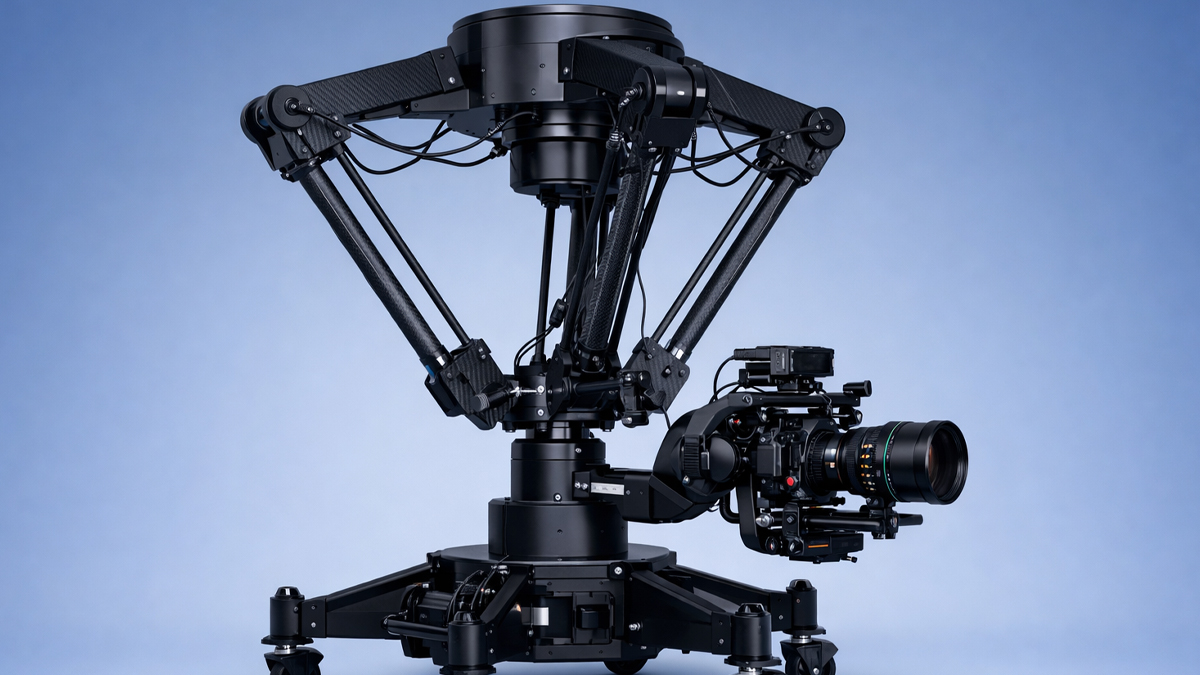
A Delta Arm Rig is an advanced robotic camera system designed to perform extremely fast, precise, and repeatable camera movements in film and video production. It is inspired by delta robot technology that uses multiple lightweight arms connected to a central platform. In the cinema industry, this rig is adapted to carry high speed cinema cameras instead of industrial tools. The structure allows the camera to move in complex three dimensional paths with exceptional speed and accuracy.
The Delta Arm Rig is mainly used for high-speed cinematography, product commercials, action shots, tabletop filming, and motion-controlled sequences. It can capture dramatic camera movements such as rapid push ins, circular sweeps, spirals, and sudden directional changes. Because of its robotic precision, the movement can be repeated multiple times with identical accuracy, which is essential for visual effects, compositing, and slow-motion scenes.
Unlike traditional camera cranes or dollies, the Delta Arm Rig focuses on speed and precision rather than long travel distances. It operates within a defined workspace, often mounted on a stable base. The robotic arms work together in coordination to control the camera platform. This combination of mechanical design and digital control makes the Delta Arm Rig a powerful tool in modern cinematic technologies.
A Delta Arm Rig is a robotic camera arm system that uses three or more linked arms arranged in a triangular formation to control a camera with high speed and accuracy. It is one of the most dynamic tools in the field of robotic camera rigs within the cinema industry.
How does Delta Arm Rig Work?
Parallel Arm Structure: The Delta Arm Rig works on a parallel robotic mechanism where multiple arms are connected to a fixed base and converge at a moving platform. Each arm is powered by high precision motors. When the motors rotate, they change the angles of the arms, which in turn moves the camera platform in three dimensional space. The design allows smooth and synchronized motion.
Motorized Control System: The rig uses servo motors or high torque motors that are controlled by a computer system. The operator programs the desired movement path using motion control software. The system calculates the exact joint angles required and sends signals to the motors. This ensures accurate positioning and consistent speed.
Motion Programming: Before shooting, technicians program the movement into the control system. The software allows adjustments for speed, acceleration, deceleration, and timing. Once programmed, the rig can repeat the same motion multiple times without variation. This is extremely useful in scenes where different elements are shot separately and later combined in post production.
Real Time Operation: In some setups, the rig can be operated in real time using control panels or joysticks. However, most cinematic uses rely on pre programmed motion to achieve perfect synchronization with lighting, props, and special effects.
Stability and Balance: The Delta Arm Rig is designed to maintain balance even at high speeds. The parallel arm structure distributes forces evenly. This reduces vibration and ensures that the captured footage remains stable, especially when combined with a gimbal system.
The Delta Arm Rig works by translating motor movements into coordinated arm motions that precisely position and move the camera through space.
What are the Components of Delta Arm Rig?
Base Frame: The base frame is the foundation of the rig. It is usually made from strong materials such as steel or aluminum. The base keeps the entire structure stable during operation and supports the motors and arms.
Robotic Arms: The robotic arms are lightweight yet strong components connected to the base. Typically, three arms are arranged in a triangular layout. These arms move simultaneously to control the camera platform.
Motor System: High precision servo motors power the arms. These motors are responsible for controlling the speed and direction of movement. They are connected to motor drivers that regulate electrical input.
Camera Platform: The camera platform is the moving section at the center where the camera is mounted. It can include mounting plates, quick release systems, and sometimes a stabilizing gimbal.
Control Unit: The control unit is the brain of the rig. It includes a computer system, motion control software, and interfaces for programming movements. Operators use this unit to design and execute camera paths.
Power Supply System: The rig requires a reliable power source to run motors and control electronics. This can include external power connections or high capacity battery systems.
Safety Mechanisms: Emergency stop systems, limit sensors, and collision detection sensors are included to ensure safe operation. These systems protect both equipment and crew.
Cabling and Communication Lines: Data cables connect motors and sensors to the control unit. Proper cable management is important to avoid interference during high speed movements.
These components work together as a unified system to deliver precise and dynamic camera motion.
What are the Types of Delta Arm Rig?
High Speed Delta Arm Rig: This type is optimized for extremely fast camera movements. It is often used in commercial shoots where objects move quickly, such as liquid splashes or product drops.
Compact Delta Arm Rig: Designed for smaller studios and tabletop shoots, this version has a limited range but offers excellent precision. It is suitable for product photography and macro cinematography.
Heavy Payload Delta Arm Rig: Built to carry larger cinema cameras and additional equipment, this type features stronger motors and reinforced arms. It is used in high end film productions.
Portable Delta Arm Rig: This type is engineered for mobility. It can be assembled and disassembled quickly, making it suitable for location shoots.
Custom Built Delta Arm Rig: Some production houses design custom rigs tailored to specific project requirements. These may include extended reach, specialized mounts, or integration with other robotic systems.
Each type serves different needs within cinematic technologies while maintaining the core parallel arm structure.
What are the Applications of Delta Arm Rig?
Product Commercials: The Delta Arm Rig is widely used in product advertisements. It captures dynamic movements around products such as beverages, cosmetics, electronics, and food items.
High Speed Cinematography: For slow motion shots that require rapid camera motion, this rig delivers exceptional performance. It allows filmmakers to capture dramatic effects with precision.
Visual Effects Integration: Since movements can be repeated exactly, it is ideal for scenes involving green screen and digital compositing. Multiple passes can be combined seamlessly.
Action Sequences: In action scenes where timing is critical, the rig provides controlled and repeatable motion paths that enhance visual impact.
Music Videos: Creative camera sweeps and fast transitions are common in music videos. The Delta Arm Rig enables these stylish movements.
Scientific and Industrial Filming: Beyond cinema, it is also used in research and technical demonstrations where precise camera positioning is required.
The versatility of the Delta Arm Rig makes it valuable across various filming scenarios.
What is the Role of Delta Arm Rig in Cinema Industry?
The Delta Arm Rig plays a transformative role in the cinema industry by expanding creative possibilities. It enables filmmakers to achieve shots that would be difficult or impossible with manual camera systems.
It enhances production efficiency by reducing retakes. Since the motion can be programmed and repeated, directors can focus on performance and lighting adjustments without worrying about inconsistent camera movement.
The rig also supports complex visual storytelling. Fast and fluid camera motion adds energy and emotion to scenes. It contributes to high production value and modern cinematic style.
In large scale productions, it works alongside other robotic camera rigs to create coordinated multi camera setups. This integration reflects the growing importance of automation and precision in cinematic technologies.
What are the Objectives of Delta Arm Rig?
The primary objective of the Delta Arm Rig is to provide precise and repeatable camera motion. This ensures consistency in professional film production.
Another objective is to achieve high speed movement without compromising stability. The rig is designed to combine speed with accuracy.
It also aims to enhance creative flexibility. Directors and cinematographers can experiment with complex motion paths that would be risky or impossible manually.
Safety is another key objective. By using robotic control, potentially dangerous shots can be executed without placing crew members at risk.
The rig seeks to improve efficiency and reduce production time by automating complex camera operations.
What are the Benefits of Delta Arm Rig?
The Delta Arm Rig offers exceptional precision, which ensures professional quality footage.
It provides repeatable motion, making it ideal for visual effects and composite shots.
High speed capability allows filmmakers to capture dynamic and dramatic sequences.
Compact design makes it suitable for studio environments with limited space.
Reduced human error leads to consistent results and fewer retakes.
Enhanced safety protects both crew and equipment during complex shots.
Improved creative control allows cinematographers to design intricate motion paths.
These benefits make the Delta Arm Rig a valuable investment for advanced film production.
What are the Features of Delta Arm Rig?
Parallel arm mechanism ensures stable and coordinated motion.
High torque servo motors deliver powerful and smooth movement.
Advanced motion control software allows detailed programming.
Multiple axis movement enables complex three dimensional camera paths.
Quick mounting system supports different camera types.
Safety sensors and emergency stop features ensure secure operation.
Customizable configurations adapt to various production needs.
Integration capability allows connection with lighting and visual effects systems.
These features collectively define the technological strength of the Delta Arm Rig.
What are the Examples of Delta Arm Rig?
Several production studios and robotic technology companies have developed delta based camera rigs for commercial and cinematic use.
Some high speed robotic systems used in advertising are inspired by industrial delta robots but modified for cinema cameras.
Specialized motion control companies create custom delta style rigs for tabletop filming and product shoots.
In large film studios, custom engineered delta arm systems are integrated into advanced robotic camera setups for high precision sequences.
While specific brand names vary, the concept remains consistent across implementations.
What is the Definition of Delta Arm Rig?
The Delta Arm Rig is defined as a robotic camera system that uses a parallel arm mechanism arranged in a triangular configuration to control a camera platform with high speed, precision, and repeatability within a defined workspace for cinematic production.
This definition emphasizes its mechanical structure, functional purpose, and application within the cinema industry.
What is the Meaning of Delta Arm Rig?
The meaning of Delta Arm Rig comes from the word delta, which refers to the triangular arrangement of its arms, and arm rig, which refers to the robotic support structure that holds and moves a camera.
In practical terms, it means a triangular robotic camera arm system designed for fast and precise motion in filmmaking.
It represents the combination of robotics and cinematography to achieve advanced camera movement.
What is the Future of Delta Arm Rig?
The future of the Delta Arm Rig is closely linked with advancements in robotics, artificial intelligence, and cinematic technologies.
Future systems may include artificial intelligence based motion planning that automatically adjusts camera paths based on subject movement.
Improved materials may reduce weight while increasing strength, allowing higher speed and larger payloads.
Wireless control and cloud based programming may enhance flexibility in studio environments.
Integration with virtual production stages and real time rendering engines will expand creative possibilities.
As automation becomes more common in filmmaking, the Delta Arm Rig will likely play an even greater role in delivering precise, efficient, and visually stunning camera motion.
Summary
- Delta Arm Rig is a robotic camera system based on a parallel triangular arm structure
- It provides high speed, precise, and repeatable camera movement
- It is widely used in product commercials, action scenes, and visual effects shots
- It includes components such as base frame, motors, arms, control unit, and camera platform
- It enhances creative flexibility and production efficiency
- It improves safety during complex or high speed shots
- It supports integration with modern cinematic technologies
- Its future involves artificial intelligence, lighter materials, and advanced automation
- It represents the fusion of robotics and cinematography in the cinema industry
- It plays a key role in shaping modern high precision filmmaking practices

