

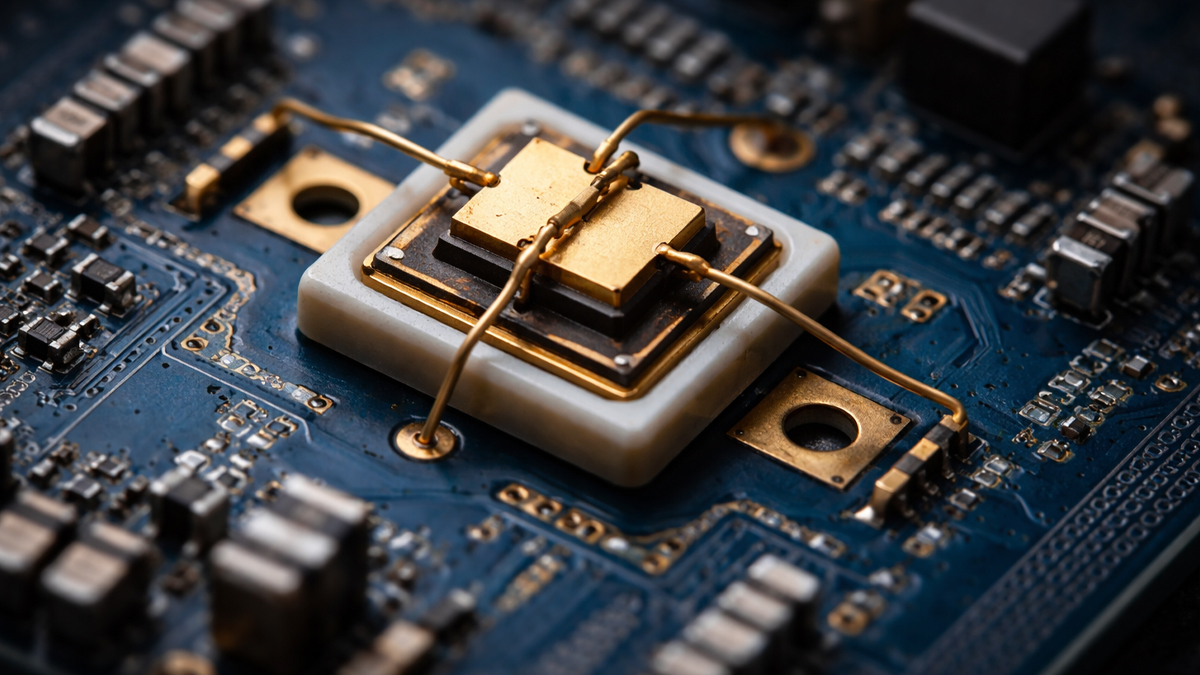
What is High-Electron-Mobility Transistor (HEMT)?
A High-Electron-Mobility Transistor, commonly called a HEMT, is a special kind of field effect transistor designed to operate at very high frequencies and at high power levels with excellent efficiency. It became popular because it can move electrical charge extremely quickly through its channel, which helps it amplify weak signals or switch power with less loss than many traditional transistor structures.
The key idea behind a HEMT is that it uses a junction between two different semiconductor materials instead of relying only on a single material. This junction is called a heterojunction. Because the materials have different electrical properties, the junction forms a very thin region where electrons can move with very little resistance. That low resistance path is one of the reasons HEMT devices can perform so well in radio frequency systems, microwave systems, and modern power electronics.
In practical terms, HEMTs are widely used anywhere designers need fast response, low noise, high gain at high frequency, or high efficiency at high voltage. This includes communication infrastructure, radar, satellite links, and increasingly, high efficiency power conversion systems. Inside cinematic electronics, HEMTs appear in equipment that handles high frequency wireless links, precision signal chains, and compact high power power supplies used in cinema production and exhibition.
How does High-Electron-Mobility Transistor?
A HEMT works by controlling the flow of electrons through a channel using an electric field created by the gate terminal. Like other field effect transistors, it typically has three main terminals: source, gate, and drain. When a suitable voltage is applied to the gate, it changes the conductivity of the channel, allowing current to flow from source to drain.
What makes a HEMT different is how the channel is formed. In many HEMT designs, two different semiconductor layers are used, such as gallium arsenide with aluminum gallium arsenide, or gallium nitride with aluminum gallium nitride. At their interface, electrons gather in a very thin sheet called a two-dimensional electron gas. This electron sheet has extremely high mobility, meaning electrons can move rapidly with fewer collisions. Fewer collisions means lower resistance and lower heat for the same current.
When the gate voltage is adjusted, it controls the electron density in that two-dimensional electron gas region. Reducing electron density pinches the channel and decreases current. Increasing electron density strengthens the channel and increases current. Because the channel is so thin and the electrons move so quickly, the transistor can respond extremely fast, making it ideal for microwave amplification, low noise front ends, and modern high speed power switching.
What are the Components of High-Electron-Mobility Transistor
A HEMT is built from both electrical terminals and internal semiconductor layers that enable its high performance. The most important components include:
Source terminal
The source is where electrons enter the device channel. In many circuits, it is the reference for channel current.
Drain terminal
The drain is where electrons leave the channel. The voltage between drain and source often sets the electric field that drives current.
Gate terminal
The gate controls the channel conductivity. By applying a gate voltage, the device either allows current flow or restricts it.
Heterostructure layers
These are the stacked semiconductor layers made from different materials. Their interface creates the conditions for high electron mobility.
Two-dimensional electron gas region
This is the ultra thin electron channel that forms at the heterojunction. It is the main reason for low resistance and high speed.
Barrier layer
The barrier layer helps confine electrons to the channel region. It also influences threshold behavior and device stability.
Buffer layer and substrate
These provide mechanical support and help manage electric fields and heat. Substrates can vary depending on device type and cost targets.
Passivation and field plates
Many HEMTs include surface passivation to reduce traps and improve reliability. Field plates help shape electric fields to increase breakdown voltage and reduce harmful peak fields.
Together, these elements allow HEMTs to achieve high gain, fast switching, low noise, and strong efficiency, which is why they are used in demanding cinematic electronics environments.
What are the Types of High-Electron-Mobility Transistor
HEMT is a broad family, and different types are optimized for different jobs. Common types include:
GaAs HEMT
Gallium arsenide HEMTs are known for excellent high frequency performance and low noise. They are widely used in microwave receivers, low noise amplifiers, and high frequency communication equipment.
pHEMT
Pseudomorphic HEMT is a popular GaAs based variation that improves electron mobility and device performance by using strained layers. pHEMT devices are common in radio frequency front ends where low noise and high gain are critical.
GaN HEMT
Gallium nitride HEMTs are designed for high power and high voltage. They can handle strong electric fields and can operate at high frequencies while maintaining good efficiency. GaN HEMTs have become very important for both radio frequency power amplifiers and power switching applications.
Enhancement mode HEMT
This type is normally off at zero gate voltage. Many designers prefer normally off behavior for safety and simpler control in power electronics.
Depletion mode HEMT
This type is normally on at zero gate voltage and needs a negative gate voltage to turn off. It is common in certain radio frequency designs, but it can require extra care in power systems.
MIS-HEMT
Metal Insulator Semiconductor HEMT includes an insulating layer under the gate to reduce leakage and improve control and reliability.
Each type exists because different cinema industry systems have different priorities, such as ultra low noise for wireless audio receivers, high power for transmitters, or high efficiency for compact power supplies inside projectors and servers.
What are the Applications of High-Electron-Mobility Transistor
HEMT devices show up in many real world systems because they combine speed, efficiency, and strong signal performance. Major applications include:
Low noise amplifiers
HEMTs are widely used in low noise amplifiers for receivers. This matters when signals are weak, such as satellite signals, long range wireless links, and sensitive measurement equipment.
Microwave and millimeter wave systems
Radar, point to point links, 5G infrastructure, and high frequency test equipment often rely on HEMT based amplifiers because they maintain gain at frequencies where many devices struggle.
Radio frequency power amplifiers
GaN HEMTs are especially common in high power amplifiers because they can deliver high output power with good efficiency, reducing heat and power consumption.
High efficiency power conversion
GaN HEMTs are increasingly used in switched mode power supplies, fast chargers, and data center power systems because fast switching can reduce losses and shrink magnetics, enabling compact designs.
High speed switching and drivers
Their fast switching helps in motor drives, power factor correction stages, and specialized pulsed power circuits.
Aerospace and defense electronics
Systems that demand high reliability, high frequency operation, and strong efficiency often use HEMTs for both receiving and transmitting chains.
In cinematic electronics, these applications translate into cleaner wireless links, stronger signal integrity in high bandwidth systems, and smaller, cooler power supplies inside critical cinema equipment.
What is the Role of High-Electron-Mobility Transistor in Cinema Industry
The cinema industry depends heavily on electronics that must be reliable, quiet, and capable of handling high data rates and demanding power profiles. HEMTs support these needs in both production and exhibition.
In film and television production, wireless systems are everywhere: wireless microphones, in ear monitoring, camera control links, and video transmitters. Many of these systems operate at high frequencies and must maintain low noise and stable amplification to avoid dropouts, hiss, or interference. HEMT based low noise amplifiers can help the receiver front end maintain sensitivity, which improves range and link stability in crowded radio environments.
In cinema exhibition, modern theaters rely on digital cinema servers, networked audio processing, projectors, and control systems. Efficient power conversion is crucial because projectors and servers run for long hours and generate significant heat. GaN HEMT based power supplies can switch faster and reduce energy loss, which can lower heat output, reduce fan noise, and improve overall equipment lifespan. Lower heat also improves reliability, which is a major operational priority for cinemas.
HEMT technology also supports high frequency amplification used in communication backhaul, satellite distribution, and specialized broadcasting links that may feed content to venues. In short, HEMTs quietly sit behind many cinema experiences by enabling clean signals, stable wireless performance, and efficient power systems that keep critical equipment running smoothly.
What are the Objectives of High-Electron-Mobility Transistor
The objectives of HEMT technology can be understood as design goals that solve real problems in high performance electronics:
Increase electron mobility for faster operation
A central objective is to create a channel where electrons move rapidly, improving frequency response and switching speed.
Reduce noise in sensitive signal chains
Many HEMTs are designed to provide low noise amplification, which improves receiver sensitivity and signal clarity.
Improve power efficiency
Especially for GaN HEMTs, the objective is to reduce conduction and switching losses so systems waste less energy as heat.
Enable high power density
HEMTs aim to deliver more power from a smaller device area, supporting compact electronics designs.
Support high voltage operation
GaN HEMTs are built to handle high electric fields, which helps power systems operate at higher voltages with improved efficiency.
Maintain stable performance at high frequency
Many transistor technologies degrade in gain as frequency increases. A key objective of HEMTs is to remain useful deep into microwave and sometimes millimeter wave bands.
Improve reliability under demanding conditions
HEMT designs often include structures like field plates and passivation to control electric fields and reduce degradation mechanisms over time.
These objectives align well with cinema industry needs: dependable equipment, high quality signals, compact and quiet systems, and energy efficient operation.
What are the Benefits of High-Electron-Mobility Transistor
HEMT devices bring several practical benefits that engineers value:
High speed performance
Because electrons move with high mobility in the channel, HEMTs can operate at very high frequencies. This supports fast communication links and wide bandwidth amplification.
Low noise amplification
Many HEMT variants offer excellent noise performance, which is essential for receivers. Cleaner amplification helps preserve signal detail and reduces unwanted hiss or artifacts.
High efficiency
In power applications, fast switching and low resistance can reduce losses. This can improve efficiency, lower heat, and allow smaller cooling systems.
High power capability
GaN HEMTs can deliver high output power at radio frequencies and handle high power switching in power electronics, making them versatile across many system types.
Compact system design
Higher switching frequency in power supplies can reduce the size of inductors and transformers. Higher gain at high frequency can reduce the number of amplifier stages. Both can shrink system size.
Better thermal outcomes at the system level
Even when the device itself can handle high temperatures, the larger benefit is often reduced heat generation for the same delivered power, which helps reliability.
For cinema equipment, these benefits can mean quieter projection booths, more reliable servers, stronger wireless audio links, and robust communication systems for production environments.
What are the Features of High-Electron-Mobility Transistor
HEMT devices are known for specific features that distinguish them from many other transistor families:
Heterojunction channel formation
The channel is created at the interface of two different semiconductor materials, enabling a high mobility electron path.
Two-dimensional electron gas conduction
The electron channel is extremely thin and highly conductive, supporting fast response and strong current capability.
High frequency gain
HEMTs maintain useful gain into microwave frequencies and beyond, which supports modern wireless and radar applications.
Low on resistance options
Especially in GaN HEMT power devices, designers can achieve low resistance, reducing conduction losses.
High breakdown voltage potential
GaN based devices can handle high electric fields, supporting high voltage operation in both power amplifiers and switching power supplies.
Fast switching edges
In power conversion, fast switching can reduce switching losses and improve efficiency, but it also requires careful layout to control electromagnetic interference.
Gate structure variations
Devices can be depletion mode or enhancement mode, and many include insulated gate structures to improve leakage and control.
Strong power density
HEMTs can pack high performance into a small footprint, enabling compact modules used in professional cinema and broadcast environments.
What are the Examples of High-Electron-Mobility Transistor
Examples of where HEMT devices are commonly found can make the concept easier to picture:
Wireless microphone receiver front ends
A receiver may use a HEMT based low noise amplifier at the input stage to improve sensitivity and reduce noise, helping maintain a clean audio signal.
Video transmitter power amplifiers
Portable video transmitters used on sets often need efficient high frequency power amplification to send high quality signals with stable range.
Satellite and broadcast receiver modules
HEMT based low noise amplifiers are widely used in satellite reception chains, which can be part of content distribution pipelines.
5G and point to point microwave radios
These systems often use GaN HEMT power amplifiers for efficient transmission and GaAs pHEMT devices in sensitive receive chains.
Radar and sensing systems
While not cinema equipment directly, many imaging and sensing technologies that share design heritage with cinematic systems use HEMTs for high frequency performance.
High efficiency power supplies in digital cinema equipment
Modern cinema servers, networking equipment, and advanced projector subsystems may use GaN HEMT based power stages to reduce size and heat.
These examples show that HEMTs are not limited to one niche. They appear in both signal processing and power conversion, which are both critical to modern cinematic electronics.
What is the Definition of High-Electron-Mobility Transistor
The definition of a High-Electron-Mobility Transistor is: a field effect transistor that uses a heterojunction structure to create a high mobility electron channel, enabling high frequency operation, low noise amplification, and or high efficiency power performance depending on the design and material system.
This definition highlights three pillars. First, it is still a field effect transistor, meaning an electric field controls current flow. Second, it relies on a heterojunction to form the channel, which is the structural feature that separates it from many conventional FET designs. Third, it is designed to excel in performance areas that matter in advanced electronics, especially frequency, noise, and efficiency.
A helpful way to think about the definition in simple terms is this: a HEMT is a transistor built to let electrons move very fast in a controlled path, so it can handle signals that change extremely quickly or switch power with less waste.
What is the Meaning of High-Electron-Mobility Transistor
The meaning of the name High-Electron-Mobility Transistor is very direct when you break it down:
High refers to the fact that the device is engineered for high performance, commonly at high frequency or high power.
Electron refers to the charge carriers that primarily conduct current in the channel for most HEMT designs.
Mobility describes how easily and quickly electrons can move through the channel material. Higher mobility means electrons travel with less resistance and fewer collisions.
Transistor means it is a device that can control current, usually for amplification or switching.
So the meaning is that the transistor is designed so electrons move through it with unusually high ease and speed. That directly explains why HEMTs are so strong in microwave amplifiers and why GaN HEMTs are so effective in modern power electronics.
In the cinema industry context, this meaning connects to results you can feel: fewer dropouts in wireless systems, cleaner amplification, and smaller, cooler power stages that run for long hours without creating excessive heat and fan noise.
What is the Future of High-Electron-Mobility Transistor
The future of HEMT technology is closely tied to two major trends: higher frequency communications and more efficient power conversion.
On the high frequency side, wireless systems continue moving to higher bands with wider bandwidth. This pushes the need for devices that can amplify signals at microwave and millimeter wave frequencies with good efficiency and stable gain. HEMT families, especially advanced GaN and GaAs variants, are likely to remain central in these systems. Better device structures, improved packaging, and more refined thermal designs will help deliver higher power with better reliability.
On the power side, GaN HEMTs are expanding into more applications because they can switch fast and reduce losses. As designers gain experience controlling electromagnetic interference and protecting devices from voltage spikes, adoption increases in power supplies for computing, networking, and professional equipment. Cinema systems that depend on servers, network distribution, and advanced projection can benefit from smaller power units, less heat, and higher efficiency.
Another important future direction is integration. More HEMT based modules are being built with integrated drivers, protection features, and optimized layouts. This reduces design complexity and helps more industries adopt the technology without requiring deep radio frequency or power electronics expertise.
Overall, the future points toward wider use, better reliability, higher efficiency, and broader availability in both cinematic electronics production gear and cinema exhibition infrastructure.
Summary
- High-Electron-Mobility Transistor is a field effect transistor that uses a heterojunction to form a very fast, low resistance electron channel.
- The two-dimensional electron gas channel enables high frequency operation, low noise amplification, and strong efficiency.
- Common types include GaAs HEMT, pHEMT, GaN HEMT, enhancement mode, depletion mode, and MIS-HEMT.
- Applications include low noise amplifiers, microwave radios, radar systems, radio frequency power amplifiers, and high efficiency power conversion.
- In the cinema industry, HEMTs support reliable wireless links, clean signal chains, and compact high efficiency power supplies for cinema equipment.
- Key objectives focus on speed, low noise, efficiency, high power density, high voltage capability, and long term reliability.
- Benefits include high gain at high frequency, reduced noise, improved efficiency, compact designs, and better system thermal behavior.
- The future of HEMT points toward higher frequency communications, broader GaN power adoption, and more integrated, easier to use device modules.

