

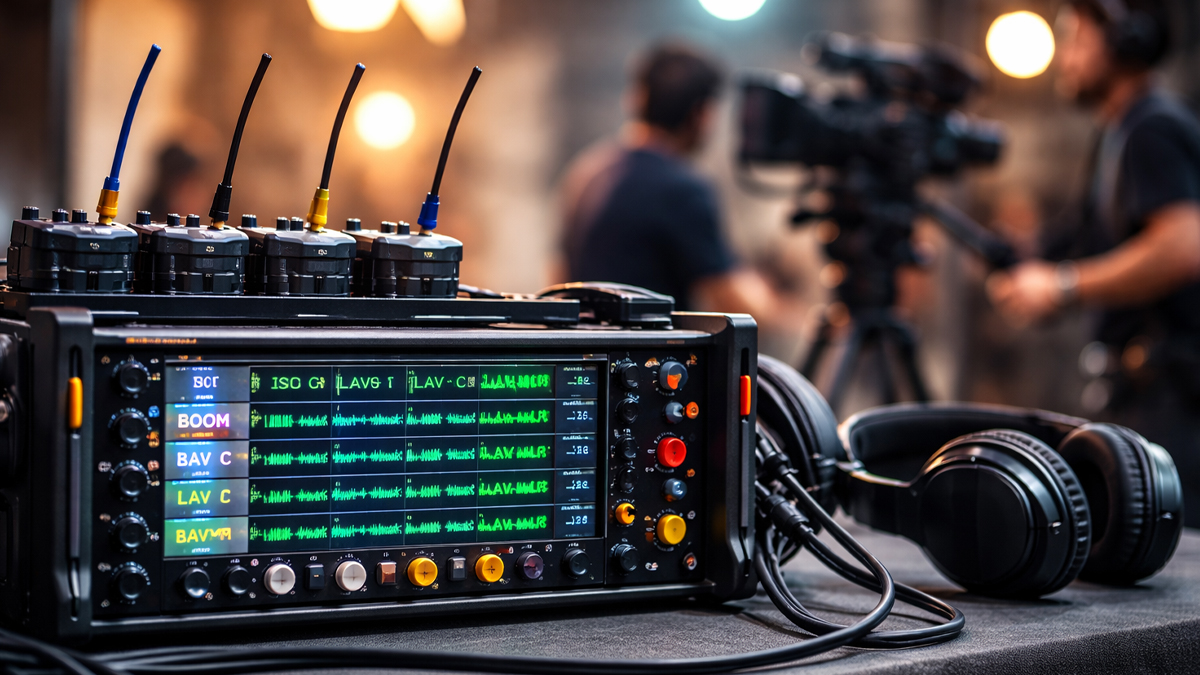
What is ISO Audio Track?
Core idea: An ISO Audio Track is an isolated audio recording of a single microphone or a single audio source captured on set, kept separate from other microphones instead of being blended into one combined track.
Why it is called ISO: ISO is short for isolated. In cinema sound, isolated means each microphone signal is recorded on its own track so it can be edited, cleaned, and mixed later with maximum control.
How it differs from a mix track: A mix track is a live blend made during filming, where multiple microphones are combined into one track, often mono or stereo. An ISO track keeps every mic separate. Many productions record both at the same time, because the mix track is helpful for quick review, while ISO tracks are essential for detailed post production work.
Where ISO tracks live: ISO tracks are usually recorded inside a multitrack audio file, often a Broadcast Wave file with multiple channels. Each channel corresponds to a different mic, such as a boom mic, a lavalier mic on an actor, or a plant mic hidden on set.
Why ISO tracks matter: On a film set, microphones capture many things at once. Clothing rustle, background noise, overlapping dialogue, and room reflections can vary wildly from mic to mic. ISO tracks give the sound team and post production team the freedom to choose the cleanest mic for each line and build a polished final soundtrack.
How does ISO Audio Track Work?
Signal path: A microphone captures sound and turns it into an electrical signal. That signal goes through a preamp, then into a field recorder or mixer recorder. The recorder assigns that signal to a dedicated track, creating an isolated recording for that mic.
Track assignment: Each microphone input on the recorder is routed to its own channel. For example, boom mic goes to one channel, Actor A lavalier goes to another channel, Actor B lavalier goes to another channel, and so on. Each channel is recorded independently.
Simultaneous recording with a production mix: Many sound teams record ISO tracks and also record a mix track at the same time. The mix track is a quick blend for playback and for editorial reference. The ISO tracks are the raw materials for dialogue editing and final mixing.
Sync with picture: ISO tracks are synchronized to the camera footage using timecode, slate clap, or both. Timecode keeps audio and video aligned over long takes. The slate clap provides a clear sync point and a visual and audible reference.
Metadata and labeling: Professional recorders embed metadata such as scene number, take number, date, timecode, and track names. Track names might indicate the mic type and the talent name. Good metadata is a major reason ISO tracks stay usable and searchable in post production.
What happens after filming: The sound team delivers audio files to post production. The assistant editor or sound team ingests them into the editing system, confirms sync, and organizes tracks so that dialogue editors can work quickly. Later, the re recording mixer uses these isolated sources to build the final mix.
What are the Components of ISO Audio Tracks
Microphones: ISO tracks start with microphones. Common types include boom microphones, lavalier microphones, plant microphones, and sometimes handheld microphones. Each mic captures a different perspective and has different strengths.
Wireless systems: Lavalier microphones often run through wireless transmitters and receivers. The receiver output feeds the recorder, creating a dedicated ISO track for that lavalier.
Preamps: Preamps boost the mic signal to a usable level. Clean, low noise preamps help ensure the ISO track has good clarity and enough headroom.
Field mixer or mixer recorder: Many cinema sound setups use a mixer recorder that can both mix and record. It takes multiple mic inputs, provides monitoring and level control, and records each input as its own ISO track.
Multitrack recorder: A multitrack recorder captures many channels at once, often as a polyphonic audio file. This is the device that actually writes the isolated tracks to storage.
Timecode generator and sync system: Timecode keeps audio aligned with camera. Some recorders have built in timecode. Others use external timecode boxes attached to camera and recorder.
Storage media: ISO tracks generate large amounts of data. Recorders write to SD cards, SSDs, or other media. Productions often keep backups and follow strict data handling rules.
Monitoring tools: Headphones, headphone amplifiers, and sometimes on set speakers help the sound team verify the quality of each ISO track. Monitoring is crucial because problems like distortion, radio interference, and clothing noise can ruin a take.
Cables and power: Reliable cables, balanced connections, batteries, and power distribution are practical components that keep ISO recording stable through long shooting days.
Sound reports and documentation: Sound reports list scene and take details, mic assignments, notes about noise issues, and track naming. These reports help post production understand what each ISO track contains.
What are the Types of ISO Audio Tracks
Boom ISO track: This isolated track comes from the boom microphone, usually a shotgun mic outdoors or a hypercardioid indoors. Boom audio often sounds natural and matches the camera perspective, but it can be affected by distance and room reflections.
Lavalier ISO track: This isolated track comes from a lavalier mic placed on an actor. It is close to the mouth, so it can be very clear, but it can suffer from clothing rustle and a slightly less natural tone.
Plant mic ISO track: A plant mic is hidden on set, such as in a lamp shade, behind a picture frame, or near a table. Plant ISO tracks can rescue dialogue when boom coverage is difficult.
Handheld mic ISO track: Some scenes, such as concerts, interviews, or press events, use handheld microphones. The isolated recording helps retain clean voice capture even in loud environments.
Stereo ambience ISO track: Some productions record ambience or room tone in stereo, sometimes as dedicated isolated channels. These tracks help create smooth transitions and realistic backgrounds in the final mix.
Music playback reference ISO track: When a scene involves playback music, a reference feed may be recorded as an isolated track to help sync performance and guide post production.
IFB and communications reference tracks: In certain workflows, production communication feeds might be recorded for reference. These are usually not part of the final mix, but they can help diagnose issues or confirm cues.
Safety ISO track: Some sound teams record a lower level safety track for critical dialogue to protect against sudden loudness or clipping. This provides a backup if the main track distorts.
What are the Applications of ISO Audio Tracks
Dialogue editing: ISO tracks are the foundation of dialogue editing. Editors can choose the cleanest mic for each line, remove unwanted noise, and create smooth dialogue continuity.
Noise reduction and restoration: Isolated tracks allow precise cleanup. It is easier to remove hiss, hum, clothing rustle, and background noise when the dialogue is not already mixed with other mics.
Mic selection for best performance: Different mics capture different emotional detail. A lavalier might capture intimate whispers, while a boom might capture a more natural room sound. ISO tracks let the mixer pick what best serves the scene.
ADR decision making: Automated Dialogue Replacement is used when location audio is not usable. ISO tracks help determine whether ADR is necessary and which parts can be saved with cleanup.
Multilingual versions and dubbing: ISO tracks improve clarity for dubbing and localization teams. Clear dialogue sources support better translation timing and more natural voice matching.
Music and effects mixing: When dialogue is clean and controlled, the music and effects can be mixed more creatively. ISO dialogue helps ensure speech stays intelligible without crushing the rest of the soundtrack.
Broadcast and streaming deliverables: Many deliverables require dialogue stems, music stems, effects stems, and sometimes separate dialogue and narration versions. ISO tracks make it easier to create these stems accurately.
Immersive and spatial audio workflows: As immersive formats grow, clean dialogue sources become even more valuable. ISO tracks allow dialogue placement and spatial treatment without dragging along unwanted noise.
Archiving and future remastering: Long after release, films may be remastered for new formats. Well preserved ISO tracks give future teams the raw material needed for improved mixes.
What is the Role of ISO Audio Tracks in Cinema Industry
Quality control on set: ISO recording encourages careful mic placement and monitoring. It helps the production sound team capture options, not just a single combined result.
Protection against unpredictable environments: Film sets can be noisy. Traffic, generators, crowds, wind, and wardrobe noise can change quickly. ISO tracks provide multiple chances to save dialogue because one mic might be cleaner than another.
Speed and flexibility in post production: Post production schedules can be tight. ISO tracks speed up editing because dialogue editors can instantly audition mic choices and build clean dialogue tracks without begging for missing sources.
Better storytelling through sound: Sound supports emotion and clarity. ISO tracks let the sound team shape dialogue tone, intimacy, and space in a way that serves the story.
Collaboration across departments: Picture editors, assistant editors, dialogue editors, sound designers, and re recording mixers all benefit from isolated sources. ISO tracks create a common, reliable audio foundation for everyone.
Reduced risk of costly reshoots: If dialogue is unusable, reshoots can be expensive. ISO tracks reduce that risk by capturing multiple clean sources and giving post production more rescue options.
Industry standard workflow: Modern cinema production expects ISO tracks as part of professional audio deliverables. Many post houses assume they will receive a mix track plus all ISO tracks, properly labeled and timecode synced.
What are the Objectives of ISO Audio Tracks
Capture clean dialogue options: The main objective is to capture usable dialogue with multiple mic choices so that the best sounding source can be selected later.
Maintain separation of sources: Isolation prevents one mic from contaminating another in the recording stage. Even though microphones will still pick up some bleed in the real world, keeping tracks separate preserves control.
Support detailed editing: The objective is to enable surgical editing, including removing coughs, adjusting timing, reducing noise, and smoothing transitions.
Preserve performance authenticity: Great acting moments happen once. ISO tracks aim to preserve those moments with the highest possible clarity and flexibility.
Improve mix accuracy: With isolated tracks, the final mix can balance dialogue, music, and effects more accurately because dialogue can be shaped without heavy compromise.
Reduce reliance on ADR: Another objective is to minimize ADR by making as much original location dialogue usable as possible.
Enable consistent deliverables: ISO tracks help create dialogue stems, international versions, and platform specific mixes, all of which rely on clean separation.
Make troubleshooting easier: If an issue occurs, isolated tracks help identify the cause. For example, if only one lavalier has interference, it can be addressed without damaging the rest of the audio.
What are the Benefits of ISO Audio Tracks
More control in post production: Editors and mixers can pick the best microphone for every word and every moment.
Cleaner dialogue: Because each mic is isolated, cleanup tools work better and dialogue can be made clearer without unwanted artifacts.
Better continuity: If one take has boom noise and another has lavalier rustle, ISO tracks allow editors to blend sources and maintain consistent tone across cuts.
Improved dynamic range management: Isolated tracks can be leveled, compressed, or de essed independently, leading to a more natural sound.
Faster problem solving: Issues like distortion, RF hits, or clothing noise can be isolated and repaired on the affected track instead of ruining everything.
Greater creative freedom: Sound teams can decide how close, how intimate, or how spacious the dialogue should feel, and they can change that choice during the story.
Stronger collaboration: Post production teams work more efficiently when they have well organized ISO tracks with clear labels and timecode.
Higher overall production value: Clear dialogue is one of the biggest markers of professional cinema sound. ISO tracks help deliver that clarity consistently.
What are the Features of ISO Audio Tracks
One microphone per track: The defining feature is that each mic gets its own dedicated recording channel.
Simultaneous multichannel recording: ISO workflows capture many tracks at the same time, often alongside a separate mix track.
Timecode synchronization: ISO tracks are typically timecode stamped so they align perfectly with the camera footage.
Metadata rich files: Professional ISO recordings include scene, take, roll, and track name information inside the audio files, making post production organization easier.
High resolution audio: ISO tracks are often recorded at professional standards such as 24 bit depth and 48 kHz or higher sample rates, depending on production requirements.
Track naming conventions: ISO track names may include mic type and talent name, which reduces confusion and speeds up editing.
Pre fader and post fader options: Depending on workflow, ISO tracks may be recorded pre fader for maximum raw integrity, while the mix track reflects fader moves for monitoring and reference.
Safety recording possibilities: Some systems allow dual recording levels or backup media recording to protect against data loss and clipping.
Compatibility with post production tools: ISO audio files are designed to ingest smoothly into editing and mixing software, supporting workflows from offline editorial to final mixing.
What are the Examples of ISO Audio Tracks
Two actor dialogue scene: Actor A lavalier is recorded as one ISO track, Actor B lavalier as another ISO track, and the boom mic as another ISO track. In post, the editor uses the boom for most lines and switches to lavalier when the boom has room echo or misses a line.
Crowded street scene: The boom captures too much traffic. The lavalier ISO tracks are cleaner. The dialogue editor relies on lavalier tracks for intelligibility, then adds controlled ambience and room matching to keep the scene natural.
Restaurant scene with clatter: Plates and cutlery create sharp transient noise. A plant mic near the table is recorded as its own ISO track. Post production uses it selectively to fill gaps when lavalier rustle becomes noticeable.
Action scene with heavy movement: Clothing noise is common on lavaliers. The boom ISO track may be cleaner for certain lines, while lavalier ISO tracks provide backup for lines where the boom is too far away.
Musical performance scene: A feed from playback or instrument microphones can be recorded as separate isolated channels. This helps the music editor sync performance accurately while keeping dialogue and crowd noise separate.
Documentary style interview: Each speaker mic is recorded as its own ISO track. This allows clean editing when people overlap, and it supports creating versions with different language dubs or captions.
Multi camera reality style scene: Several lavaliers and multiple booms may be recorded at once. ISO tracks allow the editor to choose the best sources depending on which camera angle is used and where the subject is positioned.
What is the Definition of ISO Audio Tracks
Technical definition: ISO Audio Tracks are independent audio recordings where each track contains the signal from a single microphone or a single audio source, captured separately during production to preserve control for post production editing and mixing.
Workflow definition: ISO Audio Tracks are the raw production audio elements delivered to post production alongside or in addition to a production mix, organized by timecode and metadata so they can be synced, edited, restored, and mixed into the final soundtrack.
Practical definition: ISO Audio Tracks are separate mic recordings that give the sound team options, enabling cleaner dialogue and better overall sound quality in the final film.
What is the Meaning of ISO Audio Tracks
Meaning in simple terms: ISO Audio Tracks mean each microphone gets its own lane. Instead of mixing everything together during filming, the sound team captures each mic separately so the best audio can be chosen later.
Meaning for filmmakers: ISO Audio Tracks mean fewer audio disasters. If one mic has a problem, another mic might be usable. That reduces risk and improves final quality.
Meaning for editors: ISO Audio Tracks mean freedom. Editors can cut dialogue cleanly, remove noise more precisely, and match audio across different shots and takes.
Meaning for audiences: ISO Audio Tracks mean clearer dialogue, more immersive sound, and a more professional viewing experience, even if the audience never realizes why it sounds better.
What is the Future of ISO Audio Tracks
Smarter metadata and automation: Future ISO workflows will likely include richer metadata, such as automatic speaker identification, mic position notes, and environment tagging. This can speed up dialogue editing and improve organization.
AI assisted dialogue assembly: Machine learning tools can help automatically select the best mic for each line, detect noise issues, and propose edits. Human sound editors will still make final creative decisions, but AI can reduce repetitive work.
Improved wireless reliability: Wireless systems are continually evolving with better frequency management, lower latency, and higher fidelity. Cleaner wireless capture means cleaner lavalier ISO tracks.
More integrated on set and post workflows: Cloud based collaboration and faster data transfer can allow post production teams to begin organizing and syncing ISO tracks earlier, sometimes even while filming is still in progress.
Immersive audio expectations: As immersive formats become more common, clean dialogue sources will remain critical. ISO tracks will support advanced spatial placement and better separation between dialogue and environmental sound.
Higher channel counts: Productions are using more microphones and more complex setups. Recorders and workflows will continue expanding to handle higher track counts without sacrificing reliability.
Enhanced quality control tools: Future recorders may provide more intelligent warnings for clipping, RF hits, and clothing noise, helping sound teams correct problems immediately and protect ISO track quality.
Archival and remastering value: As cinema libraries are remixed for new platforms, ISO tracks will become even more valuable. The industry will likely place even more emphasis on proper archiving and standardized delivery practices.
Summary
- ISO Audio Tracks are isolated recordings of individual microphones or sources captured separately for maximum control in post-production.
- They usually record alongside a mix track and stay synchronized with video using timecode and slate reference.
- Key components include microphones, wireless systems, preamps, mixer recorders, timecode tools, storage media, and clear documentation.
- Common ISO types include boom, lavalier, plant, ambience, safety tracks, and reference feeds depending on the scene.
- ISO tracks support dialogue editing, noise reduction, mic selection, ADR decisions, localization, and professional deliverables.
- In the cinema industry, ISO tracks reduce risk, improve workflow speed, and raise overall sound quality and clarity.
- The future points toward richer metadata, AI assisted editing, stronger wireless performance, and deeper integration between set and post workflows.

