

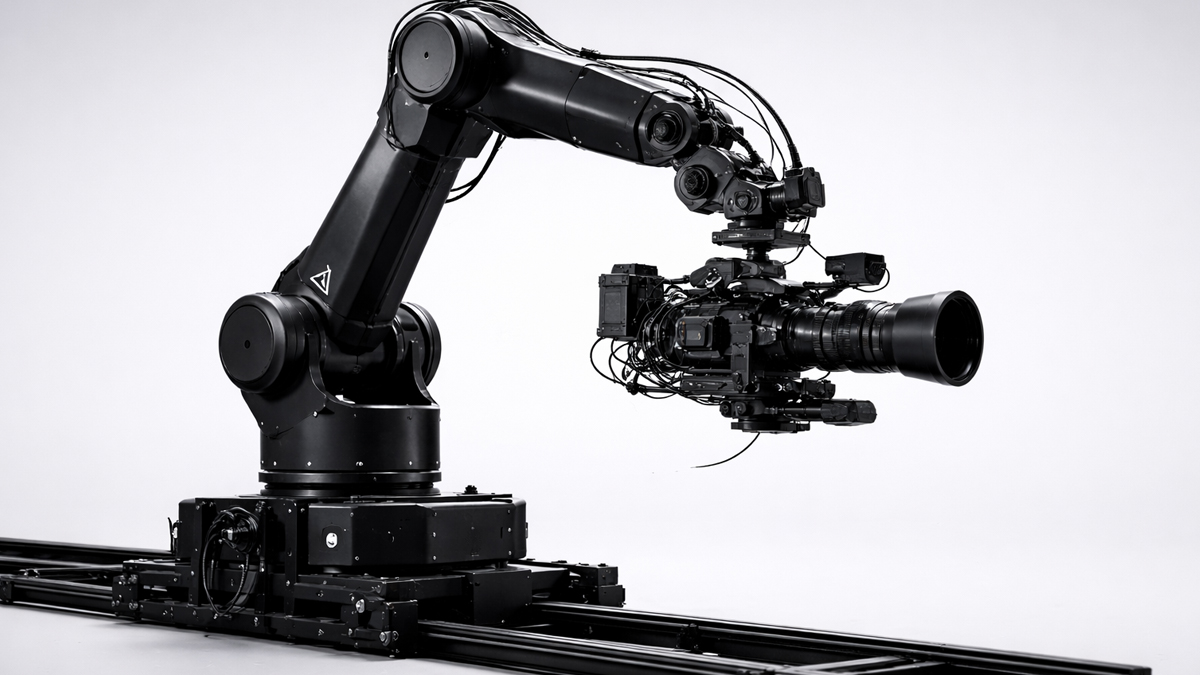
What is Motion Control Rig?
A Motion Control Rig is a robotic camera rig that moves a camera along a planned path with extremely high precision, and it can repeat that same movement again and again with near perfect accuracy. In cinema, this matters because many shots need the camera to travel in a smooth, controlled way while keeping the framing, focus, and timing consistent. A motion control system lets filmmakers program a camera move once, record the movement data, and then replay it as many times as needed.
At a basic level, the rig combines a mechanical structure (rails, arms, pan tilt heads, or cranes) with motorized drives and a computer controller. The controller tells each motor where to go, how fast to move, when to accelerate, and when to slow down. Because the movement is programmable and repeatable, it becomes possible to shoot multiple passes of the same scene, such as a clean plate, a pass with actors, a pass with practical effects, and a pass optimized for lighting or reflections. Later, these passes can be composited together in post production.
Motion control rigs are used for more than visual effects. They are also used for product films, tabletop cinematography, macro shots, time lapse sequences, and dynamic camera moves that require safety and precision. In short, motion control turns camera movement into something measurable, repeatable, and controllable like animation, but captured with a real camera in the real world.
How does Motion Control Rig Work?
Motion control works by converting a creative camera move into a set of exact instructions that motors can follow. The system starts with a mechanical platform that can move the camera in one or more axes. Common axes include slide (left to right), lift (up and down), pan (turning left or right), tilt (turning up or down), roll (rotating the camera), and sometimes focus, iris, and zoom control through lens motors.
Programming stage: The operator creates the move using one of several methods. One method is keyframe programming, where the operator sets important positions and times, and the system calculates the smooth path between them. Another method is teach and repeat, where the operator physically guides the rig or uses a joystick to perform the move once, and the system records the motion. A more advanced method is importing motion data from animation or 3D software so the physical camera move matches a virtual camera.
Control stage: After the move is programmed, the controller translates the planned path into motor commands. Each motor has an encoder that reports its position back to the controller. This feedback loop helps the system correct small errors and maintain accuracy. The controller also manages speed profiles so the camera does not jerk or vibrate. Smooth acceleration and deceleration are important for cinematic motion.
Synchronization stage: In cinema, motion control often needs to synchronize with other systems. The rig can be synced with the camera shutter, frame rate, lighting cues, turntables, or even moving props. This synchronization ensures that every take aligns perfectly in time, which is crucial for compositing and for matching action across repeated passes.
Playback stage: The move is executed, and the system can replay it with the same timing and positions. If the filmmaker needs a slight adjustment, the operator can offset the starting point, change the speed, or fine tune keyframes. Because the move is data driven, small changes can be made without losing repeatability.
What are the Components of Motion Control Rig?
A motion control rig is built from several core parts that work together as one system. Each part affects performance, stability, and repeatability.
Mechanical structure: The physical frame that supports the camera and defines the movement style. This might be a slider on rails, a crane, a robotic arm, or a hybrid system. The structure must be stiff and stable to reduce vibration.
Drive system: The motors and transmission parts that create movement. Common options include stepper motors or servo motors. Transmission can use belts, gears, lead screws, or direct drive. The choice affects speed, torque, smoothness, and noise.
Motion axes modules: The individual movement units such as a dolly axis for travel, a lift axis for vertical motion, and a pan tilt head for rotation. Some rigs are modular so axes can be added or removed depending on the shot.
Encoders and sensors: Devices that measure position and sometimes speed. Encoders provide feedback so the controller knows where each axis is at all times. Additional sensors can include limit switches for safety and home position calibration.
Controller unit: The brain of the rig. It runs the motion control software, stores motion paths, and sends commands to motors. Controllers also manage safety rules, speed limits, and axis coordination.
Software interface: The user interface used to program and monitor moves. It can be a dedicated control panel, a computer application, or a tablet based interface. Good software allows keyframes, curves, easing, loop playback, and timeline control.
Power system: Motors and controllers need stable power. On sets, power may come from mains electricity, generators, or battery systems. Clean power matters because voltage drops can cause errors or reduced motor performance.
Camera mounting and balancing: Plates, cages, and mounts keep the camera secure. Balancing reduces strain on motors and helps produce smoother moves, especially on pan tilt heads and robotic arms.
Lens and focus control: Many motion control setups include follow focus motors and lens control units. This allows focus pulls and zoom moves that repeat perfectly across takes.
Data and synchronization tools: Timecode devices, trigger boxes, and camera control cables help the rig sync with the camera and other equipment. Some systems record metadata for post production.
Safety components: Emergency stop buttons, axis limits, collision zones, and physical guards protect crew and equipment. On powerful rigs, safety planning is essential.
What are the Types of Motion Control Rig?
Motion control rigs come in different forms depending on the type of movement, payload, and shooting environment. Each type fits specific cinematic needs.
Slider based motion control: A motorized slider moves the camera along a straight line. It is popular for interviews, product shots, and small cinematic moves. It can be portable and quick to set up.
Dolly and track motion control: A larger system where a camera dolly moves along track. It supports heavier cameras and longer travel distances. It is used for complex passes and wide set moves.
Crane and jib motion control: A motorized crane provides sweeping vertical and horizontal arcs. It is useful for dramatic rising shots, overhead moves, and large parallax changes.
Pan tilt head motion control: A motorized head controls rotation. It can be mounted on a tripod, crane, car rig, or slider. It is often combined with other axes for richer motion.
Robotic arm motion control: A multi axis robotic arm provides highly flexible movement with many degrees of freedom. It can do fast, precise moves and repeat them accurately. It is common in VFX work, tabletop, and dynamic commercial shots.
Gantry motion control: A rig that moves on an overhead frame, often with X and Y travel and sometimes Z movement. It can cover a large area and is used for studio work, stage productions, and controlled environments.
Turntable and product motion control: A motorized turntable rotates an object while the camera stays fixed or also moves. It is widely used in product cinematography and VFX scanning style workflows.
Cable cam motion control: A camera travels along cables with motorized control. Some systems can repeat moves in controlled setups, useful for action and large spaces where track is difficult.
Hybrid systems: Many professional setups combine a dolly axis with a lift column and a pan tilt head, or combine a slider with a robotic head and lens motors. Hybrid designs are common because they provide flexibility without the full complexity of a robotic arm.
What are the Applications of Motion Control Rig?
Motion control is used across many areas of filmmaking and content production. The common thread is the need for precise, repeatable movement.
Visual effects and compositing: Multiple passes of the same move can be combined. This supports split screens, set extensions, matte paintings, miniature work, and complex element layering.
Repeatable action takes: When a stunt or effect must align with camera movement, repeatability helps. A rig can run the same move while different elements change in the scene.
Tabletop and product cinematography: Motion control gives smooth macro moves and consistent timing. It helps create premium product visuals, such as liquid pours, packaging reveals, and beauty shots.
Time lapse with movement: A motion control slider can move a little between frames, creating motion time lapse that feels cinematic and dimensional.
Matchmoving and CG integration: When the camera move is known and repeatable, it becomes easier to align CG elements with live action. Some systems export motion data for 3D software pipelines.
Miniatures and model shots: Motion control has a strong history in miniature photography because it makes scale feel believable. Smooth, repeatable moves help sell the illusion.
Virtual production and LED stages: Motion control can synchronize camera movement with background playback, tracking, and lighting cues. Even when real time tracking is used, motion control remains useful for repeatable plate capture.
Motion design style live action: Creative teams can treat the camera move like a designed animation, with exact beats and rhythm. This is useful for title sequences and stylized transitions.
Multi camera and multi pass lighting tests: For controlled testing, the same movement can be recorded while changing lighting setups, lens choices, or exposure settings.
Education and research filming: Repeatable movement supports controlled experiments, documentation, and scientific imaging where consistent framing matters.
What is the Role of Motion Control Rig in Cinema Industry?
Motion control rigs play a key role in modern cinema because they bridge creative camera movement and technical precision. They help filmmakers achieve shots that would be difficult, risky, or impossible to perform consistently by hand.
Enabling complex visual effects: Many cinema level VFX shots depend on multiple perfectly aligned passes. Motion control makes this workflow reliable, reducing alignment errors and saving time in post production.
Improving consistency across takes: Even without heavy VFX, continuity matters. Motion control helps maintain consistent framing and timing, especially for scenes that require multiple takes with the same camera move.
Expanding creative language: Cinematography often relies on movement to express emotion and energy. With motion control, the camera can move with designed precision, creating shots that feel choreographed and intentional.
Supporting high end commercial and studio production: The cinema industry includes feature films, streaming series, and premium advertising. Motion control is widely used in all of these to achieve polished visuals.
Increasing safety and control: Certain shots involve explosions, flying debris, or fast moving objects. With motion control, the move can be planned and executed without placing a camera operator in danger.
Integrating with digital workflows: Modern productions rely on metadata, camera tracking, and 3D pipelines. Motion control fits naturally because it produces structured motion data and consistent repeatable results.
Efficiency on set: While setup can take time, motion control often reduces reshoots and post production fixes because the movement is controlled and predictable. On a large production, that reliability can be valuable.
What are the Objectives of Motion Control Rig?
The objectives of a motion control rig in cinematic technologies are clear and practical. It aims to deliver repeatable precision while still serving creative storytelling.
Repeatability objective: The rig should reproduce the same move with the same timing across many takes and passes.
Precision objective: The rig should hit exact positions and maintain smooth motion without drift, wobble, or visible vibration.
Creative control objective: The system should let filmmakers design moves that match the story tone, pacing, and visual style.
Synchronization objective: The rig should align movement with camera triggering, lighting cues, and other timed events.
Efficiency objective: The rig should reduce trial and error by allowing planned motion, saved presets, and quick playback adjustments.
Safety objective: The rig should include predictable behavior and emergency controls that reduce risk to people and equipment.
Data objective: The rig should store and export motion information for post production, matchmoving, or virtual camera recreation.
Scalability objective: The rig should support different camera sizes and shot types, from small mirrorless setups to heavier cinema cameras depending on the system.
What are the Benefits of Motion Control Rig?
Motion control rigs bring a mix of artistic and practical benefits to cinema production.
Perfectly repeatable moves: This is the signature benefit. Repeatability supports multi pass compositing and consistent coverage.
Higher production value: Smooth, precise motion often looks more premium. It can make even simple subjects feel cinematic.
Better VFX results: When passes align, compositing becomes easier and cleaner. This can reduce post production cost and time.
Reduced reshoots: Predictable movement lowers the chance of continuity errors that force reshoots.
Creative freedom with confidence: Filmmakers can plan ambitious moves knowing they can repeat and refine them without losing alignment.
Safer shooting for hazardous scenes: The camera can be positioned and moved remotely, which reduces risk.
Consistent timing for performance and effects: If an effect must happen at an exact frame, the rig helps hit that timing reliably.
Improved teamwork across departments: Camera, VFX, lighting, and art departments can coordinate around a known camera path, making planning easier.
Useful for small teams too: Compact motion control sliders and heads make controlled motion accessible to smaller productions, not only big studios.
What are the Features of Motion Control Rig?
A strong motion control rig includes features that support real world production needs, not just movement.
Programmable keyframes: The operator can set start and end positions and add intermediate points for complex paths.
Ease curves and smooth ramps: The system supports natural looking acceleration and deceleration for cinematic motion.
Multi axis coordination: Several axes can move together smoothly so the camera path feels fluid and intentional.
Save and recall moves: Moves can be stored, named, and recalled, which helps on multi day shoots.
Loop playback and previews: The rig can run the move repeatedly for rehearsal, lighting checks, and timing review.
Motion scaling and offsets: Operators can adjust speed, travel distance, or starting position while keeping the move shape similar.
Camera trigger control: The rig can trigger the camera for stop motion, time lapse, or frame accurate capture.
Lens control integration: Focus, zoom, and iris can be automated and repeated for consistent lens behavior.
Exportable motion data: Many systems can export motion paths for post production, matchmoving, or 3D workflows.
Safety limits and emergency stop: The rig can enforce axis limits, speed caps, and instant shutdown controls.
Remote operation: Operators can control the rig from a safe distance, which helps on tight sets or hazardous scenes.
Payload management: Advanced systems offer tuning for different camera weights to keep motion stable.
What are the Examples of Motion Control Rig?
Motion control rigs appear in many recognizable cinematic scenarios. The examples below show how the technology is used in practice.
VFX split screen dialogue: A single actor plays multiple characters in the same scene. The camera move repeats exactly for each performance pass, then the shots are combined.
Miniature spaceship flyby: A model is filmed with a precise moving camera to create a realistic sense of scale. Multiple passes capture different lighting and elements for compositing.
Product commercial with liquid and reflections: The camera move repeats while different passes capture liquid splash, label highlights, and clean reflections. These are composited into one polished shot.
Time lapse city skyline with parallax: A motorized slider moves slowly during a time lapse so buildings and clouds feel three dimensional instead of flat.
Match cut transitions: A designed camera move ends on a frame that can be matched with another scene. Repeatability helps the editor and VFX team align the cut.
Motion controlled explosion plate: The camera runs a programmed move while practical effects occur. A second clean pass without effects is captured for compositing and cleanup.
Title sequence style camera choreography: The camera moves with precise rhythm, often combined with motion graphics that track perfectly to the footage.
Virtual production plate capture: A scene on an LED stage is captured multiple times with identical motion to support different lighting or background versions.
What is the Definition of Motion Control Rig?
A Motion Control Rig is a motorized, computer controlled camera movement system designed to execute precise, programmable, and repeatable camera motions across one or more axes for cinematic production. It combines mechanical support, motion drives, sensors, and control software to create controlled camera movement that can be replayed consistently.
What is the Meaning of Motion Control Rig?
The meaning of Motion Control Rig in the cinema industry is simple: it means camera movement that can be measured, programmed, and repeated with accuracy. Instead of relying only on human muscle memory and manual operation, motion control treats camera motion as data. That data driven approach allows filmmakers to repeat the same move for multiple takes, multiple passes, and complex workflows where alignment and timing matter.
On a creative level, the meaning also includes reliability. A director and cinematographer can commit to a bold moving shot because they know they can reproduce it, refine it, and integrate it with visual effects if needed. Motion control turns the camera into a controlled performer on set, capable of repeating choreography with consistency.
What is the Future of Motion Control Rig?
The future of motion control in cinema is moving toward systems that are smarter, faster to set up, and more connected to digital production pipelines.
Smaller and more accessible systems: Compact motion control tools will continue to improve, making precise motion common even in small productions and creator studios.
Better integration with virtual production: Motion control will increasingly connect with real time tracking, LED stage workflows, and scene data so physical and virtual cameras match more easily.
AI assisted move design: Future software may help operators design smoother moves, avoid collisions, and suggest cinematic easing based on shot intent.
Improved automation for focus and lens behavior: Lens motors and camera metadata will become more tightly integrated, enabling repeatable focus pulls and zoom choreography with higher accuracy.
Cloud and network based collaboration: Motion paths and camera metadata may be shared across departments more easily, helping VFX and editorial teams start work sooner.
More advanced safety systems: As rigs become more powerful, safety features such as collision prediction, virtual safety zones, and automated slowdowns will become more common.
Higher precision with better stabilization: Improved encoders, motor control, and mechanical design will reduce micro vibration, especially for macro and high resolution capture.
Cross platform motion data standards: The industry may adopt more consistent ways to export and import motion control data between rigs and post production tools.
In the long run, motion control will likely become less of a special tool and more of a normal part of camera movement options, used whenever a production needs precision, repeatability, and confidence.
Summary
- Motion control rigs are robotic camera systems that create programmable and repeatable camera movement for cinema.
- They work by using motors, sensors, and a controller to execute a planned motion path with smooth timing.
- Key components include the mechanical structure, motors, encoders, controller, software, power, lens control, and safety systems.
- Types range from sliders and dollies to cranes, gantries, and multi axis robotic arms.
- Applications include VFX compositing, product cinematography, miniatures, motion time lapse, and matchmoving workflows.
- In the cinema industry, motion control improves creative control, continuity, safety, and integration with digital pipelines.
- The main objectives are repeatability, precision, synchronization, efficiency, safety, and usable motion data.
- The future will focus on easier setup, tighter virtual production integration, smarter software, and more accessible systems.

