

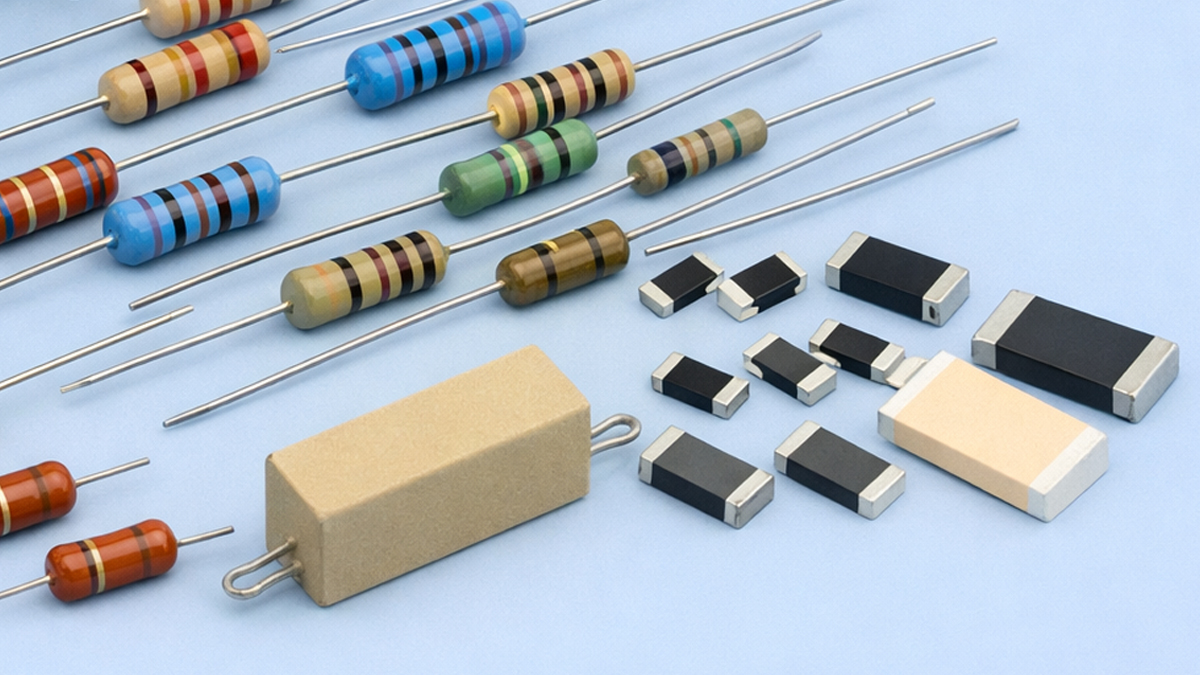
What is Ohm’s Law?
Ohm’s Law is one of the most important principles in electronics. It explains the relationship between voltage, current, and resistance in an electrical circuit. In simple words, it tells us how electricity behaves when it moves through a path that resists its flow. This idea is especially useful when working with resistors, because resistors are designed to control and limit electrical current.
Basic idea: Ohm’s Law states that voltage equals current multiplied by resistance. This is written as V = I × R. Here, V means voltage, I means current, and R means resistance. If you know any two of these values, you can calculate the third one. This makes Ohm’s Law a practical tool for students, technicians, engineers, and anyone involved in music electronics.
Importance in resistor study: Resistors are among the most common components in electronic devices used in the music industry. They help set levels, divide voltage, protect parts, reduce noise in some cases, and shape how signals behave. Ohm’s Law gives the mathematical foundation for understanding all of these functions. Without it, it would be very difficult to predict how a resistor will affect a circuit.
Connection to music electronics: In music equipment such as amplifiers, mixers, audio interfaces, synthesizers, pedals, microphones, and studio devices, electrical signals must be controlled very carefully. A signal that is too weak may create poor sound quality, and a signal that is too strong may cause distortion or damage. Ohm’s Law helps designers manage these signal and power conditions with accuracy.
Educational value: Ohm’s Law is often one of the first formulas taught in electronics because it is simple, logical, and useful. Once a learner understands it, many other concepts in audio electronics become easier to follow. It builds a bridge between theory and practical circuit work.
How does Ohm’s Law Work?
Ohm’s Law works by showing how three electrical quantities affect one another. When voltage increases while resistance stays the same, current increases. When resistance increases while voltage stays the same, current decreases. This simple relationship helps explain the behavior of many circuits found in music electronics.
Voltage and electrical push: Voltage can be understood as the force that pushes electric charge through a circuit. In audio devices, voltage may come from a battery, power supply, or signal source. A higher voltage generally pushes more current through a resistor if the resistance remains unchanged.
Resistance and opposition: Resistance is the opposition to the flow of current. A resistor adds controlled resistance to a circuit. If the resistor value is high, it allows less current to pass. If the resistor value is low, it allows more current to pass. This is why resistor selection is so important in audio design.
Current and flow: Current is the movement of electric charge through a conductor or component. In circuits used in music equipment, current must often be kept within safe and useful limits. Too much current can overheat parts. Too little current can make a circuit fail to perform as intended.
Practical calculation: If a pedal circuit has a 9 volt supply and a resistor of 1000 ohms, the current is 9 divided by 1000, which equals 0.009 amperes, or 9 milliamperes. This is a direct use of Ohm’s Law. In the same way, if you know current and resistance, you can calculate voltage. If you know voltage and current, you can calculate resistance.
Real circuit understanding: In music electronics, Ohm’s Law is used in bias networks, LED indicators, input and output protection, voltage dividers, tone shaping sections, and many other areas. It works as a guide that helps a designer know how a circuit will respond before it is built.
What are the Components of Ohm’s Law?
Ohm’s Law is built around three main electrical components or quantities. These are voltage, current, and resistance. Understanding each one clearly is necessary for correct circuit analysis and design.
Voltage: Voltage is the electrical potential difference between two points. It is measured in volts. In music electronics, voltage can appear as supply voltage, signal voltage, or bias voltage. A guitar pedal battery may provide 9 volts, while a professional audio device may use higher or multiple supply levels. Voltage is what drives the electrical movement in a circuit.
Current: Current is the rate of flow of electric charge. It is measured in amperes, often shortened to amps. In small audio circuits, current is often measured in milliamperes. Current matters because electronic components operate safely only within certain limits. Designers use Ohm’s Law to ensure that current stays at an appropriate level.
Resistance: Resistance is the property that opposes current flow. It is measured in ohms. A resistor is the physical component that provides a chosen amount of resistance. In music electronics, resistor values can range from a few ohms to millions of ohms depending on the circuit purpose. Small resistor changes can affect gain, tone, timing, and signal level.
Formula relationship: The formula V = I × R connects all three quantities. Rearranging the formula gives I = V ÷ R and R = V ÷ I. These three forms are all based on the same law. They simply allow the user to solve for the unknown value.
Measurement tools: Although the law itself is theoretical, it becomes practical when used with tools like multimeters, oscilloscopes, and circuit testers. A technician can measure voltage and resistance, then estimate current. This helps during troubleshooting and maintenance of music equipment.
What are the Types of Ohm’s Law?
Strictly speaking, Ohm’s Law is a single law, not a group of separate laws. However, in practical teaching and circuit work, people often talk about different forms or uses of Ohm’s Law. These forms help apply the same principle in different situations.
Voltage form: The most familiar form is V = I × R. This form is used when current and resistance are known, and voltage needs to be found. In audio circuits, this is useful when calculating the voltage drop across a resistor.
Current form: The second common form is I = V ÷ R. This form is used when voltage and resistance are known, and current needs to be found. It is one of the most frequently used forms in practical electronics because current control is very important in circuit safety and performance.
Resistance form: The third form is R = V ÷ I. This form is used when voltage and current are known, and the needed resistance must be calculated. It helps when choosing the correct resistor value during circuit design or repair.
Direct current use: Ohm’s Law is easiest to apply in direct current circuits, where voltage and current remain stable and flow in a steady direction. Many small sections of music electronics, especially power and bias areas, can be studied this way.
Alternating current approximation: In audio work, signals are often alternating current by nature. While full alternating current analysis may involve additional ideas such as impedance and phase, the basic thinking of Ohm’s Law still provides a starting point. For simple resistive sections, the law remains directly useful.
Series and parallel applications: Ohm’s Law is also applied in series circuits and parallel circuits. In a series path, total resistance affects the same current throughout the path. In a parallel structure, voltage remains common across branches, and current divides according to resistance values. These practical settings often shape how the law is taught and used.
What are the Applications of Ohm’s Law?
Ohm’s Law has many applications in electronics, and these become especially important in equipment used for sound creation, recording, processing, and reproduction. It is not just a classroom formula. It is a daily working tool.
Resistor selection: One of the most direct applications is choosing the right resistor value. If a circuit needs a certain current from a known voltage source, Ohm’s Law helps determine the resistor needed. This is useful in LED indicator circuits, signal routing, and protection networks.
Voltage division: Many music devices use voltage dividers to create reference voltages or reduce signal levels. A voltage divider uses resistors to split voltage in a controlled way. Ohm’s Law helps calculate how much voltage appears across each resistor.
Current limiting: Components such as LEDs, transistors, and integrated circuits may need current limiting to avoid damage. A resistor is often placed in series with the component. Ohm’s Law allows the designer to calculate the correct resistor value for safe operation.
Power supply design: Stable power is essential in audio equipment. Ohm’s Law helps calculate current draw, voltage drops, and resistor values inside regulation and filtering sections. This improves reliability and reduces noise issues.
Signal attenuation: In audio electronics, signal levels often need to be reduced without severe quality loss. Resistor networks can attenuate a signal, and Ohm’s Law helps calculate how much reduction will occur.
Troubleshooting: During repair work, a technician may measure a voltage that seems too low or too high. By applying Ohm’s Law, it becomes possible to identify whether a resistor has failed, whether a short circuit is present, or whether a component is drawing too much current.
Speaker and load analysis: Although speakers involve more than simple resistance, basic resistance measurements and simple current calculations can still help in understanding load conditions. This is useful during basic equipment checks and rough analysis.
What is the Role of Ohm’s Law in Music Industry?
Ohm’s Law plays a quiet but powerful role in the music industry because modern music depends heavily on electronics. Every stage of sound production involves devices that rely on controlled electrical behavior.
Instrument electronics: Electric guitars, basses, keyboards, and synthesizers use circuits that depend on resistors and controlled voltage paths. Volume controls, tone sections, pickup loading, and signal conditioning are all influenced by resistor behavior that can be studied through Ohm’s Law.
Audio processing gear: Effects pedals, compressors, equalizers, preamps, and channel strips all use resistor networks. These networks help set gain, shape frequency response, create bias conditions, and manage input and output levels. Ohm’s Law helps designers predict and refine these functions.
Recording systems: Studio equipment such as microphone preamps, mixers, interfaces, and monitor controllers must maintain clean and stable electrical conditions. Unwanted noise, distortion, or imbalance can reduce recording quality. Ohm’s Law helps designers maintain proper circuit values so that signals remain strong and controlled.
Live sound systems: In concert environments, amplifiers, powered speakers, signal processors, and stage electronics must work reliably under pressure. Understanding voltage, current, and resistance helps technicians protect equipment and diagnose problems quickly.
Manufacturing and innovation: Companies that make music equipment depend on accurate circuit design. Ohm’s Law is one of the basic tools used in product development, testing, and quality control. Even highly advanced digital music devices still contain power sections and analog components where this law remains relevant.
Education and training: The music industry needs engineers, technicians, repair specialists, and designers. Ohm’s Law is part of the foundation of their training. It allows people to move from simple repair work to deeper design understanding.
What are the Objectives of Ohm’s Law?
Ohm’s Law itself is a natural relationship rather than a human plan, but in education and practical electronics, it serves several important objectives. These objectives help explain why it is taught and used so widely.
Understanding circuit behavior: One major objective is to help learners and professionals understand how electrical circuits respond under different conditions. When voltage changes, current changes. When resistance changes, current also changes. This creates a predictable model.
Supporting safe design: Another objective is to support safe and reliable circuit design. By using Ohm’s Law, designers can avoid giving components too much current or too much voltage stress. This helps protect both the circuit and the user.
Improving accuracy: Music electronics often requires precise control over signal level, component bias, and current flow. Ohm’s Law helps improve design accuracy because it gives exact numerical relationships rather than guesswork.
Helping diagnosis: In repair and maintenance, one objective is to find faults efficiently. Ohm’s Law allows a technician to compare expected values with actual measurements. This can reveal damaged resistors, wrong supply levels, or abnormal current paths.
Building educational confidence: For students, a key objective is to develop confidence in basic electronics. Once a learner understands Ohm’s Law, other ideas such as power, impedance, and signal conditioning become easier to grasp.
Connecting theory and practice: It also serves the objective of linking mathematical knowledge with real devices. Learners can calculate a value on paper and then verify it in an actual circuit. This reinforces understanding and supports practical skill development.
What are the Benefits of Ohm’s Law?
Ohm’s Law offers many benefits because it makes electronics easier to understand, design, and maintain. Its usefulness has remained strong for generations.
Simplicity: One of its greatest benefits is simplicity. The law is easy to remember and easy to apply. Even beginners can use it to solve real circuit problems after a short introduction.
Predictability: Electronics becomes far more manageable when behavior can be predicted. Ohm’s Law provides this predictability. It tells the user how a resistor will influence current and voltage under known conditions.
Design efficiency: Instead of testing many random resistor values, a designer can calculate the correct value directly. This saves time, reduces waste, and improves the quality of circuit planning.
Troubleshooting support: During equipment failure, Ohm’s Law helps narrow down the source of the problem. It turns repair work into a logical process rather than a guessing exercise.
Better sound system reliability: In the music industry, reliability is very important. A failed circuit can interrupt a performance or recording session. By helping engineers design within safe limits, Ohm’s Law contributes to dependable equipment operation.
Foundation for advanced learning: Many advanced topics in electronics rest on this basic law. Understanding it gives learners a strong starting point for studying audio amplifiers, filters, oscillators, signal paths, and power systems.
Useful across many devices: The law applies to a wide range of music related devices, from simple passive circuits to more advanced active equipment. Its benefit is not limited to one kind of product.
What are the Features of Ohm’s Law?
Ohm’s Law has several notable features that make it valuable in both basic and advanced electronics work.
Clear mathematical relationship: The most obvious feature is its clear and direct formula. It links voltage, current, and resistance in a simple equation that can be rearranged easily.
Wide practical relevance: Another feature is that it applies across many common circuit situations. Whether someone is designing a resistor network for a preamp or checking current in a pedal circuit, the law remains helpful.
Easy measurement connection: The quantities in Ohm’s Law can be measured with common test tools. This makes the law practical for hands on work. A student or technician can verify calculations by taking actual readings.
Strong teaching value: The law is highly effective as an educational tool because it introduces learners to the logic of circuit relationships. It also encourages disciplined thinking and careful calculation.
Support for resistor based design: Since resistors are central to so many circuits, Ohm’s Law becomes one of the most used tools in resistor analysis. It supports circuit planning, component matching, and performance adjustment.
Adaptability: While the law is simplest in pure resistive circuits, its core logic also supports broader electronic understanding. In audio electronics, it often serves as the first step before deeper analysis.
Reliability: It remains one of the most reliable and trusted laws in basic electrical engineering. Its long standing use in education and industry shows its stability and importance.
What are the Examples of Ohm’s Law?
Examples make Ohm’s Law easier to understand because they show how it works in real situations, especially in music electronics.
LED indicator in a pedal: A guitar pedal powered by 9 volts uses an LED that should operate at 10 milliamperes. If the LED drops about 2 volts, the resistor must handle the remaining 7 volts. Using R = V ÷ I, the resistor value is 7 ÷ 0.01, which equals 700 ohms. A nearby standard resistor value would be selected in practice.
Volume control network: In an audio circuit, resistors may be used to reduce signal level before it enters another stage. If a designer wants a known voltage drop across a resistor network, Ohm’s Law helps determine the resistor values needed to control current and voltage.
Bias resistor in a transistor stage: A transistor amplifier section in a preamp may need a certain current to operate correctly. With a known supply voltage and target current, Ohm’s Law helps select the resistor that sets the operating condition.
Power supply dropper resistor: Some small circuits use a resistor to reduce voltage for a lower power section. By calculating the expected current draw, the designer can choose a resistor that creates the needed voltage drop.
Troubleshooting example: Suppose a mixer circuit should show 12 volts at a point, but only 4 volts is measured. By checking the resistor values and expected current path, a technician may discover that a resistor has changed value or that another part is pulling too much current.
Pickup loading in instruments: The effective resistance connected to a guitar pickup can change tonal character. While full tonal response involves more than simple resistance, Ohm’s Law still helps explain the current and voltage behavior in related circuits.
What is the Definition of Ohm’s Law?
Ohm’s Law can be defined as the electrical law that states that the current flowing through a conductor between two points is directly proportional to the voltage across those points, provided the temperature and physical conditions remain constant. It also means that the current is inversely proportional to resistance.
Simple definition: In everyday learning language, Ohm’s Law means that voltage, current, and resistance are mathematically connected. If one value changes, at least one of the others is affected.
Technical definition: In formula form, the law is expressed as V = I × R. This definition is widely used in electrical engineering, electronics education, and practical circuit analysis.
Meaning for resistor study: In the context of resistors, the definition becomes very practical. A resistor controls current by introducing a known resistance, and Ohm’s Law tells exactly how that resistance affects voltage and current.
What is the Meaning of Ohm’s Law?
The meaning of Ohm’s Law goes beyond the formula itself. It represents order and predictability in electrical behavior. It tells us that circuits are not random. They follow relationships that can be understood and measured.
Meaning in learning: For a beginner, the meaning of Ohm’s Law is that electricity can be studied in a clear and logical way. It removes fear and confusion by showing that circuit behavior has structure.
Meaning in music electronics: In audio and music equipment, the meaning is practical control. Designers can set signal levels, current limits, and voltage conditions with confidence. This helps create equipment that sounds good, works reliably, and can be repaired when needed.
Meaning in professional work: For engineers and technicians, the law means efficiency and precision. It supports careful design decisions and helps avoid costly mistakes in manufacturing and servicing.
Meaning in innovation: Even when technology advances, the meaning remains important because new devices still depend on stable electrical relationships. Whether a product is simple or advanced, the basic principles still matter.
What is the Future of Ohm’s Law?
Ohm’s Law has a strong future because it is a basic scientific principle that continues to support modern electronics. Technology may evolve, but foundational laws do not become outdated.
Continued relevance in music devices: As the music industry develops more digital tools, smart instruments, portable systems, and compact studio devices, resistor based circuits will still exist in power sections, analog front ends, interfaces, protection circuits, and control paths. Ohm’s Law will remain essential in these areas.
Role in miniaturization: Modern music equipment is becoming smaller and more efficient. Smaller circuits require accurate current and voltage planning. Ohm’s Law helps engineers achieve this precision.
Importance in education: Future audio engineers, electronics students, and service professionals will still begin with Ohm’s Law because it remains one of the clearest entry points into circuit understanding.
Support for sustainable design: Efficient use of power is becoming more important in modern electronics. Ohm’s Law helps reduce unnecessary current draw and heat generation, which supports energy conscious design.
Use in repair and restoration: Vintage music gear is still valued by many musicians and collectors. Repairing older amplifiers, mixers, and analog devices will continue to require a strong understanding of basic resistor behavior and Ohm’s Law.
Bridge to advanced systems: Future systems may use more intelligent control and digital processing, but the hardware underneath still needs solid electrical design. Ohm’s Law will continue to serve as a bridge between basic electronic parts and advanced musical technology.
Summary
- Ohm’s Law explains the relationship between voltage, current, and resistance.
- The main formula is V = I × R, and it can be rearranged to find current or resistance.
- It is especially important for understanding how resistors work in electronic circuits.
- In music electronics, it is used in pedals, amplifiers, mixers, synthesizers, preamps, and studio gear.
- It helps with resistor selection, current limiting, voltage division, troubleshooting, and safe design.
- The law supports both education and practical circuit work in the music industry.
- Its simplicity, accuracy, and reliability make it one of the most valuable tools in electronics.
- Ohm’s Law remains highly relevant for the future of music technology and audio equipment design.

