

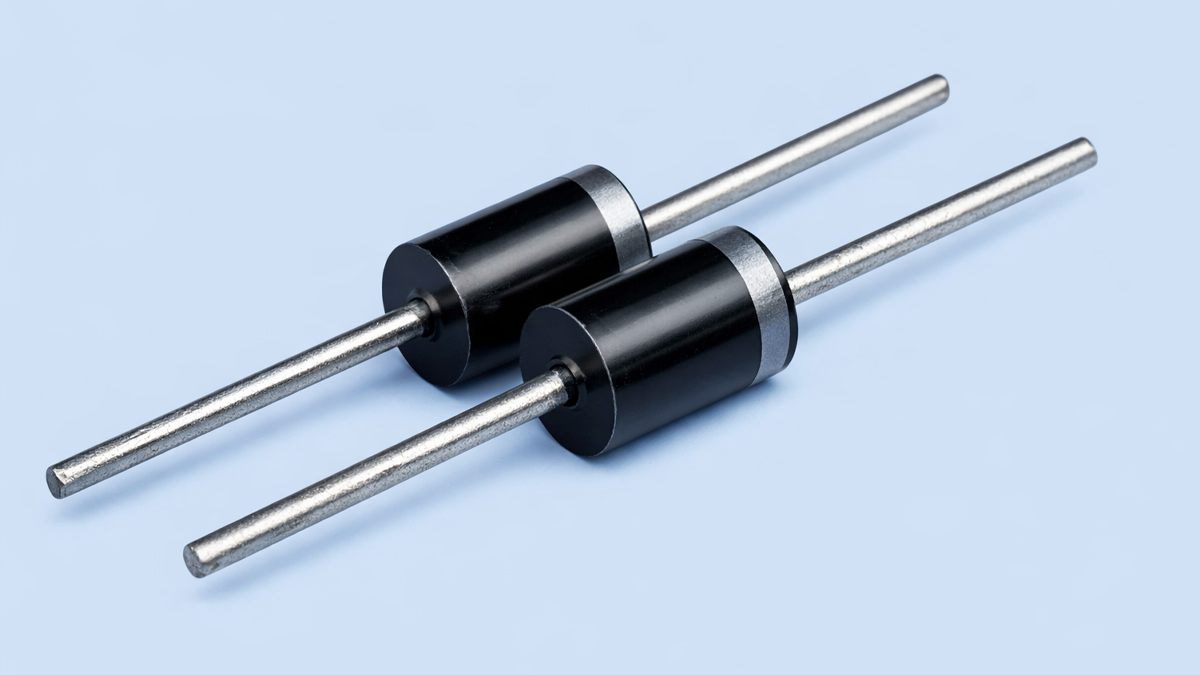
What is Rectifier Diode?
A rectifier diode is a semiconductor diode designed mainly to convert alternating current into direct current. In simple terms, it acts like a one way valve for electricity. When an electrical signal changes direction back and forth, which is what AC does, the rectifier diode blocks one direction and allows the other direction to pass. The result is a current that mostly flows in a single direction, which is the foundation of DC power.
In Cinematic Electronics under the Cinema Industry, rectifier diodes are everywhere because most professional cinema equipment needs stable DC power inside, even when the input comes from AC mains, generators, UPS systems, or power distribution units. Cameras, monitors, wireless video links, LED lighting drivers, on set chargers, audio recorders, media servers, and digital cinema projectors contain internal power conversion stages. Rectifier diodes sit right at the front end of those stages, helping the system turn incoming power into something electronics can safely and reliably use.
A rectifier diode is different from small signal diodes used mostly for switching or signal shaping. Rectifier diodes are built for power handling. They are designed to carry higher currents, tolerate higher reverse voltages, and survive repetitive stress from power conversion cycles. In cinema workflows, where equipment runs for long shooting days, travels through different power conditions, and faces frequent on off cycles, rectifier diode reliability matters in a very practical way.
How does Rectifier Diode Work?
A rectifier diode works using the basic diode principle of forward bias and reverse bias. When the diode is forward biased, meaning the anode is at a higher potential than the cathode, it conducts and allows current to flow. When it is reverse biased, the diode blocks current, allowing only a tiny leakage current to pass. This one direction behavior is what makes rectification possible.
Forward conduction: When the AC waveform swings positive in the direction that forward biases the diode, the diode conducts and current flows through the load. The diode has a forward voltage drop, so some voltage is lost across it, and power is dissipated as heat. In high current cinema power systems, that heat can be significant, which is why diode selection, heatsinking, and thermal design are important.
Reverse blocking: When the AC waveform swings negative, the diode becomes reverse biased and blocks current. It must withstand the peak reverse voltage without breaking down. If the reverse voltage rating is too low, the diode can fail. In cinema power supplies that may see spikes, generator noise, or long cable runs, designers often include margin and protective networks to keep the rectifier safe.
Rectification patterns: Rectifier diodes can be used in half wave rectification, where one diode passes only one half of the AC cycle, or full wave rectification, where a pair of diodes with a center tapped transformer or a four diode bridge converts both halves of the AC cycle into pulsating DC. Full wave rectification is far more common in modern cinema equipment because it provides smoother output and better transformer utilization.
Filtering and regulation: Rectification alone produces pulsating DC, not clean DC. The next stages include capacitors and sometimes inductors to filter ripples, followed by voltage regulation to maintain stable rails. Rectifier diodes are the gatekeepers that enable everything after them, but the quality of the overall DC depends on the full power chain.
What are the Components of Rectifier Diode?
A rectifier diode is a device, but it has internal and packaging related components that define how it behaves in real circuits. Understanding these elements helps connect the diode to practical cinema electronics design.
PN junction: The core of a rectifier diode is the PN junction formed by p type and n type semiconductor regions. This junction creates the one way conduction property. In many rectifier diodes, the junction area is relatively large to handle higher currents.
Anode and cathode terminals: The diode has two terminals. The anode is where conventional current enters during forward conduction. The cathode is where conventional current exits. Most rectifier diodes mark the cathode with a stripe on the body, which is critical during assembly and service.
Semiconductor die: Inside the package is the silicon die that contains the junction. The die is bonded to leads and to a thermal path. In power diodes, the die and bonding are designed to handle surge currents and dissipate heat.
Encapsulation and package: Rectifier diodes are packaged in many forms such as axial lead packages for through hole use, surface mount packages for compact designs, and stud mount or module packages for high power systems. The package affects thermal performance, voltage creepage distances, and mechanical robustness.
Heat dissipation path: Power rectification creates heat. The diode includes internal metal connections and sometimes exposed pads that transfer heat to a PCB copper area, a heatsink, or a chassis. In cinema gear, where size, weight, and airflow can be limited, thermal design becomes a real constraint.
Protective and structural features: Some rectifier diodes, especially in high power rectifier assemblies, include features such as avalanche capability or ruggedized constructions to survive voltage spikes. While not always described as a separate component, these design choices matter for reliability in field conditions.
What are the Types of Rectifier Diode?
Rectifier diodes come in several types, each optimized for specific voltage, current, switching speed, and efficiency needs. In Cinematic Electronics, different types appear in different zones of equipment, from heavy AC to DC front ends to compact DC to DC converters.
Standard silicon rectifier diode: These are the classic power diodes used in many mains frequency rectifiers. They are robust and economical, suitable for 50 Hz and 60 Hz rectification in power supplies and battery chargers. Their forward drop is moderate and their switching speed is not very fast, which is fine at mains frequency.
Fast recovery rectifier diode: These diodes are designed to switch off more quickly, reducing reverse recovery losses in higher frequency power conversion. They are common in switch mode power supplies used in modern cinema equipment, including camera adapters, LED drivers, and media server power modules.
Ultra fast recovery rectifier diode: These are faster versions with even shorter recovery times. They help reduce switching losses and electromagnetic interference in high frequency circuits. In compact power supplies used in on camera accessories, ultra fast types can improve efficiency and reduce heat.
Schottky rectifier diode: Schottky diodes use a metal semiconductor junction rather than a PN junction. They have a lower forward voltage drop, which improves efficiency, especially at low voltages. They also switch very fast. However, their reverse voltage ratings are typically lower and leakage current can be higher. In cinema gear, Schottky rectifiers are common in low voltage rails, battery powered devices, and DC to DC conversion stages where every watt matters.
Bridge rectifier assemblies: A bridge rectifier is a configuration of four diodes packaged as a single component or built from discrete diodes. It enables full wave rectification without needing a center tapped transformer. Many cinema power bricks and internal power supplies use bridge rectifiers at the input stage.
High power stud and module rectifiers: For larger systems such as high power lighting supplies, large UPS units, or projector power stages, rectifiers can be physically large components mounted to heatsinks or in rectifier modules. These are about handling high currents and high voltages with reliable thermal management.
What are the Applications of Rectifier Diode?
Rectifier diodes appear in any application that needs conversion from AC to DC or needs blocking and steering of current paths. In cinema environments, that covers an enormous range of systems.
AC to DC power supplies: The most direct application is the input stage of power supplies. Cinema cameras, monitors, video routers, audio mixers, wireless receivers, and control systems all have internal power supplies that begin with rectification.
Battery chargers and charging docks: Charging V mount batteries, gold mount batteries, and other production battery systems involves rectification. Even if the charger is a smart switch mode design, rectifier diodes are part of the front end and often part of internal conversion stages.
LED lighting drivers: Many LED fixtures and panels use rectifiers to convert AC input to DC, then regulate current for LEDs. Rectifier efficiency impacts heat, brightness stability, and long term reliability.
Protection and polarity management: Rectifier diodes can be used to protect circuits against reverse polarity connections. On set, quick cable swaps happen often, and protection is valuable. A diode can prevent damage if a connector is inserted incorrectly.
Power ORing and redundancy: In some systems, multiple power sources may feed a load. Rectifier diodes can isolate sources and allow seamless switching. For example, a device might accept both an external adapter and a battery, and diodes can ensure current flows from the preferred source without back feeding.
Snubber and flyback paths: In inductive loads such as motors, relays, and some audio power sections, diodes provide a safe path for inductive energy when a switch turns off. In cinema gear, this may appear in rig control systems, automation modules, or certain mechanical control units.
Signal related rectification: While rectifier diodes are mainly power devices, rectification is also used for detection and envelope extraction in certain circuits. In audio and measurement equipment used in production, rectification may appear in metering or sensing circuits, though often smaller diodes are used there.
What is the Role of Rectifier Diode in Cinema Industry?
The cinema industry depends on an ecosystem of electronics that must run reliably in diverse and sometimes harsh conditions. Rectifier diodes play a quiet but essential role because they support the stability of the power foundation.
Powering digital imaging pipelines: Digital cinema cameras, recorders, and monitors rely on multiple DC rails. These rails are created inside the device by converting external power into internal regulated voltages. Rectifier diodes are part of the conversion front end. If rectification is unstable or inefficient, internal voltages ripple more, components heat up, and sensitive imaging circuits can suffer.
Reducing downtime on set: A failed power module can halt a shoot. Rectifier diode selection affects surge tolerance, heat handling, and lifetime. Robust rectification helps reduce unexpected failures in chargers, adapters, and distribution boxes used on set.
Supporting stable lighting performance: Flicker and brightness instability in lighting can ruin shots. While flicker often relates to driver design and filtering, rectification is the first step that shapes the DC bus feeding the driver. High quality rectification combined with proper filtering improves stability.
Handling generator and mobile power conditions: Many productions use generators, temporary power, and long cables. Voltage can vary, and spikes can occur. Rectifier diodes with proper ratings and protective design help equipment survive these conditions.
Improving energy efficiency and thermal behavior: Heat is the enemy of reliability, especially in compact camera bodies, small wireless transmitters, or sealed projector modules. Using low loss rectification in the right places improves efficiency and reduces heat, which can translate to longer runtimes, less fan noise, and better component lifespan.
Enabling portable battery ecosystems: Battery powered operation is central to modern production. Rectifier diodes support charging, power path control, and protection. A well designed rectification strategy can reduce wasted energy and help batteries deliver more usable time.
What are the Objectives of Rectifier Diode?
The objectives of a rectifier diode are practical and measurable. They guide why the component exists and what it must achieve in a circuit.
Convert AC to DC: The primary objective is to allow conversion of alternating current into direct current so that electronic circuits can operate.
Allow one direction current flow: Rectifier diodes enforce directional conduction, preventing unwanted reverse current that could damage components or create instability.
Withstand reverse voltage safely: A key objective is to block reverse voltage without breakdown. This is essential in mains connected supplies and any circuit with inductive or switching behavior.
Handle required current and surge loads: Rectifiers must carry normal load current and survive inrush currents such as capacitor charging surges when equipment is switched on.
Minimize power loss: Another objective is to reduce forward voltage drop and switching losses so that the system wastes less power and generates less heat.
Support reliable operation over time: Rectifier diodes must operate across temperature ranges, duty cycles, and varying power conditions without degrading quickly.
Enable safe system integration: In cinema equipment, the rectifier diode objective also includes predictable behavior under field conditions such as generator noise, frequent plugging and unplugging, and temperature variation from outdoor shoots.
What are the Benefits of Rectifier Diode?
Rectifier diodes bring direct benefits to electronic systems, especially where stable DC is required from AC sources.
Stable power foundation: They enable the creation of DC rails that power sensitive digital and analog circuits used across cinema workflows.
Simpler power conversion: Using diodes to steer current provides a straightforward and proven method to create rectified outputs with predictable behavior.
Improved equipment reliability: Properly rated rectifier diodes reduce the risk of failure due to reverse voltage breakdown or overheating, lowering downtime.
Protection against reverse current: In power input protection and power ORing, rectifier diodes prevent reverse flow that could damage batteries, adapters, or distribution systems.
Cost effective design: Compared to complex active rectification solutions, standard rectifier diodes offer a strong balance of cost and performance for many needs.
Wide availability and standardization: Rectifier diodes are produced in many ratings and packages, making them easy to source and replace, which helps maintenance teams and technicians.
Better efficiency when optimized: Schottky and fast recovery rectifiers can increase efficiency in switch mode stages, helping compact cinema gear run cooler and longer.
What are the Features of Rectifier Diode?
Rectifier diodes are characterized by features that help engineers and technicians select the right part for the job. These features also explain why one rectifier diode is better than another in specific cinema equipment.
Forward current rating: This indicates how much current the diode can conduct continuously without overheating beyond limits. Cinema power supplies and chargers choose ratings based on expected loads and thermal design.
Surge current capability: Power supplies often experience a brief inrush current when capacitors charge. Rectifier diodes specify peak surge ratings to ensure they survive these events repeatedly.
Peak inverse voltage rating: This is the maximum reverse voltage the diode can withstand. For mains connected rectifiers, this is a critical safety and reliability parameter.
Forward voltage drop: The voltage lost across the diode during conduction determines power dissipation. Lower forward drop improves efficiency and reduces heat.
Reverse recovery time: In high frequency switching circuits, the diode must turn off quickly. Faster recovery reduces switching losses and reduces noise.
Reverse leakage current: Some diodes leak more current when reverse biased. In battery powered cinema gear, lower leakage can help preserve battery life.
Thermal resistance and package style: The package influences how easily heat escapes. Surface mount diodes rely on PCB copper for cooling, while larger packages may mount to heatsinks.
Ruggedness and reliability characteristics: Some rectifier diodes offer avalanche ratings or better tolerance to transient spikes. This can be valuable in the cinema industry where power conditions can be unpredictable.
What are the Examples of Rectifier Diode?
Examples can be understood in two ways. One is examples of diode families commonly used in electronics. The other is examples of how rectifier diodes appear inside cinema industry equipment. Both viewpoints help education.
Common rectifier diode families: Popular general purpose rectifier diode families include the 1N400x series for low current mains frequency rectification and the 1N540x series for higher current. Fast recovery families include parts in the UF series and FR series. Schottky families include many low voltage rectifiers used in DC rails and converters. The exact part used depends on voltage and current requirements, packaging needs, and switching frequency.
Bridge rectifier examples: Many devices use a four diode bridge rectifier in a single package. These parts are often labeled with current and voltage ratings and are used in power adapters, chargers, and internal power stages.
Cinema equipment examples: A digital cinema projector power supply uses a bridge rectifier and fast recovery diodes in its power factor correction and conversion stages. An on set battery charger uses rectifier stages to create a DC bus for controlled charging. LED lighting fixtures use rectifiers to convert AC input to DC before current regulation. A camera power adapter uses rectification and filtering to supply stable DC to internal regulators. Power distribution boxes may use diodes for reverse current protection and for combining multiple supply inputs safely.
Service and repair examples: Technicians diagnosing a dead power brick may test the bridge rectifier and its diodes for open circuits or shorts. In the field, a rectifier diode failure can show up as blown fuses, overheating, unusual hum, or unstable power delivery.
What is the Definition of Rectifier Diode?
A rectifier diode is a semiconductor device designed to conduct electrical current primarily in one direction and block current in the opposite direction, enabling the conversion of alternating current to direct current in power conversion circuits.
What is the Meaning of Rectifier Diode?
The meaning of rectifier diode is simple when broken into parts. Rectifier refers to rectification, which is the process of converting AC into DC. Diode refers to a two terminal semiconductor device that allows one direction current flow and blocks the reverse direction. So the meaning is a diode used mainly for rectification, built to handle the electrical stresses of power conversion such as higher current, higher reverse voltage, and repetitive switching conditions.
In the context of Cinematic Electronics, the meaning extends to reliability and performance under production realities. It is not only about converting AC to DC. It is also about doing it efficiently, with low heat, low noise, and strong tolerance for power irregularities so that cinema equipment behaves consistently.
What is the Future of Rectifier Diode?
The future of rectifier diodes is shaped by the same forces shaping cinema technology: higher efficiency, smaller size, lower noise, better thermal behavior, and more robust operation in portable and hybrid power systems.
Higher efficiency rectification: As cinema equipment becomes more compact and power dense, designers seek to reduce losses. Schottky diodes have already improved efficiency at low voltages. Beyond that, active rectification using MOSFETs is increasingly used in some power supplies to reduce losses further. Even when active rectification is adopted, diodes still remain in many roles, such as protection and certain stages where simplicity and ruggedness matter.
Wide bandgap materials: Silicon carbide and gallium nitride technologies influence power electronics. Silicon carbide diodes, especially SiC Schottky diodes, offer high voltage capability with fast switching and low recovery losses. These are useful in high efficiency power factor correction and high voltage switching stages. As costs come down, these diodes are likely to appear more in high end cinema projectors, high power lighting supplies, and robust location power systems.
Improved thermal packaging: New packages and better thermal interfaces can help diodes dissipate heat more efficiently. This supports higher power density designs, meaning more power in smaller power bricks, lighter chargers, and quieter equipment with less fan dependence.
Better EMI performance: Power conversion noise can interfere with audio, wireless video, and sensitive imaging electronics. Faster diodes with optimized recovery behavior can reduce electromagnetic interference. Future rectifiers may emphasize soft recovery characteristics that reduce ringing and noise.
Integration into modules: More rectification will be integrated into power modules that combine diodes, protection circuits, and thermal management. This can increase reliability and simplify design for equipment manufacturers.
Focus on field reliability: The cinema industry values equipment that works across countries, voltages, and unpredictable conditions. Future rectifier diode solutions will likely include more built in protection, better surge tolerance, and improved lifetime under cyclic loads.
Summary
- A rectifier diode is a power focused diode used mainly to convert AC into DC by allowing current in one direction and blocking the other direction.
- It works through forward bias conduction and reverse bias blocking, enabling half wave or full wave rectification depending on circuit design.
- Its key internal elements include the PN junction, anode and cathode terminals, semiconductor die, and a package designed for heat dissipation.
- Major types include standard silicon rectifiers, fast recovery rectifiers, ultra fast rectifiers, Schottky rectifiers, bridge rectifiers, and high power rectifier modules.
- Common applications include AC to DC power supplies, battery chargers, LED drivers, polarity protection, power source isolation, and inductive energy handling.
- In the cinema industry, rectifier diodes support reliable powering of cameras, projectors, lighting, audio systems, and on set power infrastructure.
- Objectives include safe AC to DC conversion, reverse voltage blocking, current handling, loss reduction, and long life operation under real conditions.
- Benefits include stable DC foundations, improved reliability, simpler power conversion, equipment protection, cost effectiveness, and efficiency gains with optimized diode choices.
- Features that matter most are forward current rating, surge rating, peak inverse voltage, forward drop, recovery time, leakage current, and thermal performance.
- The future includes higher efficiency approaches, more use of SiC and advanced Schottky diodes in premium power stages, improved thermal packaging, and better noise behavior for sensitive cinema electronics.

