
What is Robotic Arm Rig?
A robotic arm rig is a motorized, computer controlled mechanical arm used to move a camera with extremely high precision. In cinema, it is part of robotic camera rigs under cinematic technologies, and it is designed to repeat complex camera moves exactly, maintain stable motion, and execute movements that are difficult or risky for a human operator to perform manually.
Unlike a standard camera crane or handheld stabilizer, a robotic arm rig uses multiple powered joints and a programmable control system. This allows it to position a camera at specific coordinates, rotate it on multiple axes, and follow a planned motion path with consistent speed and timing. The result is smooth, repeatable, and highly controllable camera motion that can be synchronized with actors, props, visual effects, lighting cues, or other moving equipment.
In practical filmmaking terms, robotic arm rigs help production teams achieve shots such as perfectly repeated product spins, precise motion control for compositing, high speed moves for dynamic action, and safe camera placement in tight or hazardous environments. They are used in studios, sound stages, virtual production volumes, commercials, music videos, live events, and increasingly in on set workflows where data driven camera movement supports visual effects and post production.
Purpose and identity: A robotic arm rig is a motion control camera platform that combines an industrial style robotic arm with cinema focused mounting, stabilization, and control tools so that the camera movement is both artistic and technically repeatable.
Why it matters: Modern filmmaking often needs exact repetition for multiple takes, multiple lighting passes, or multiple plate captures. Robotic arm rigs make that repeatability possible while preserving creative flexibility for the director and cinematographer.
How does Robotic Arm Rig Work?
A robotic arm rig works by translating a planned camera move into coordinated motion across several motorized joints. Each joint is driven by a servo motor and monitored by sensors, allowing the system to measure position, speed, and acceleration in real time. The control software sends commands to each motor so the arm follows a precise path, with smooth ramps up and down in speed to avoid jerks or unwanted vibration.
Motion planning: The operator defines the move using a control interface. This can be done by keyframing positions along a timeline, by teaching the arm through manual guiding on certain systems, or by using joystick style operation that is recorded and refined later. Once the motion is defined, the software calculates how each joint should move at every moment to produce the desired camera path.
Closed loop control: The system continuously compares the target position to the actual position using encoders and feedback sensors. If the arm deviates due to load changes, cable drag, or minor disturbances, the controller corrects the motor commands instantly. This feedback loop is a major reason robotic moves are so consistent.
Camera coordination: The robotic arm rig does not only move the camera in space. In many cinema setups, it can also coordinate pan, tilt, roll, focus, zoom, and iris through integrated lens control systems. This means the physical movement and the optical movement can be synchronized, producing a shot that feels intentional and perfectly timed.
Repeatability and iteration: Once a move is saved, it can be repeated across multiple takes with the same timing and path. The crew can adjust one variable at a time, such as changing an actor mark, shifting lighting, swapping props, or capturing multiple passes for visual effects. Because the camera move remains consistent, compositing and match work in post production becomes easier and cleaner.
Safety and constraints: The control system includes safety zones, speed limits, collision avoidance settings, and emergency stops. The operator can define boundaries so the arm does not enter restricted areas or hit set pieces. This is essential when working near talent or expensive equipment.
Integration with virtual production: In LED volume stages and real time rendering pipelines, robotic arm rigs can output camera tracking and lens metadata so the virtual camera matches the physical camera. This makes the background perspective respond correctly to camera motion, improving realism and reducing post work.
Core principle: A robotic arm rig converts creative camera intent into mathematically controlled motion, producing smooth and repeatable movement that can be synchronized with the wider production workflow.
What are the Components of Robotic Arm Rig?
A robotic arm rig is a system, not a single device. It includes mechanical, electrical, and software components designed to work together in a film safe, production friendly way.
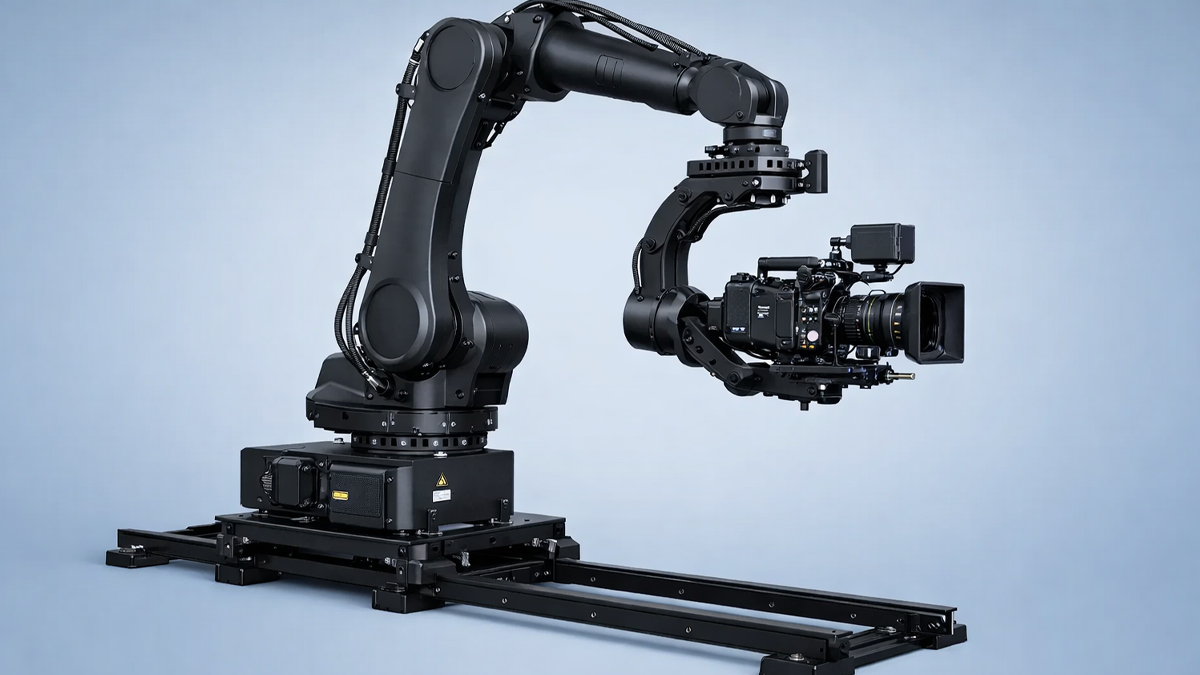
Robotic arm structure: The arm is the primary mechanical body with multiple joints. Each joint provides a degree of freedom, such as rotating the base, lifting the shoulder, bending the elbow, and rotating the wrist. These joints allow the camera to move through space and orient itself precisely.
Actuators and motors: Servo motors drive each joint. They are chosen for torque, precision, and responsiveness. High quality servo systems enable smooth starts and stops, which is critical for cinematic movement.
Encoders and sensors: Encoders measure joint rotation and position. Additional sensors can monitor load, temperature, vibration, and sometimes external references. Feedback from sensors allows stable and accurate closed loop control.
End effector and camera mount: The end of the arm holds the camera. In cinema applications, this includes a camera plate, quick release systems, balancing adjustments, and sometimes a gimbal or stabilized head. The mount must handle the weight of the camera package, including lens, matte box, motors, cables, and accessories.
Control computer and motion controller: A dedicated controller runs the motion algorithms. It interprets the operator commands and calculates motor signals. The controller manages speed, acceleration, smoothing, and safety constraints.
Operator interface: The interface may be a control panel, software application, joystick console, or a combination. Operators use it to program moves, set keyframes, adjust easing, and store presets. In many productions, a motion control operator works alongside the camera department.
Power and distribution: Robotic arm rigs require reliable power. They use power distribution units, cable management, and sometimes battery systems for specific setups. Proper grounding and clean power help avoid noise and protect electronics.
Cable management system: Cables for video, power, lens control, and data must move with the arm without snagging. Cable looms, slip rings, or rotating connectors may be used to avoid twisting and to maintain consistent motion.
Safety systems: Emergency stop buttons, safety scanners, speed limit modes, soft limits, and collision detection are part of professional systems. Some setups include warning lights or audible signals during operation.
Software ecosystem: Software includes motion programming, playback, logging, and integration with external tools. It may connect to VFX pipelines, virtual production engines, or external timecode systems.
Support equipment: The arm usually sits on a base, pedestal, dolly, track, crane mount, or a fixed platform. Additional supports include tripods, risers, vibration isolation pads, and leveling systems.
Key takeaway: The robotic arm rig includes the arm, motors, sensors, camera mounting, controllers, software, power, and safety tools, all designed to deliver precise cinematic motion in real production conditions.
What are the Types of Robotic Arm Rig?
Robotic arm rigs vary based on size, payload, reach, speed, mounting style, and how they are used in production. The type chosen depends on the shot requirements, set constraints, and the camera package.
Studio motion control robotic arms: These are robust systems designed for repeatable, programmable moves on sound stages. They prioritize precision, smoothness, and reliability. They often integrate deeply with motion control workflows, lens control, and VFX metadata output.
High speed robotic arms: Some rigs are optimized for rapid acceleration and fast moves, often paired with high speed cameras for commercials and action shots. They can create dramatic parallax shifts, whip moves, and dynamic reveals while still maintaining repeatability.
Compact robotic arms: Smaller rigs are designed for tight spaces, tabletop shoots, and product cinematography. They carry lighter camera packages or specialized cameras and are easier to transport and set up.
Heavy payload robotic arms: These are built to carry large cinema camera packages, long lenses, or specialized stabilized heads. They are used when the shot requires full size cinema quality with complex accessories.
Gimbal integrated robotic arms: These combine a robotic arm with a stabilized gimbal head. The robotic arm handles large spatial movement, while the gimbal smooths micro vibrations and offers additional control over camera orientation.
Track mounted or dolly mounted robotic arms: In these setups, the robotic arm sits on a moving base such as a track dolly or a motorized platform. This adds another layer of motion, allowing longer travel shots while still keeping the robotic precision.
Crane mounted robotic arms: Some systems mount on cranes or telescopic booms, blending crane movement with robotic articulation. This is useful for large set moves and wide sweeping shots with precise end positioning.
Virtual production focused robotic arms: These rigs emphasize camera tracking, lens metadata, and synchronization with real time engines. They are selected for LED stages and workflows where camera data drives background rendering.
Collaborative and safety enhanced arms: Certain arms are designed with lower force, speed limitations, and improved safety features. In film, they may be used in closer proximity to talent under strict safety protocols.
Selection logic: The type of robotic arm rig is chosen based on payload, reach, speed, precision, portability, and integration needs, especially whether the project requires motion control repetition or virtual production data exchange.
What are the Applications of Robotic Arm Rig?
Robotic arm rigs are used in many film and media contexts because they offer controlled camera motion that can be repeated and refined.
Motion control for VFX: When a shot needs multiple passes, such as clean plates, lighting variations, or element captures, robotic repetition makes compositing easier. The camera path matches across takes, reducing alignment problems in post production.
Product cinematography: Commercials often require precise camera moves around products like watches, phones, cars, cosmetics, and food. Robotic arms create consistent arcs, spirals, push ins, and orbit moves that highlight design details.
Tabletop and miniature work: Small scale scenes benefit from precise and slow movement. Robotic arms can mimic large cinematic moves on miniature sets, adding realism and depth.
Action and dynamic camera moves: High speed robotic arms can deliver rapid moves that would be dangerous or impossible with handheld or crane methods. The motion can be rehearsed and repeated safely.
Virtual production and LED volumes: Robotic motion combined with camera tracking supports real time rendered backgrounds. Consistent motion helps maintain stable parallax and improves the blend between real foreground and virtual environment.
Live events and broadcast: Some productions use robotic arms for repeatable camera moves in live environments, such as stage shows or studio broadcasts, where consistent framing and predictable motion are valuable.
Title sequences and special shots: Complex moves through tight spaces, around objects, or along precise geometric paths can be designed for stylish title sequences, music videos, or brand films.
Scientific and technical filming: In industrial and educational content, robotic arms provide controlled filming of experiments, machinery, and processes where precision and repeatability matter.
Multi camera synchronization: In advanced setups, robotic moves can be synchronized with other cameras, lighting cues, and timecode. This supports multi angle coverage and complex staged motion sequences.
Training and previs: Some teams use robotic rigs to test camera moves, refine timing, and preview how a shot will look before shooting. The move can be iterated quickly and stored for later use.
Core idea: Robotic arm rigs are applied wherever precision, repeatability, controlled speed, and complex motion paths improve shot quality or production efficiency.
What is the Role of Robotic Arm Rig in Cinema Industry?
In the cinema industry, the robotic arm rig plays a role that blends artistry with engineering. It enables filmmakers to design camera movement like choreography, ensuring the move can be executed precisely across takes, across days, and across different production phases.
Enabling repeatable storytelling: Many cinematic moments depend on timing and consistency. When a director wants a move that hits a precise mark as an actor performs a beat, a robotic arm can repeat that move until the performance and camera timing align perfectly.
Supporting visual effects pipelines: Modern films rely on VFX for set extensions, creature integration, screen replacements, and complex composites. Robotic camera moves that repeat precisely reduce the workload of match moving and help VFX teams align elements more accurately.
Expanding creative possibilities: Robotic arms can execute moves that are difficult for traditional rigs, such as tight spirals around an object, precise arcs through narrow spaces, or fast moves that stop on an exact frame. This opens new visual language for cinematographers.
Improving safety and risk management: Some shots place the camera near hazards, heavy props, vehicles, or stunts. A robotic system can be operated with safety boundaries and rehearsed motion paths, reducing risk to crew and talent.
Increasing efficiency on set: When a move is programmed, the crew can repeat it quickly without rebuilding the shot each time. This helps when shooting multiple versions of a scene, multiple products, or multiple lighting setups.
Standardizing quality: In high end commercials and studio work, brands expect consistent visual polish. Robotic motion provides that consistency, delivering smooth camera movement and precise framing.
Integrating with modern production tech: Robotic arm rigs connect with lens control, camera tracking, timecode, and real time rendering. This makes them a central tool in data driven filmmaking and virtual production.
In short: The robotic arm rig is a precision camera movement tool that strengthens creative control, VFX reliability, production safety, and workflow efficiency across many types of cinematic projects.
What are the Objectives of Robotic Arm Rig?
The objectives of a robotic arm rig in cinematic technologies are practical, creative, and technical. They guide why productions choose this tool instead of traditional camera support systems.
Precision movement: The rig aims to place the camera exactly where it needs to be, with accurate orientation and stable motion along the path.
Repeatability: One of the primary objectives is to repeat the same camera move across many takes, enabling consistent results for performance refinement, VFX passes, and editorial options.
Smooth cinematic motion: The system is designed to deliver smooth acceleration and deceleration so the shot feels cinematic rather than mechanical.
Complex path execution: The rig aims to perform multi axis moves that combine translation and rotation, such as moving forward while arcing, tilting, and rolling with controlled timing.
Programmability and automation: Another objective is to store and recall moves, allowing rapid resets and consistent playback even after equipment changes or schedule breaks.
Synchronization: Robotic rigs aim to synchronize with other systems such as turntables, lighting cues, playback monitors, and timecode, creating reliable multi system choreography.
Safety and control: The rig is intended to improve safety by enabling remote operation, boundary limits, and controlled rehearsal of complex shots.
Data output for workflows: In VFX and virtual production, the objective includes providing camera position data and lens metadata to support post production and real time rendering.
Creative flexibility: Even with automation, the objective remains to support creative experimentation by allowing quick iterations, adjustable parameters, and fine control over timing.
Overall objective: To deliver controlled camera motion that is precise, repeatable, smooth, and workflow friendly, while supporting the creative goals of cinematic storytelling.
What are the Benefits of Robotic Arm Rig?
Robotic arm rigs bring a set of benefits that directly impact image quality, creative options, production speed, and post production reliability.
High repeatability for multiple takes: The ability to replay the same move is a major benefit. It helps directors refine performances and allows editors to choose between takes without camera variation complicating continuity.
Better visual effects alignment: When multiple passes are needed, consistent camera motion reduces compositing errors and shortens VFX iteration cycles.
Consistent framing and focus support: With integrated control systems, robotic rigs can maintain consistent framing and support focus and lens choreography, reducing variability between takes.
Complex shots become achievable: Moves that would be extremely challenging with handheld, crane, or dolly setups can be executed with controlled precision.
Time savings on set: Once a move is programmed, resets are faster. The crew spends less time re blocking the camera and more time capturing usable takes.
Higher safety for risky shots: Robotic operation can keep crew away from hazardous areas while still capturing close, dynamic angles.
Creative experimentation with control: Operators can test variations by adjusting speed curves, camera positions, and timing without rebuilding physical rigging.
Improved quality for product and tabletop work: In commercial production, robotic rigs deliver consistent premium motion that highlights product surfaces and design features cleanly.
Better integration with modern pipelines: Data output, tracking, and synchronization benefits workflows in virtual production, VFX, and post production.
Reliable motion at different speeds: Robotic arms can perform extremely slow moves for subtle drama or very fast moves for energy, while maintaining smoothness and control.
Net benefit: Robotic arm rigs reduce uncertainty and increase control, allowing productions to achieve complex cinematic motion with repeatable quality and improved workflow efficiency.
What are the Features of Robotic Arm Rig?
Robotic arm rigs are defined by features that support cinematic performance, operational reliability, and integration with production environments.
Multi axis degrees of freedom: Multiple joints allow the camera to move and orient with high flexibility, enabling complex motion paths.
Programmable keyframes and timelines: Operators can set positions and orientations at specific times, then let the software interpolate smooth motion between them.
Speed and acceleration control: Fine control over speed ramps helps produce cinematic easing, avoiding abrupt starts and stops.
Motion smoothing and filtering: Software tools reduce mechanical harshness and produce organic camera feel while keeping precision.
Move storage and recall: Saved moves can be recalled for reshoots, additional passes, or later production days, supporting continuity.
Real time manual control and record: Operators can drive the arm manually using joysticks, record the motion, then refine it for final playback.
Lens and camera integration: Many systems interface with lens motors, focus controllers, and camera trigger functions to synchronize movement with optical changes.
Safety boundaries and soft limits: Operators can define restricted zones and limit speeds, improving safety near talent and set pieces.
Timecode and synchronization support: Integration with timecode allows coordination with music playback, effects cues, and multi device motion.
Metadata capture and export: Systems may record position data, orientation data, and lens data, which can support VFX match moving and virtual production.
Mounting flexibility: The rig can be mounted on pedestals, dollies, tracks, or cranes depending on production needs.
Production focused design: Cinema oriented systems often include quick setup tools, robust cabling solutions, and user interfaces tailored for on set work.
Feature summary: Robotic arm rigs combine programmable motion, smooth control, repeatable playback, safety systems, and production integration to deliver high end cinematic camera movement.
What are the Examples of Robotic Arm Rig?
Examples of robotic arm rigs in cinema typically refer to well known systems and configurations used in production. The exact model used depends on payload, speed, and integration needs, but the general categories are consistent.
Industrial robotic arms adapted for cinema: Some productions use industrial robotic arms from major robotics manufacturers and pair them with cinema control software, camera mounting solutions, and lens control systems. These are common in studio environments where robustness and precision are prioritized.
Dedicated cinema robotic systems: There are purpose built robotic camera systems designed specifically for film and commercial work. These often include production friendly interfaces, shot programming tools, and integration with motion control workflows.
High speed commercial rigs: Certain systems are marketed for rapid, dramatic camera moves used in commercials, music videos, and stylized content. They emphasize acceleration, repeatability, and the ability to create signature motion looks.
Tabletop robotic arms: Compact rigs used for product shots, food cinematography, and macro work are common in commercial studios. They often support smaller cameras or specialized lenses and can execute very slow, controlled movements.
Robotic arm with stabilized head configuration: A common setup is an arm carrying a stabilized gimbal head. The arm handles large moves, while the gimbal smooths micro vibrations and manages precise framing.
Track plus robotic arm configuration: Some stages combine a track mounted base with a robotic arm to add long travel movement. This enables shots that move across the set while still performing precise multi axis motion at the camera.
Virtual production robotic camera configuration: In LED volume stages, a robotic arm rig may be paired with camera tracking systems and lens encoders. This provides real time camera data to rendering engines, improving the alignment of virtual backgrounds.
Practical example scenarios: A robotic arm circles a product while the lens zooms and focus pulls on cue. A robotic arm repeats a move for a clean plate and a VFX plate. A robotic arm performs a fast push in to a character at the exact moment a practical effect triggers.
These examples show that robotic arm rigs are not limited to one brand or one format. They are a family of solutions that combine a robotic arm with cinema control and camera mounting systems.
What is the Definition of Robotic Arm Rig?
A clear definition of a robotic arm rig in the cinema industry is as follows.
Definition: A robotic arm rig is a programmable, motorized multi joint camera support system that moves and orients a camera with high precision and repeatability, enabling controlled cinematic motion and motion control workflows for filming, visual effects, and virtual production.
This definition emphasizes the essential qualities. It is programmable, it is multi joint, it is precise, it is repeatable, and it is used to move a camera for cinematic purposes.
What is the Meaning of Robotic Arm Rig?
The meaning of robotic arm rig goes beyond the mechanical device and describes what it represents in cinematic technologies.
Meaning in simple terms: It is a smart camera moving machine that can perform the same move again and again with accuracy, helping filmmakers create smooth, complex shots and making it easier to combine multiple takes or effects.
Meaning in filmmaking context: It represents control and consistency. A director and cinematographer can design a camera move as a repeatable sequence rather than relying only on human steadiness or mechanical constraints. The rig becomes a tool for choreographed motion, like a programmable dancer that can repeat a performance on cue.
Meaning in production workflow: It also means data. In many modern workflows, the rig is a source of camera movement information that can be used in post production and real time rendering. That data driven meaning is increasingly important in VFX heavy projects.
Meaning for creative expression: Finally, it means expanded creative vocabulary. The rig allows camera moves that can feel impossible or too risky by traditional methods, giving filmmakers new ways to express energy, tension, elegance, or scale.
In essence: The meaning of robotic arm rig is precise, repeatable camera motion for creative storytelling and technical reliability in modern cinema production.
What is the Future of Robotic Arm Rig?
The future of robotic arm rigs in the cinema industry is strongly tied to automation, smarter software, better integration, and more accessible workflows. Several trends are likely to shape how these systems evolve and how widely they are adopted.
Smarter motion programming: Motion design tools are becoming more intuitive. Future systems will likely offer easier ways to design moves through visual interfaces, path drawing, and real time previews. Operators will spend less time on complex setup and more time on creative refinement.
AI assisted operation: AI can help generate camera moves based on shot goals such as keep subject centered, maintain a specific screen position, avoid occlusions, or match a reference style. This does not replace creative choice, but it can speed up exploration and provide starting points that artists can refine.
Improved safety and collision awareness: More advanced sensors and environment awareness can help rigs detect obstacles and enforce safer operation. This can support closer collaboration with talent under controlled conditions.
Deeper virtual production integration: Robotic rigs will continue to integrate with real time engines and tracking ecosystems. Better lens metadata handling, improved camera tracking accuracy, and more robust synchronization will help make virtual backgrounds more believable and reduce post production fixes.
More portable and modular designs: As demand grows outside large studios, manufacturers will likely build smaller, faster to deploy rigs that still offer cinematic smoothness. Modular components and lighter mounting solutions can help more productions adopt robotics.
Better vibration control and cinematic feel: Future systems may include improved mechanical damping, smarter smoothing algorithms, and integrated stabilization. The goal is to maintain precision while delivering a natural cinematic motion feel.
Standardized data pipelines: As VFX and virtual production pipelines mature, there will likely be stronger standards for how motion and lens data are recorded and shared. This can make robotic rigs more interoperable across tools.
Cost accessibility and wider adoption: As technology matures, costs often decrease and the ecosystem grows. More rental houses, studios, and mid size productions may adopt robotic rigs, not only for VFX but also for general cinematography.
Creative collaboration workflows: The future may include better collaboration between departments. For example, a cinematographer, VFX supervisor, and virtual production team could adjust a move together using a shared preview environment, then capture the final move with reliable repeatability.
Future outlook: Robotic arm rigs will become more intelligent, more integrated, and easier to use, making precision camera movement and data driven filmmaking more common across a wider range of cinema and media projects.
Summary
- A robotic arm rig is a programmable, motorized camera movement system that provides precise and repeatable cinematic motion.
- It works through coordinated multi joint control using motors, sensors, and software that plan and correct motion in real time.
- Key components include the robotic arm, servo motors, encoders, camera mount, control computer, operator interface, power, cable management, and safety systems.
- Types vary by size, payload, speed, and integration, including compact rigs, high speed rigs, heavy payload rigs, and virtual production focused rigs.
- Applications include VFX motion control, product cinematography, tabletop work, dynamic action shots, live studio moves, and virtual production workflows.
- In the cinema industry, robotic arm rigs improve creative control, consistency across takes, safety for complex shots, and efficiency on set.
- Objectives include precision, repeatability, smooth motion, complex path execution, synchronization, safety, and useful data output for post production.
- Benefits include better VFX alignment, consistent framing, faster resets, safer operation, and the ability to achieve difficult camera moves reliably.
- Features commonly include programmable keyframes, motion smoothing, speed control, move recall, lens integration, timecode support, and safety boundaries.
- The future points toward smarter software, AI assisted motion design, stronger virtual production integration, improved safety, and more portable systems.

