

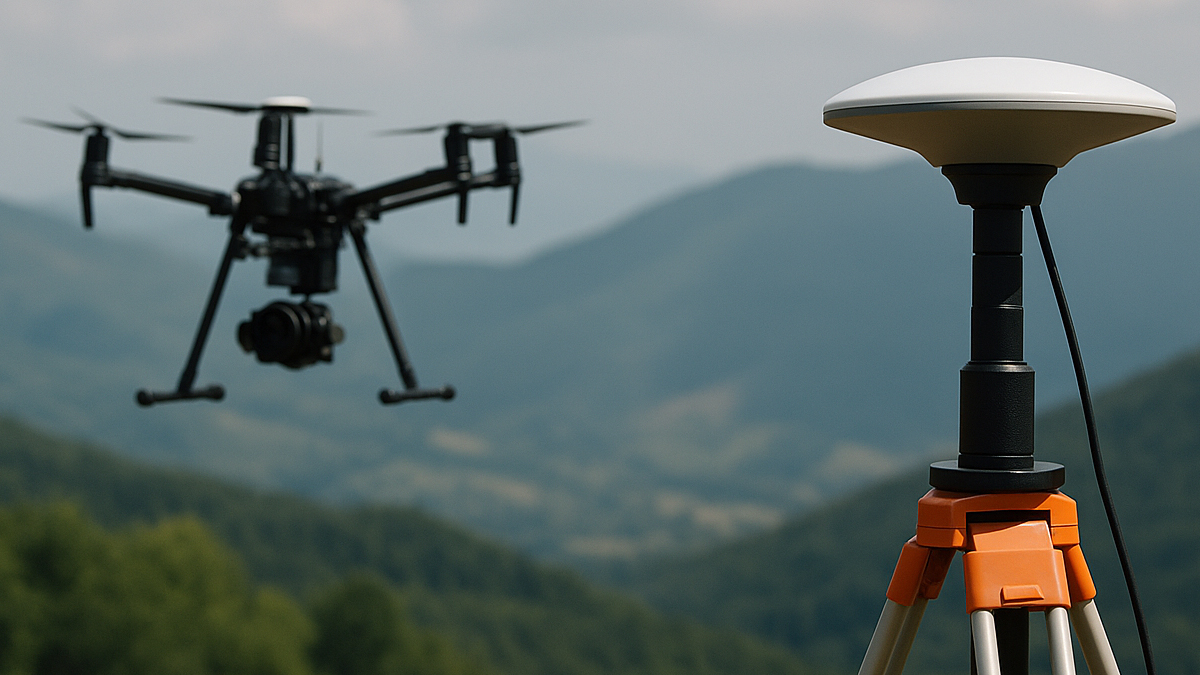
What is RTK Base Station?
RTK Base Station is a ground based reference system that helps drones achieve extremely accurate positioning. RTK stands for Real Time Kinematic. It is a method that improves the standard accuracy of satellite navigation by using correction data from a known fixed location. In simple terms, the base station sits at a precisely surveyed point on the ground and continuously measures satellite signals. It compares the position it calculates from satellites with its true known position. Then it generates correction data and sends it to a drone or to a network that the drone can access.
In drone cinematography, this level of accuracy is not a luxury. It is quickly becoming a creative and operational advantage. Standard GPS can drift by a meter or more depending on conditions. For casual flying that may be fine. But for precise cinematic moves, complex camera paths, and repeatable takes, a small drift can ruin a shot. RTK base stations reduce this error to a few centimeters under good conditions. This enables smoother flight lines, reliable hovering, consistent framing, and confident automation.
RTK base stations are part of a broader ecosystem that includes GNSS satellites, radio or internet data links, and RTK enabled drone receivers. When all pieces work together, the drone receives corrected positioning in real time. That is why many high end drone platforms used in professional productions support RTK, especially for mapping, surveying, and now increasingly for film and television work where precision and repeatability matter.
How does RTK Base Station Work?
The working principle is straightforward but technically elegant. The RTK base station receives signals from multiple satellite constellations such as GPS, GLONASS, Galileo, and BeiDou. Because the base station is placed at a known fixed coordinate, it can calculate the difference between where the satellites say it is and where it actually is. This difference is the positioning error caused by atmospheric delays, clock inaccuracies, orbital errors, and local signal conditions.
The base station then generates real time correction messages. These messages are typically based on carrier phase measurements, which are much more precise than basic code based GPS. The corrections are transmitted to the drone through one of two common methods.
Radio link
The base station broadcasts corrections over a dedicated frequency. The drone has a compatible receiver that listens to these corrections while flying.
Network link
The base station feeds corrections into an internet based RTK service. The drone connects via cellular or a ground control gateway and receives corrections through protocols such as NTRIP.
Once the drone receives this correction data, its onboard RTK receiver combines the satellite signals with the base station corrections. This process resolves ambiguities in carrier phase measurements and produces a highly precise position solution. The result is a drone that knows its location with centimeter level accuracy in real time.
For cinematography, the benefit is not only accuracy but also stability. The drone can hold position more tightly, follow pre planned routes more faithfully, and repeat a flight path across multiple takes with far less drift. This precision can transform how directors and drone pilots design shots.
What are the Components of RTK Base Station
An RTK base station system usually includes the following key elements.
GNSS receiver
This is the core sensor that tracks satellite signals. High quality multi band and multi constellation receivers improve accuracy and reliability.
GNSS antenna
The antenna is designed to reduce multipath errors and receive clean satellite signals. It is often mounted on a stable platform with a clear sky view.
Known reference point
The base station must be placed at a precisely known coordinate. Accuracy depends on correct surveying or reliable reference data.
Communication module
This can be a radio transmitter, a cellular modem, or an internet gateway. It sends correction data to the drone.
Power system
Permanent stations often use mains power with backup. Portable stations rely on batteries, sometimes with external power banks.
Mounting and leveling hardware
Stable mounting is critical. Tripods, fixed poles, or rooftop mounts help maintain consistent geometry.
Control and configuration software
Operators use software to set coordinate references, choose satellite systems, monitor signal health, and manage data output formats.
Data format and protocol support
Many base stations output RTCM correction messages. Network systems may support NTRIP streaming.
In the context of drone cinematography, portability and quick setup can be just as important as raw accuracy. Film crews may need compact base stations that can be deployed on location quickly, with minimal technical overhead.
What are the Types of RTK Base Station
RTK base stations come in several forms, each suited to different operational needs.
Single base portable station
This is a compact unit placed near the filming location. It is ideal for remote shoots where a network RTK service is unavailable. It offers strong local accuracy and does not rely on cellular coverage.
Permanent fixed base station
These are installed at studios, large production facilities, or long term outdoor venues. They provide consistent corrections for repeated use over weeks or months.
Network RTK stations
This type uses multiple fixed stations distributed across a region. The system computes corrections and delivers them via the internet. For film crews working in cities with good connectivity, this can reduce the need to carry their own base station.
Integrated manufacturer ecosystem stations
Some drone brands provide their own base stations designed to pair seamlessly with their RTK drones. These tend to offer easier setup and more reliable integration, which is attractive for fast paced production environments.
Hybrid base and rover setups
In specialized workflows, a crew may use a base station with additional rovers or reference receivers to support complex multi drone coordination or motion capture style positioning tasks.
Choosing the right type depends on shooting location, time constraints, connectivity, equipment budgets, and the need for repeatable precision.
What are the Applications of RTK Base Station
RTK base stations were originally widely used in surveying and mapping, but their applications now extend into many areas that overlap with cinematic production.
Precision drone navigation
Helps drones fly smoother and hold stable positions even in challenging environments.
Pre programmed autonomous flights
Allows accurate waypoint missions so the drone follows a designed camera path with minimal drift.
Repeatable takes
Enables the same flight path to be repeated across multiple takes, which is critical for VFX continuity.
Terrain and location scanning
Supports high accuracy aerial mapping for pre production planning, location modeling, and set extensions.
Virtual production workflows
Accurate drone positioning can be integrated with real time 3D environments, helping align real footage with digital elements.
Multi drone coordination
When multiple drones operate in the same airspace, precise positioning improves safety and path separation.
High precision inspection footage
In industrial documentary or branded content, RTK helps capture consistent close range footage of structures.
Event cinematography
Stadiums, festivals, and large outdoor events benefit from accuracy when flight paths must be predictable and compliant.
These applications show that RTK is not just a technical upgrade. It can influence planning, safety, creative imagination, and post production quality.
What is the Role of RTK Base Station in Cinema Industry
The cinema industry increasingly values accuracy, repeatability, and integration with digital pipelines. RTK base stations support all three.
First, they improve shot reliability. A drone holding position within centimeters can maintain composition more precisely. This matters for slow reveals, locked off aerial frames, or shots that require the drone to hover near obstacles while keeping a stable angle.
Second, RTK supports creative complexity. Directors can design intricate camera moves using waypoints and motion curves, knowing that the drone will follow the path closely. This is especially useful for shots that must match a storyboard or align with ground based camera moves.
Third, RTK enables advanced VFX workflows. When a drone can repeat the exact path, filmmakers can capture clean plates, multiple passes, or different lighting versions with better alignment. This reduces post production workload and increases realism in compositing.
Fourth, RTK plays an emerging role in data driven cinematography. As productions integrate drones with metadata capture, lens information, and spatial tracking, accurate position data becomes another valuable stream. It can help match camera movement in 3D space, support digital doubles, or assist in reconstructing environments.
In short, the role of RTK base stations in cinema is to bridge the gap between physical aerial filmmaking and precision digital production needs.
What are the Objectives of RTK Base Station
The objectives of using an RTK base station in drone cinematography and related cinematic technologies include the following.
Achieve centimeter level positional accuracy
This is the core technical goal.
Reduce drift during hovering and slow moves
Cleaner stability improves visual quality.
Enable reliable autonomous flight paths
Supports repeatable cinematic motion planning.
Improve safety through predictable navigation
Accurate positioning helps avoid unintended deviation.
Increase confidence in close proximity shooting
Useful when filming near structures or in controlled sets.
Support VFX and multi pass capture
Ensures spatial consistency between takes.
Reduce time lost to retakes
Better first take accuracy improves production efficiency.
Advance integration with virtual production systems
Aligns real world drone movement with digital environments.
These objectives highlight that RTK base stations serve both artistic and operational priorities.
What are the Benefits of RTK Base Station
The benefits are tangible for pilots, directors, and post production teams.
Higher shot precision
The drone maintains tighter lines and stable frames.
Better repeatability
Repeating a shot becomes realistic rather than approximate.
Reduced post production alignment issues
VFX teams benefit from more consistent camera movement.
Improved safety margins
Precise navigation lowers risk in complex environments.
Higher quality automated shots
Waypoint based cinematography becomes more dependable.
More efficient location workflows
Accurate mapping and spatial data can speed planning.
Increased creative control
Filmmakers can design moves with finer detail.
Greater reliability in difficult GNSS conditions
In some environments, RTK helps maintain performance, though it still depends on signal quality.
Overall, RTK base stations help shift drone cinematography from an art that often depends on manual finesse to a craft that can also rely on repeatable precision.
What are the Features of RTK Base Station
A high quality RTK base station designed for serious drone work typically offers these features.
Multi constellation support
Uses multiple satellite systems for stronger coverage.
Multi frequency tracking
Improves accuracy and faster ambiguity resolution.
High quality antenna design
Helps reduce multipath and noise.
Real time correction output
Provides continuous data streaming.
Compatibility with common correction formats
Often supports RTCM standards.
Flexible communication options
Radio and network streaming capabilities.
Portable and rugged build
Useful for outdoor production locations.
Fast setup and easy calibration
Saves valuable production time.
Battery efficiency
Supports long shooting days without constant power changes.
Monitoring and status indicators
Provides clear feedback on satellite lock, correction quality, and transmission health.
In filmmaking, ease of use is a practical feature just as important as technical specs. A base station that is accurate but difficult to deploy may not suit fast moving shoots.
What are the Examples of RTK Base Station
Examples can be understood in two ways. One is real products within drone ecosystems. Another is common real world setups used by production teams.
Manufacturer integrated RTK stations
Some professional drone systems support dedicated base stations designed to pair with their aircraft and controllers. These are often preferred by film crews because they reduce configuration complexity.
Survey grade portable GNSS base stations
These can be used with drones that support standard correction protocols. They may require more setup knowledge but deliver excellent accuracy.
Regional network RTK services
In areas with strong cellular coverage, crews can subscribe to an RTK correction provider instead of carrying a physical base station.
Studio campus fixed stations
Large production facilities may install permanent base stations that support repeated drone work for commercials, vehicle shoots, or backlot environments.
These examples show that the concept of an RTK base station is flexible. The best choice depends on workflow, budget, and location constraints.
What is the Definition of RTK Base Station
RTK Base Station can be defined as a fixed GNSS reference system placed at a precisely known coordinate, which generates and transmits real time correction data to improve the positional accuracy of a mobile receiver such as a drone.
This definition highlights three essentials. It is fixed. It is precisely located. It transmits corrections in real time.
What is the Meaning of RTK Base Station
The meaning of RTK Base Station in practical terms is a tool that allows a drone to know where it is with far greater confidence than standard satellite navigation alone.
For drone cinematography, this meaning extends beyond engineering. It becomes a creative enabler. It means that a pre planned aerial shot can be trusted. It means that multiple passes can match. It means that the drone can behave like a precision camera rig rather than a floating platform subject to subtle navigation drift.
So the meaning is both technical accuracy and cinematic reliability.
What is the Future of RTK Base Station
The future of RTK base stations in drone cinematography looks promising and likely to expand in several directions.
Wider adoption in mainstream film drones
As costs decrease and integration improves, more cinema oriented drones will include RTK as a standard option.
Tighter integration with automation and AI
RTK will likely support smarter flight planning, obstacle aware path correction, and adaptive camera movement.
Growth of network RTK availability
More regions are building correction networks, which could reduce reliance on carrying a local base station.
Enhanced metadata pipelines
Future cinematic workflows may record RTK positioning data alongside camera settings and lens metadata, improving post production tracking and virtual production alignment.
Better performance in complex environments
Advances in antenna design, multi band receivers, and fusion with vision based positioning may provide more robust accuracy near buildings or in partially obstructed areas.
Multi drone cinematic choreography
As drone swarms and coordinated aerial rigs evolve for entertainment and live events, RTK style precision may be central to safe and synchronized movement.
Even with these advances, filmmakers will still need skilled pilots, careful planning, and responsible safety practices. RTK improves the foundation of precision but does not remove the need for professional judgment.
Summary
- RTK Base Station is a ground reference unit that sends correction data to drones for centimeter level positioning accuracy.
- It works by comparing satellite calculated position with a known fixed coordinate and transmitting the difference as real time corrections.
- Key components include a GNSS receiver, high quality antenna, stable mounting, power system, and a communication link.
- Types include portable single base units, permanent fixed stations, and region wide network RTK services.
- Applications range from precise navigation and waypoint flights to high accuracy mapping and multi drone coordination.
- In the cinema industry, RTK supports stable framing, complex automated shots, and repeatable takes for VFX workflows.
- Objectives focus on reducing drift, improving safety, enabling reliable automation, and strengthening integration with digital production pipelines.
- Benefits include better shot consistency, fewer retakes, stronger post production alignment, and increased creative control.
- Features often include multi constellation support, multi frequency tracking, flexible data links, and production friendly portability.
- The future points toward broader adoption, smarter automation, deeper virtual production integration, and more robust hybrid positioning systems.

