

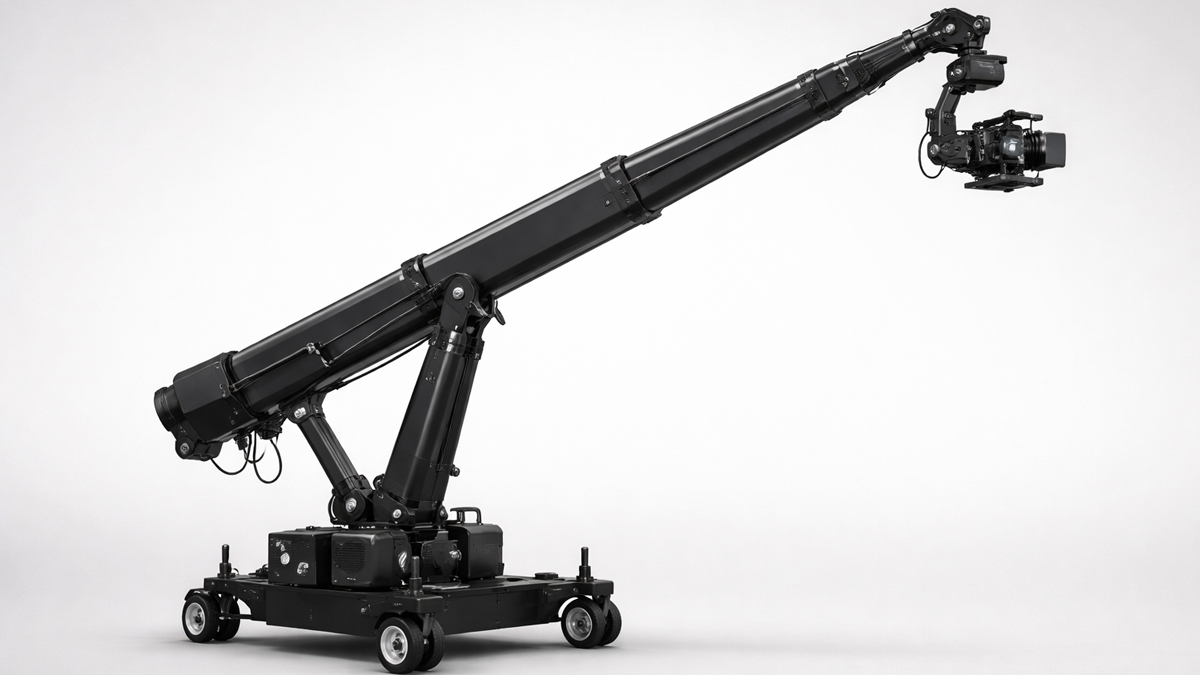
What is Telescoping Camera Crane?
A telescoping camera crane is a camera support system designed to lift, extend, and move a camera smoothly through space while the crane arm can lengthen and shorten during the shot. In the world of robotic camera rigs under cinematic technologies in the cinema industry, it is one of the most practical tools for achieving dynamic camera movement with precise repeatability. Unlike a fixed length jib, a telescoping crane can change its reach in real time. That single ability unlocks shots where the camera glides forward, rises, and pushes into a subject while also extending its arm, all in one continuous motion.
In filmmaking terms, a telescoping camera crane combines height, reach, and controlled motion into one platform. It can create dramatic reveals, sweeping establishing moves, tight push ins that feel like the camera is floating, and elegant transitions that would be difficult to achieve with handheld, tripod, or even a standard dolly. Modern versions frequently integrate motorized controls, encoded positions, stabilized heads, and software driven motion programming, which is why they fit naturally into the robotic camera rig category. The crane becomes more than a metal arm. It becomes a programmable movement system that can be tuned for speed, acceleration, smoothness, and repeatability.
A key point is that telescoping is not only about going farther. It is also about changing perspective without changing the base position too much. On many sets, space is limited. A telescoping crane can stay planted in a safe area while its arm reaches over obstacles, furniture, crowd lines, or set walls. This makes it valuable for commercials, feature films, episodic series, live studio work, and high end digital content, where the shot must look expensive, controlled, and intentional.
How does Telescoping Camera Crane Work?
A telescoping camera crane works by extending and retracting sections of its arm, often called stages, while the crane also performs the usual crane motions such as pan, tilt, boom up and down, and sometimes track movement if mounted on a dolly or platform. The telescoping action is typically driven by internal mechanisms such as belts, chains, cables, screw drives, or hydraulic systems, depending on the model and design. In modern robotic camera rigs, the extension axis is motorized and controlled through a system that can synchronize extension with other axes.
At the simplest level, the operator sets the crane on a stable base with counterbalance or a balanced design, mounts a camera at the end using a head, and then moves the arm to position the camera. In more advanced systems, the crane is paired with a remote head and a motion controller. The operator can stand away from the crane and control pan and tilt on the camera head, boom movement of the arm, and the telescoping extension. With encoded motors, the crane knows its position at every moment. This enables repeatable moves, which is critical for visual effects, motion control, and multi pass shooting.
The control workflow usually involves three layers. First is mechanical structure, which provides rigidity, safety, and smooth motion. Second is actuation, which is the motors or hydraulic components that move each axis. Third is control logic, which can be manual control, joystick control, keyframe programming, or software based path planning. In a robotic environment, the crane can be taught a move by physically operating it once and recording the motion. Then it can replay it exactly, or replay it with changes to speed, timing, or easing. This repeatability turns a camera move into data that can be reused across takes, lighting setups, or different VFX elements.
Safety and stability are part of how it works in practice. As the arm extends, leverage increases and load characteristics change. Good telescoping cranes use design strategies like internal reinforcement, balanced geometry, and counterweight systems so the motion remains stable and predictable. Many systems also include limit sensors, emergency stop functions, and software constraints to prevent the crane from extending into unsafe zones.
What are the Components of Telescoping Camera Crane?
A telescoping camera crane is made up of structural, motion, and control components that work together to deliver smooth and secure camera movement.
Base and support platform: The foundation that keeps the crane stable. It may be a tripod like base, a pedestal, a ground spreader system, a wheeled base, or a track mounted dolly interface. The base must manage the shifting forces created when the arm extends and moves.
Telescoping arm sections: Multiple nested stages that slide in and out. These sections define the extension range. The engineering focus here is stiffness, low flex, and consistent movement under load.
Extension drive mechanism: The system that physically extends and retracts the arm. Depending on the crane, it can be belt driven, chain driven, cable driven, hydraulic, or screw driven. This mechanism must be smooth and must hold position without slipping.
Boom and lift system: The parts that allow the arm to rise and fall. Some cranes use manual boom control with counterbalance, while robotic versions use motorized lift with encoded feedback.
Counterweight or balance system: Many cranes rely on counterweights to balance the camera payload and the arm. Robotic telescoping cranes may be designed for balanced motion with fewer external weights, but stability is still achieved through careful load management.
Camera head or remote stabilized head: The camera is usually mounted to a head that controls pan and tilt, and sometimes roll. In robotic rigs, this is often a remote head with motors and sometimes 3 axis stabilization for smoother results.
Payload mounting and quick release: Plates, dovetail systems, and quick release mechanisms that allow fast and secure camera mounting. Professional workflows demand repeatable positioning and minimal play.
Control system and user interface: This includes joysticks, control panels, hand wheels, or software interfaces that let operators run the crane. Advanced systems allow keyframing, speed ramping, and synchronization with other equipment.
Encoders and sensors: Position sensors provide feedback on extension length, boom angle, pan, tilt, and other axes. Encoders are essential for repeatable motion control and for integrating with VFX pipelines.
Power system and cabling: Cables for power, video, and control signals run through the crane. Many rigs aim for clean internal cable routing to avoid snagging during telescoping motion.
Safety systems: Emergency stop buttons, limit switches, soft limits in software, overload monitoring, and mechanical locks. These protect crew, talent, and equipment.
What are the Types of Telescoping Camera Crane?
There are several types of telescoping camera cranes, and each type suits different production needs, budgets, and shooting styles.
Manual telescoping camera cranes: These cranes allow the arm to extend and retract through a manual mechanism, sometimes assisted by counterbalance. They are useful where budgets are limited or where the move does not require precise repeatability. Operators rely on skill for smooth extension.
Motorized telescoping camera cranes: The extension axis is powered by a motor, enabling smoother and more consistent extension, especially during long takes. Motorized extension also reduces operator fatigue and improves precision.
Robotic telescoping camera cranes: These are fully integrated robotic camera rigs where extension, boom, and sometimes base rotation are motorized and encoded. They are designed for repeatable moves, automation, and precise control. They are widely used in commercials, high end studios, and VFX heavy shoots.
Telescoping cranes with remote heads: In this type, the telescoping arm may be manual or motorized, but the camera head is remote controlled. This allows separate control of crane movement and camera framing, improving shot accuracy.
Telescoping cranes with stabilized heads: These cranes pair with a stabilized gimbal style head. The crane provides large scale movement while stabilization reduces micro vibrations and smooths operator imperfections, ideal for longer lenses and high resolution capture.
Studio telescoping cranes: Built for controlled environments like TV studios, stages, and multi camera setups. These often prioritize reliability, repeatability, and integration with broadcast control systems.
Compact telescoping cranes: Designed for tight spaces, small crews, and lighter camera payloads. They are common in smaller productions, online content, and location shoots with limited access.
Heavy duty telescoping cranes: Designed to carry larger cinema camera packages, heavier lenses, and complex accessories. They offer longer reach and higher rigidity, but require more setup effort and careful safety procedures.
What are the Applications of Telescoping Camera Crane?
Telescoping camera cranes have broad applications across cinema and related production environments because they can deliver cinematic movement while adapting to space constraints and creative demands.
Feature films and episodic drama: They are used for sweeping reveals, emotional push ins, and elegant scene transitions. Telescoping movement helps directors add depth and scale without cutting.
Commercials and brand films: Precision and repeatability are important in commercials, especially when timing must match product action, talent movement, or lighting cues. A telescoping crane can produce premium, polished motion.
Music videos: The crane can create energetic movement, rising and plunging shots, and fast transitions that feel larger than life. Telescoping extension adds an extra layer of visual rhythm.
Live studio production and broadcast: In studios, controlled cranes can repeat moves for multiple takes, rehearsals, and live segments. Telescoping reach helps get over set pieces and into tight zones without moving the base.
Visual effects and motion control plates: Repeatable motion is essential when capturing multiple passes, such as clean plates, effects passes, and lighting reference passes. Robotic telescoping cranes can replay moves with high consistency.
Virtual production and LED volume stages: Camera movement data can feed tracking systems. Telescoping cranes can offer dramatic moves while maintaining stable tracking, supporting realistic parallax and perspective shifts.
Sports and event coverage: In certain controlled setups, cranes offer smooth overhead shots, crowd reveals, and dynamic coverage. Telescoping reach helps adjust framing quickly.
Architectural and interior filming: In tight interiors, the crane can extend over furniture, through doorways, and into rooms while the base stays outside the frame line.
Automotive and product cinematography: Telescoping cranes are excellent for controlled, repeatable moves around a vehicle or product set, especially when combined with a stabilized head and motion programming.
What is the Role of Telescoping Camera Crane in Cinema Industry?
In the cinema industry, a telescoping camera crane plays the role of a movement storyteller. It is not only a tool for spectacle. It is a tool for guiding attention, shaping emotion, and revealing information at the right moment. Because the arm can change length during the move, the crane can create camera motion that feels intentional and layered. The result is often more immersive and more polished than simpler camera support methods.
From a production standpoint, the crane also serves as a bridge between classic cinematography and modern robotic workflows. Traditional cranes require strong operator skill and coordination with a camera operator. Robotic telescoping cranes add precision, repeatability, and programmable control. This makes them valuable in a cinema environment that increasingly relies on visual effects, virtual production, and complex lighting setups where continuity and repeatability matter.
Another key role is safety and efficiency. Many shots that would require risky camera placement or complex rigging can be achieved by extending a crane from a safe base location. This reduces the need to place operators in difficult positions, and it can reduce the time spent rebuilding camera support between setups. When time is money, the ability to get a wide establishing move and then quickly shift into a close push in, without completely changing the rig, is extremely valuable.
The telescoping camera crane also supports creative consistency. Directors and cinematographers often want a signature movement style across a sequence. With robotic control, the crane can repeat a move across takes and match timing across multiple shots. This helps editors, VFX teams, and colorists because the motion is predictable and consistent.
What are the Objectives of Telescoping Camera Crane?
A telescoping camera crane is built and used to achieve specific objectives that serve both creative storytelling and production practicality.
Create smooth cinematic motion: The primary objective is to achieve fluid movement that feels natural and intentional, improving production value and audience immersion.
Enable variable reach during a shot: The telescoping function allows the camera to move closer or farther without moving the base, enabling complex perspective shifts within one take.
Support precise framing and composition: With remote heads and control systems, the crane helps maintain accurate framing even during dramatic movement.
Improve repeatability for complex shoots: In robotic and motorized systems, an objective is to record and replay the same move for multiple takes, VFX passes, or matched shots.
Reduce physical constraints on set: The crane objective includes reaching over obstacles and into tight spaces where a dolly or operator cannot easily go.
Increase safety for crew and talent: Keeping the base stable and operators at a distance can reduce risk, especially in stunts, crowded sets, or challenging environments.
Integrate with modern production pipelines: Another objective is compatibility with motion control, virtual production tracking, and synchronized systems like lighting cues or playback.
Enhance efficiency during shooting: Telescoping cranes can reduce time spent repositioning equipment, allowing faster transitions between shot sizes and angles.
What are the Benefits of Telescoping Camera Crane?
Telescoping camera cranes offer benefits that impact image quality, storytelling, and production efficiency.
Greater creative freedom: The ability to extend and retract during a move creates shot options that are difficult to replicate with fixed length cranes or dollies.
Space efficient operation: You can keep the base in a practical position while the arm reaches into areas that would otherwise require moving track or relocating support gear.
Smooth and stable motion: Professional cranes are designed for controlled acceleration and minimal vibration. This smoothness is visually noticeable, especially on longer lenses and high resolution cameras.
Repeatability and precision: Robotic versions can replay moves very accurately, supporting visual effects workflows and consistent multi take performance.
Better control over speed and easing: Motorized control allows refined speed ramps, gentle starts, and soft stops, giving the movement a premium cinematic feel.
Versatility across shot types: The same rig can deliver wide establishing moves, overhead sweeps, and tight push ins, which can reduce equipment changes.
Improved safety: Remote operation keeps crew away from moving arms and heavy equipment zones, and limits the need for risky camera placement.
Professional look for brands and narratives: The crane adds a sense of scale and polish that audiences associate with high production value.
What are the Features of Telescoping Camera Crane?
Telescoping camera cranes are defined by a set of features that make them practical for professional production.
Telescoping extension axis: The core feature that allows variable reach. High quality systems deliver smooth, consistent extension without noticeable jerks.
Rigid multi stage construction: The arm is built to maintain stiffness as it extends. Good design minimizes flex and vibration.
Motorized and encoded controls: Many cranes offer powered movement and encoders that track exact positions, enabling repeatability and integration with motion control.
Remote head compatibility: The crane typically supports remote pan and tilt heads for precise framing control during movement.
Stabilization support: Many setups pair the crane with stabilization systems to reduce micro shake, especially on long lenses.
Programmable motion and keyframes: Robotic cranes often allow moves to be programmed, edited, and replayed with consistent timing.
Clean cable management: Internal routing and slip ring options can keep cables from snagging during telescoping and rotation.
Payload versatility: The crane is built to handle a range of camera weights, from compact digital cinema cameras to heavier cinema builds depending on model.
Safety and limit systems: Mechanical and software limits, emergency stop functions, and load monitoring protect both people and equipment.
Modular configuration: Many cranes support accessories like track mounts, wheeled bases, risers, and different head options to match the shoot.
What are the Examples of Telescoping Camera Crane?
Examples of telescoping camera crane usage can be understood through real production scenarios, because the same tool can serve many creative goals.
A wide to close reveal in a dialogue scene: The camera starts wide, showing both characters and the environment. As the emotional tension rises, the crane slowly extends and moves closer to one character, tightening the frame without a cut.
An overhead to eye level transition: The crane begins high above a set, showing the layout of a room. It then booms down while retracting slightly to maintain smooth perspective, ending at eye level for an intimate moment.
A product hero shot in a commercial: The camera glides toward a product while extending the arm, creating a controlled push in that matches lighting cues and on screen graphics timing.
A moving crowd shot: The crane reaches above a crowd line, then extends forward to follow a subject moving through people, keeping the base out of the way and maintaining safety.
A VFX plate capture: A robotic telescoping crane performs a programmed move multiple times, first with actors, then as a clean plate, then with practical effects elements. The repeatability allows VFX compositing to align perfectly.
A virtual production camera move: On an LED stage, the crane moves while tracking data is used to render background perspective shifts. Telescoping extension helps adjust parallax intensity without changing the base position.
What is the Definition of Telescoping Camera Crane?
A telescoping camera crane is a camera support crane with an extendable arm composed of nested sections that can lengthen and shorten, enabling controlled camera movement in reach, height, and direction during filming. In robotic camera rigs within cinematic technologies in the cinema industry, it often includes motorized axes, encoded positioning, and remote control for precision and repeatability.
What is the Meaning of Telescoping Camera Crane?
The meaning of telescoping camera crane comes from the idea of telescoping motion, where one section slides into another like a collapsible instrument. In practical cinema terms, it means the crane arm can change its length while operating, giving filmmakers the ability to alter camera distance and perspective smoothly during a shot. It represents flexible reach combined with cinematic motion control, often enhanced by robotics for accuracy and repeated performance.
What is the Future of Telescoping Camera Crane?
The future of telescoping camera cranes is strongly connected to the broader evolution of robotic camera rigs and data driven filmmaking. As productions demand faster workflows and more complex shots, telescoping cranes are likely to become more intelligent, more compact, and more integrated with software ecosystems.
Automation and smarter control systems: Future cranes will likely offer improved motion programming tools, smoother path planning, and easier ways to design moves through intuitive interfaces. Operators may use tablet based systems, visual timelines, and prebuilt movement templates to create cinematic motion quickly.
Deeper integration with virtual production: As LED volume stages become more common, telescoping cranes will increasingly integrate with camera tracking systems and real time rendering pipelines. Better synchronization between crane movement and virtual environments will help create more believable parallax and consistent lighting interaction.
Improved stabilization and vibration management: With higher resolution sensors and longer focal lengths, tiny vibrations become more visible. Future designs may improve stiffness, add smarter damping, and integrate stabilization more seamlessly so shots remain clean even at maximum extension.
Lightweight materials and modular design: Advances in materials and engineering can reduce weight while maintaining rigidity. This could make telescoping cranes easier to transport, faster to set up, and more accessible for smaller crews.
More precise repeatability and data capture: Motion control demands will continue to grow, especially for visual effects, product work, and high end advertising. Future cranes may include higher resolution encoders, better calibration tools, and direct export of motion data for post production alignment.
Safety enhancements: Expect more advanced collision avoidance features, better zone control, and improved monitoring systems. These features will help prevent accidents on busy sets and enable closer operation near talent and set pieces.
Accessibility for more creators: As technology matures, some features that were once limited to high budget productions may appear in more affordable systems. This can bring telescoping crane style motion into mid level and independent filmmaking more often.
Summary
- A telescoping camera crane is an extendable camera crane that can lengthen and shorten its arm during a shot for dynamic cinematic movement.
- It works by combining crane motion with a telescoping extension mechanism, often motorized and encoded in robotic systems for precision.
- Key components include the base, telescoping arm stages, extension drive, lift system, counterbalance, remote head, sensors, power, and safety controls.
- Types range from manual and motorized cranes to fully robotic systems, including studio, compact, and heavy duty variants.
- Applications include feature films, commercials, music videos, broadcast studios, VFX motion control, virtual production, interiors, and product cinematography.
- In the cinema industry, it supports storytelling through smooth reveals and perspective shifts while improving safety and repeatability.
- Objectives include smooth movement, variable reach, accurate framing, repeatable motion, space efficiency, safety, pipeline integration, and faster production flow.
- Benefits include creative flexibility, stable motion, precise control, repeatable takes, efficient set operation, and a premium cinematic look.
- Future trends point toward smarter automation, stronger virtual production integration, better stabilization, lighter materials, richer motion data, and improved safety features.

