

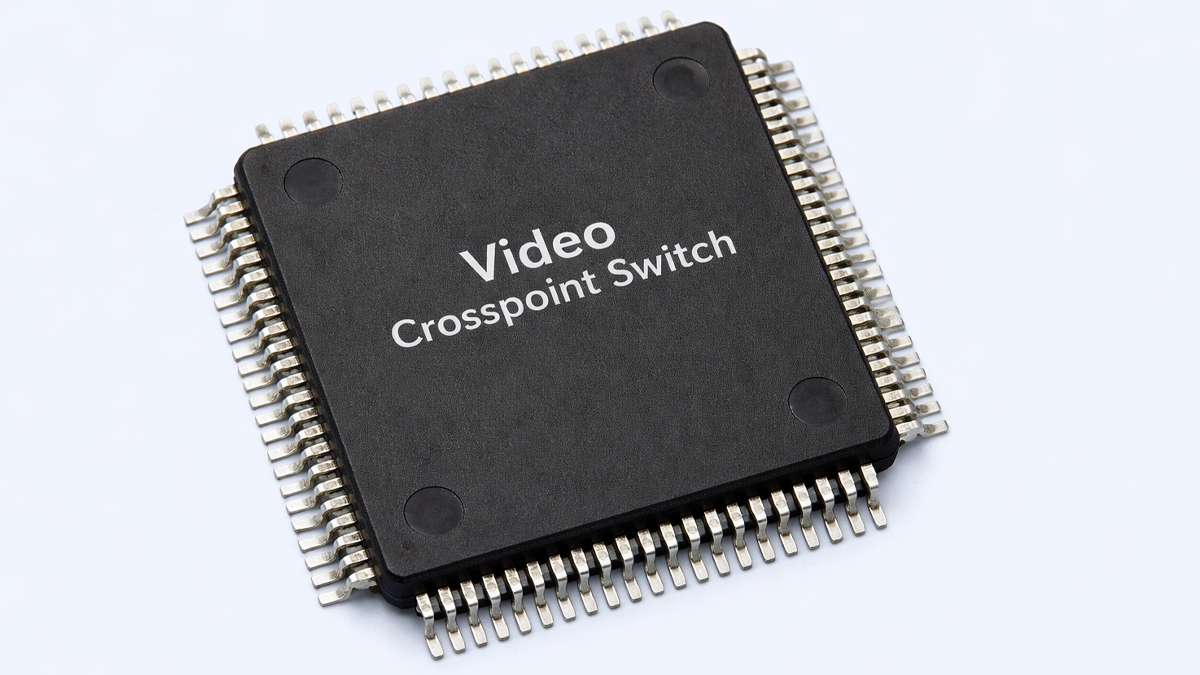
What is Video Crosspoint Switch IC?
Basic concept and overview: A Video Crosspoint Switch IC is a specialized integrated circuit designed to route multiple video input signals to multiple video output paths in a fully flexible manner. In simple terms, it allows any video input to be connected to any video output, or even to multiple outputs at the same time, based on control instructions. This switching happens electronically inside the silicon chip without altering the video content itself. The IC acts as a high speed traffic controller for video signals, ensuring that each signal reaches its intended destination with accuracy and minimal delay.
Position within integrated circuits and cinematic electronics: Within the broader category of integrated circuits, the Video Crosspoint Switch IC belongs to signal routing and switching devices. Under cinematic electronics, it plays a foundational role by enabling complex video distribution systems used in theaters, post production studios, broadcast rooms, and digital cinema projection environments. Cinema systems rely on precise video routing to maintain image integrity, synchronization, and creative flexibility, all of which are supported by this IC.
Importance in the cinema industry: Modern cinema setups no longer depend on a single video source and a single display. They involve multiple cameras, servers, media players, projectors, monitoring displays, and backup systems. A Video Crosspoint Switch IC makes it possible to dynamically select, switch, and distribute video feeds without physically reconnecting cables. This capability is essential for smooth cinematic operations, both during live events and controlled film presentations.
How does Video Crosspoint Switch IC Work?
Signal routing principle: The working of a Video Crosspoint Switch IC is based on a matrix architecture. Internally, the chip contains a grid of electronic switches arranged at the intersection points between inputs and outputs. Each intersection point, known as a crosspoint, can be activated or deactivated through digital control logic. When activated, a specific input signal is electrically connected to a selected output channel.
Control and configuration process: The IC is controlled by a digital interface such as I2C, SPI, or parallel control lines. A controlling processor or controller sends commands that specify which input should be connected to which output. The IC interprets these commands and configures the internal switching matrix accordingly. This process occurs extremely fast, allowing near instantaneous video switching without visible artifacts.
Preservation of video quality: A critical aspect of how the Video Crosspoint Switch IC works is that it does not decode, re encode, or modify the video signal. Instead, it maintains signal amplitude, timing, and frequency characteristics. High bandwidth analog or digital paths ensure that resolution, color depth, and frame rate remain unchanged, which is vital for cinematic image quality.
What are the Components of Video Crosspoint Switch IC?
Input buffers and receivers: These components receive incoming video signals from external sources. They condition the signal by matching impedance, stabilizing voltage levels, and protecting the internal circuitry. Input buffers ensure that weak or long cable signals are properly handled without degradation.
Switching matrix core: The switching matrix is the heart of the Video Crosspoint Switch IC. It consists of an array of controllable electronic switches that create flexible connections between inputs and outputs. Each switch is designed to operate at high speed and high bandwidth, supporting modern video formats used in cinema systems.
Output drivers and amplifiers: Output stages drive the selected video signal to external devices such as projectors, monitors, or recorders. These drivers ensure correct signal strength and integrity, even when driving long cables or multiple devices simultaneously.
Control logic and registers: Control logic interprets configuration commands and manages the state of the switching matrix. Internal registers store routing information, default states, and operational parameters. This logic ensures stable and predictable behavior during video switching.
Power management and protection circuits: These circuits regulate internal voltages and protect the IC from electrical faults such as overvoltage or thermal overload. In cinema environments where equipment runs for long hours, reliable power management is essential.
What are the Types of Video Crosspoint Switch IC?
Analog video crosspoint switch ICs: These ICs handle analog video signals such as composite, component, or RGB video. They are often used in legacy cinema equipment, video walls, and analog monitoring systems. Their design focuses on low noise, wide bandwidth, and minimal signal distortion.
Digital video crosspoint switch ICs: Digital variants route digital video data formats such as SDI, HDMI, or DisplayPort at the electrical signal level. They support high data rates and strict timing requirements, making them suitable for modern digital cinema infrastructure.
High definition and ultra high definition switch ICs: These types are optimized for high resolution formats including 4K and beyond. They feature increased bandwidth, improved signal isolation, and advanced equalization techniques to maintain quality at higher data rates.
Multi output broadcast grade switch ICs: Designed for professional environments, these ICs allow one input to be distributed to many outputs simultaneously. This is especially useful in cinema control rooms and broadcast style setups within large theaters.
What are the Applications of Video Crosspoint Switch IC?
Cinema projection systems: In digital cinema projection, multiple content servers and backup sources may be connected to one or more projectors. A Video Crosspoint Switch IC enables seamless source selection without interrupting playback.
Post production and editing studios: Editing suites often require switching between different video feeds, preview outputs, and reference monitors. The IC allows editors to route signals quickly and accurately during the creative process.
Live cinema events and screenings: For live broadcasts, special screenings, or film festivals, video sources may change frequently. Crosspoint switch ICs support real time switching to accommodate dynamic event requirements.
Quality control and monitoring systems: Cinema operators use multiple monitoring displays to verify signal quality, color accuracy, and synchronization. Video crosspoint switches allow the same signal to be routed to different monitoring stations as needed.
What is the Role of Video Crosspoint Switch IC in Cinema Industry?
Enabling flexible signal distribution: The cinema industry relies on adaptability. A Video Crosspoint Switch IC allows operators to reconfigure video signal paths without physical changes, saving time and reducing errors.
Supporting redundancy and reliability: Cinemas require high reliability to avoid interruptions during screenings. Crosspoint switch ICs support redundant sources and instant switching, ensuring continuous playback even if a primary source fails.
Enhancing operational efficiency: By centralizing video routing control, these ICs reduce the complexity of cinema wiring systems. This leads to cleaner installations, easier maintenance, and faster troubleshooting.
Preserving cinematic image quality: Since the IC does not alter the video content, it helps maintain the original visual intent of filmmakers, which is a core value in the cinema industry.
What are the Objectives of Video Crosspoint Switch IC?
Accurate video routing: The primary objective is to provide precise and reliable routing of video signals from multiple inputs to selected outputs without error.
Minimal signal degradation: The IC is designed to maintain signal integrity, ensuring that brightness, contrast, color, and timing remain consistent throughout the signal path.
Fast and seamless switching: Cinema environments demand quick transitions between sources. The IC enables near instantaneous switching to meet this requirement.
System scalability: Another objective is to allow cinema systems to scale easily by adding more inputs and outputs without redesigning the entire signal chain.
What are the Benefits of Video Crosspoint Switch IC?
Improved system flexibility: Cinemas can adapt to different content sources and presentation formats with ease.
Reduced hardware complexity: One IC can replace numerous mechanical switches and manual routing setups.
Enhanced reliability: Solid state switching improves durability and reduces the risk of mechanical failure.
Cost efficiency over time: Although advanced ICs may have higher initial costs, they reduce maintenance and operational expenses in the long run.
What are the Features of Video Crosspoint Switch IC?
High bandwidth support: Modern ICs are designed to handle the high data rates required for high resolution cinematic video.
Low crosstalk and noise: Advanced internal design minimizes interference between channels, preserving image clarity.
Programmable control interface: Flexible control options allow integration with cinema automation systems.
Compact and integrated design: Being an integrated circuit, it saves space and allows dense system designs.
Thermal and electrical stability: Features such as temperature monitoring and fault protection ensure stable operation during long cinema sessions.
What are the Examples of Video Crosspoint Switch IC?
Professional cinema routing ICs: These include high channel count devices used in digital cinema servers and routing frames.
Broadcast grade video switch ICs: Often adapted for cinema use, these ICs meet stringent quality and reliability standards.
High speed digital matrix ICs: Used in advanced projection and display systems that require ultra high resolution support.
Custom application specific ICs: Some cinema manufacturers design custom crosspoint switch ICs tailored to proprietary systems and workflows.
What is the Definition of Video Crosspoint Switch IC?
Formal definition: A Video Crosspoint Switch IC is an integrated electronic device that enables programmable routing of multiple video input signals to multiple video output channels through an internal switching matrix while preserving signal integrity and timing.
What is the Meaning of Video Crosspoint Switch IC?
Conceptual meaning: The meaning of a Video Crosspoint Switch IC lies in its ability to provide freedom and control over video signal flow. It represents a bridge between creative content sources and presentation systems, allowing cinema operators to manage complex video paths with simplicity and precision.
What is the Future of Video Crosspoint Switch IC?
Support for higher resolutions and frame rates: As cinema technology evolves toward higher resolutions and immersive formats, Video Crosspoint Switch ICs will continue to expand bandwidth and performance capabilities.
Integration with intelligent control systems: Future ICs will likely include enhanced diagnostics, monitoring, and automation features to support smart cinema environments.
Energy efficiency and thermal optimization: With sustainability becoming a priority, future designs will focus on reducing power consumption while maintaining performance.
Greater integration and miniaturization: Continued semiconductor advancements will allow more functionality to be integrated into smaller IC packages, enabling compact and modular cinema systems.
Summary
- Video Crosspoint Switch ICs are essential integrated circuits for flexible video routing in cinematic electronics
- They enable fast, reliable, and high quality switching between multiple video sources and displays
- These ICs preserve video integrity by avoiding signal modification or processing
- They support scalability, redundancy, and operational efficiency in cinema systems
- Ongoing advancements will align them with future cinema technologies and higher performance demands

