

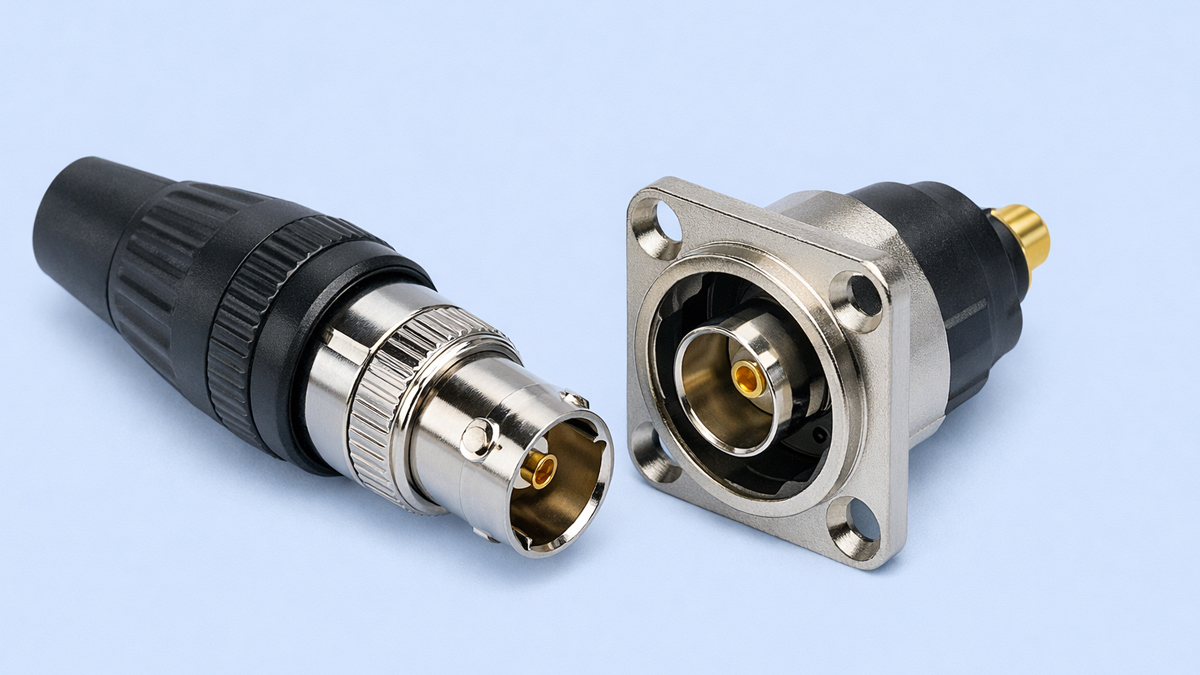
What is 6G SDI Connector?
A 6G SDI connector is a professional video connector used to carry 6G SDI video signals through coaxial cable in broadcast and cinema production workflows. SDI stands for Serial Digital Interface. The 6G part refers to a data rate of about 6 gigabits per second, which is commonly used to transport higher resolution video formats and higher frame rates than older SDI generations.
In simple terms, a 6G SDI connector is the physical interface that allows a camera, recorder, monitor, switcher, router, or distribution device to send and receive a high quality uncompressed digital video signal reliably. It is widely used because it is robust, locking, and designed for real world production conditions where cables may be long, equipment may move, and signal integrity matters.
In cinematic electronics, the 6G SDI connector sits at the point where image data leaves one device and enters another without needing compression. That matters because compression can add delay, artifacts, and complexity. Many cinema and broadcast pipelines depend on predictable quality and timing, and SDI systems are built to provide that consistency.
6G SDI sits between earlier SDI generations like HD SDI and 3G SDI and later ones like 12G SDI. It is often chosen when productions want more bandwidth than 3G SDI offers, but do not need the full 12G SDI ecosystem or when existing infrastructure supports 6G better in a specific facility or workflow.
How does 6G SDI Connector Work?
A 6G SDI connector works by providing a controlled impedance path between a coaxial cable and the input or output circuitry of SDI equipment. The connector itself does not generate the signal. It is the interface that preserves signal integrity by maintaining proper impedance matching, shielding, and secure mechanical contact.
Signal path: A 6G SDI signal is generated by a transmitter inside a camera or video device. That signal is a high speed serial stream of digital bits representing video, audio, and ancillary data. The stream travels along a 75 ohm coaxial cable, and the connector ensures that the cable is properly terminated at each end.
Impedance control: SDI relies on consistent impedance. If impedance is not maintained, reflections can occur. Reflections are like echoes in the cable that distort the signal. At 6G speeds, even small imperfections can cause errors. The connector geometry, dielectric spacing, and contact design are engineered to maintain 75 ohms as closely as possible.
Shielding and noise immunity: The outer shell of the connector bonds to the cable shield and the device chassis ground. This creates an electromagnetic barrier that reduces interference from wireless devices, motors, lighting systems, and other electronics that are common on sets and in studios.
Locking and stability: Many 6G SDI connectors are based on BNC style locking. The locking action prevents accidental disconnection and maintains stable contact pressure, which reduces intermittent signal loss.
Equalization and reclocking support: While not inside the connector, professional SDI receivers often use cable equalization and sometimes reclocking to restore the signal after long cable runs. The connector supports these systems by keeping losses and reflections low, allowing equalizers to do their job effectively.
What are the Components of 6G SDI Connector?
A 6G SDI connector is made of several functional elements that work together to provide electrical performance and physical durability.
Center contact: This is the pin or socket that carries the main signal conductor. It must maintain low resistance contact while keeping geometry consistent.
Insulator dielectric: This insulating material separates the center conductor from the outer shell. Its shape and material properties influence impedance and signal performance.
Outer conductor and shell: This metal body connects to the coaxial shield. It provides shielding, mechanical strength, and a grounding path.
Locking mechanism: Many SDI connectors use a bayonet lock. This allows quick connect and disconnect while still providing a secure fit.
Cable termination interface: On cable end connectors, this portion attaches to the coax. It may be a crimp, compression, or solder termination depending on connector style. Proper termination is critical to achieving true 75 ohm performance.
Strain relief: Many cable connectors include a boot or clamp that reduces stress on the cable. This helps prevent failure when cables are bent, pulled, or stepped on during production.
Panel mount hardware: For chassis connectors, there may be threads, nuts, washers, or flanges that mount the connector to a panel. Good panel grounding and mechanical stability improve reliability.
What are the Types of 6G SDI Connector?
6G SDI connectors are available in multiple types, mainly defined by physical form factor, mounting style, and performance grade.
Standard 75 ohm BNC connectors: These are the most common for 6G SDI. They are used on cameras, monitors, routers, patch panels, and many professional devices. They provide a proven balance of cost, durability, and performance.
DIN 1.0 2.3 connectors: These are smaller than traditional BNC and often used in dense routing equipment where many connections must fit into a small space. They can support high bandwidth SDI and are popular in broadcast infrastructure.
HD BNC connectors: These are miniaturized BNC style connectors designed for high frequency performance and high density panels. They are commonly used in modern routers and modular I O systems that need more ports in the same rack space.
Micro BNC and compact SDI connectors: Some compact cinema devices use smaller locking coax connectors to save space. These are used when device size is limited, but the workflow still needs SDI reliability.
Panel mount connectors: These are chassis connectors mounted on equipment. They can be rear mounted or front mounted. Their performance depends on the connector and the internal PCB layout.
Cable end connectors: These are field terminated connectors installed onto coax cables. They can be crimp type, compression type, or solder type. For 6G performance, precision connectors and correct tools matter.
Adapter based solutions: Sometimes workflows use adapters such as BNC to mini BNC or BNC to DIN. Adapters add insertion loss and potential impedance discontinuities, so high quality adapters are important in 6G systems.
What are the Applications of 6G SDI Connector?
6G SDI connectors appear across many professional video applications because they enable dependable uncompressed transport with low latency.
Camera to monitor links: On set, 6G SDI can connect cinema cameras to director monitors, focus puller monitors, or video village displays. The benefit is stable video with minimal delay.
Camera to recorder links: External recorders and capture devices often accept SDI input. 6G SDI can carry higher resolution signals that exceed older SDI links.
Live production switching: Switchers, routers, and production mixers use SDI for routing and switching. 6G SDI helps support higher resolution program feeds.
Studio and facility routing: Patch panels, wall plates, and routing frames often use SDI connectors. 6G SDI supports facility upgrades without fully changing to IP systems.
Transmission and distribution: SDI distribution amplifiers, splitters, and converters rely on SDI connectors to replicate feeds across multiple destinations such as monitors, recorders, and encoders.
Post production ingest: Capture cards and ingest stations may use 6G SDI to bring in camera feeds for dailies, editing, color, or VFX pipelines.
Conversion workflows: Many productions use converters such as SDI to HDMI, SDI to fiber, or SDI to IP gateways. 6G SDI connectors are the physical entry point for these conversions.
Medical and industrial imaging used in cinematic style capture: Some high end imaging environments use SDI for reliability. The connector provides secure transport in electrically noisy spaces.
What is the Role of 6G SDI Connector in Cinema Industry?
In the cinema industry, the 6G SDI connector plays the role of a reliable bridge between image capture, monitoring, recording, and processing tools. It supports production teams that need predictable quality, consistent timing, and physical robustness.
On set reliability: Film sets are dynamic. People move, cables shift, and equipment is relocated. The locking nature of SDI connectors reduces accidental unplugging compared to consumer connectors. That directly improves continuity and reduces lost takes.
Low latency monitoring: SDI can deliver video with very low latency. This helps focus pullers, camera operators, and directors make real time decisions. When timing matters, SDI is often preferred over compressed transport methods.
Support for professional metadata: SDI can carry embedded audio, timecode, and ancillary data. That data can be critical for sync, logging, and downstream workflows. The connector ensures the physical link stays stable so that this embedded data is not lost.
Integration across gear ecosystems: Many cinema devices from different manufacturers support SDI. A 6G SDI connector enables interoperability between cameras, monitors, recorders, wireless video systems, and routing devices.
Infrastructure compatibility: Many studios and rental houses already have extensive coax infrastructure. 6G SDI allows higher bandwidth signals to run on quality coax without requiring a complete rewiring to fiber or IP, depending on distance and cable quality.
Signal quality preservation: For critical viewing, uncompressed signals help ensure the monitor shows what the camera sees. This matters for lighting decisions, color judgement on set, and client approval sessions.
What are the Objectives of 6G SDI Connector?
The objectives of a 6G SDI connector in cinematic electronics are focused on signal integrity, reliability, and ease of integration.
Maintain signal integrity at high data rates: The connector must preserve impedance and minimize reflections so the 6G signal remains clean.
Provide robust physical connection: The connector should resist vibration, pulling, and repeated connect cycles while staying reliable.
Enable consistent shielding: The connector should maintain strong shielding continuity from cable to device to reduce interference.
Support standardized workflows: The connector should adhere to industry expectations so technicians can use familiar tools, cables, and patching practices.
Allow fast setup and teardown: Production environments value speed. A bayonet locking connector supports quick changes while staying secure.
Facilitate long cable runs within practical limits: With proper coax and equipment equalization, SDI systems can run over significant distances. The connector helps ensure the loss budget stays manageable.
Reduce downtime and troubleshooting: A stable connector reduces intermittent faults that are difficult to diagnose under time pressure.
What are the Benefits of 6G SDI Connector?
6G SDI connectors deliver practical benefits that matter in both field production and facility environments.
Reliable locking connection: The connector is designed to stay connected even when cables move, reducing the chance of signal dropouts.
Uncompressed high quality video transport: 6G SDI supports high data rate signals with minimal compromise, which improves monitoring and recording fidelity.
Low latency: SDI transport is typically very low delay, supporting real time decision making for focus, framing, and exposure.
Embedded audio and ancillary data: SDI can carry multiple audio channels and useful metadata, simplifying cabling and improving sync.
Broad ecosystem support: Many professional devices support SDI, making it easy to connect cameras, monitors, recorders, routers, and converters.
Scalable infrastructure: Facilities can upgrade from older SDI generations to 6G in specific paths, extending the life of existing coax networks.
Better operational discipline: Standard connectors and labeling practices in SDI environments help teams maintain clean signal routing and documentation.
Field serviceability: Many SDI cable connectors can be terminated or repaired with proper tools, which helps rental houses and production crews.
What are the Features of 6G SDI Connector?
A 6G SDI connector includes features that are engineered for high frequency video transport and professional handling.
75 ohm impedance design: The connector geometry is optimized to support 75 ohm coaxial systems used by SDI.
High bandwidth performance: Quality connectors are built to reduce insertion loss and return loss at frequencies relevant to 6G SDI.
Durable metal construction: Most professional SDI connectors use strong metal bodies that survive heavy use.
Bayonet style locking: The twist lock design provides quick attachment with secure retention.
Consistent shielding: The connector body connects the cable shield to equipment ground, reducing noise and interference.
High mating cycle rating: Production gear is connected and disconnected often. Professional connectors are designed for many cycles.
Compatibility with standard coax cable types: Many 6G installations use broadcast grade 75 ohm coax such as common RG series or specialized low loss cables chosen for distance requirements.
Options for right angle and straight connectors: Cable routing on rigs and racks often requires different connector shapes.
Availability of panel mount and cable mount variants: This supports both equipment design and field cabling.
What are the Examples of 6G SDI Connector?
Examples of 6G SDI connector usage can be described by common production scenarios and device pairings rather than brand specific marketing.
Cinema camera SDI output to on set monitor: A camera outputs a 6G SDI signal through a BNC connector, feeding a production monitor for director and focus puller viewing.
Camera SDI output to wireless video transmitter: The transmitter accepts 6G SDI input via a locking connector, enabling stable feed to receivers at video village.
SDI router input and output ports: A routing frame uses high density SDI connectors such as DIN 1.0 2.3 or HD BNC to manage many 6G lines in a small rack space.
Patch panel connections: A studio patch bay offers 75 ohm BNC connectors on the front panel for flexible routing of 6G feeds.
SDI to fiber converter: A converter accepts 6G SDI via a coax connector and transmits the signal over fiber for long distance runs.
Recorder ingest input: A field recorder accepts 6G SDI to capture high quality video externally, especially when a camera output provides SDI as the clean feed.
Studio monitor wall distribution: Distribution amplifiers use multiple SDI outputs, each using a 6G capable connector to feed different monitors.
What is the Definition of 6G SDI Connector?
A 6G SDI connector is a 75 ohm coaxial connector used to interface equipment and cables carrying 6G SDI serial digital video signals, designed to preserve signal integrity, provide shielding, and maintain a secure mechanical connection for professional uncompressed video transport.
What is the Meaning of 6G SDI Connector?
The meaning of 6G SDI connector can be understood by breaking down the term into its parts and then combining them into a practical interpretation.
6G meaning: It indicates a class of SDI signal that operates at roughly 6 gigabits per second, enabling higher resolution and higher frame rate video transport compared to older SDI formats.
SDI meaning: It refers to Serial Digital Interface, a standardized method for sending professional digital video, often with embedded audio and data, over coaxial cable.
Connector meaning: It is the physical interface that joins cables to devices and devices to each other, ensuring that electrical performance remains stable and the mechanical connection stays reliable.
Combined meaning: A 6G SDI connector is the professional physical link that makes 6G SDI signal transport possible in real production and studio environments, supporting uncompressed video workflows with dependable connectivity.
What is the Future of 6G SDI Connector?
The future of 6G SDI connectors is shaped by evolving production needs, infrastructure realities, and the continued push for higher resolution, higher frame rates, and more connected workflows.
Continued coexistence with 12G SDI and IP video: Many facilities are moving toward 12G SDI for single cable 4K workflows and toward IP video standards for large scale routing. Even so, 6G SDI is likely to remain in use where it matches the required bandwidth and where installed infrastructure supports it well.
Long lifecycle in rental and studio environments: Cinema and broadcast gear often remains in service for years. As long as cameras, monitors, recorders, and converters continue to support 6G SDI I O, the connectors will stay relevant. Rental houses may keep 6G capable cabling because it is widely compatible and dependable.
Higher density connector adoption: Space in racks and on devices is limited. The trend toward compact connectors such as HD BNC and DIN 1.0 2.3 may continue, especially in routers, modular systems, and compact converters.
Better cable and connector engineering: As data rates increase, manufacturers continue improving return loss performance, machining precision, dielectric materials, and termination methods. This improves robustness and practical cable length performance.
More hybrid transport systems: Productions often combine SDI, HDMI, fiber, and IP. In such hybrid setups, 6G SDI connectors may act as the local device connection while gateways convert the signal to fiber or IP for long runs and networked distribution.
Increased use in compact cinema electronics: As cameras and accessories become smaller and more modular, some devices may rely on miniaturized SDI capable connectors. However, the core requirement remains the same, stable 75 ohm performance and locking reliability.
Education and standardization in workflow design: As crews adopt more advanced imaging formats, understanding cable quality, connector choice, termination quality, and testing becomes even more important. The connector will remain a key point where best practices can prevent failures.
Summary
- A 6G SDI connector is a professional 75 ohm coaxial connector used to carry 6G SDI uncompressed digital video signals in cinema and broadcast workflows.
- It works by maintaining impedance, shielding, and secure contact so that high speed serial video data can travel reliably through coaxial cable.
- Key components include the center contact, dielectric insulator, outer shell, locking mechanism, and cable termination or panel mounting hardware.
- Common types include standard 75 ohm BNC, HD BNC, DIN 1.0 2.3, and other compact SDI capable connector formats depending on density and device size.
- Applications include camera to monitor, camera to recorder, wireless video transmission input, routing systems, patch panels, converters, and facility distribution.
- In the cinema industry, it supports reliable on set connections, low latency monitoring, embedded data transport, and interoperability across professional gear.
- Objectives include preserving signal integrity at 6G speeds, ensuring durability in production conditions, enabling quick setup, and reducing troubleshooting.
- Benefits include robust locking, uncompressed quality, low delay, embedded audio and metadata support, and compatibility with professional infrastructure.
- Features focus on 75 ohm impedance control, high bandwidth performance, strong shielding, durability, and availability in both cable mount and panel mount styles.
- The future likely includes coexistence with 12G SDI and IP, more high density connector adoption, and continued use in hybrid and long lifecycle production environments.

