

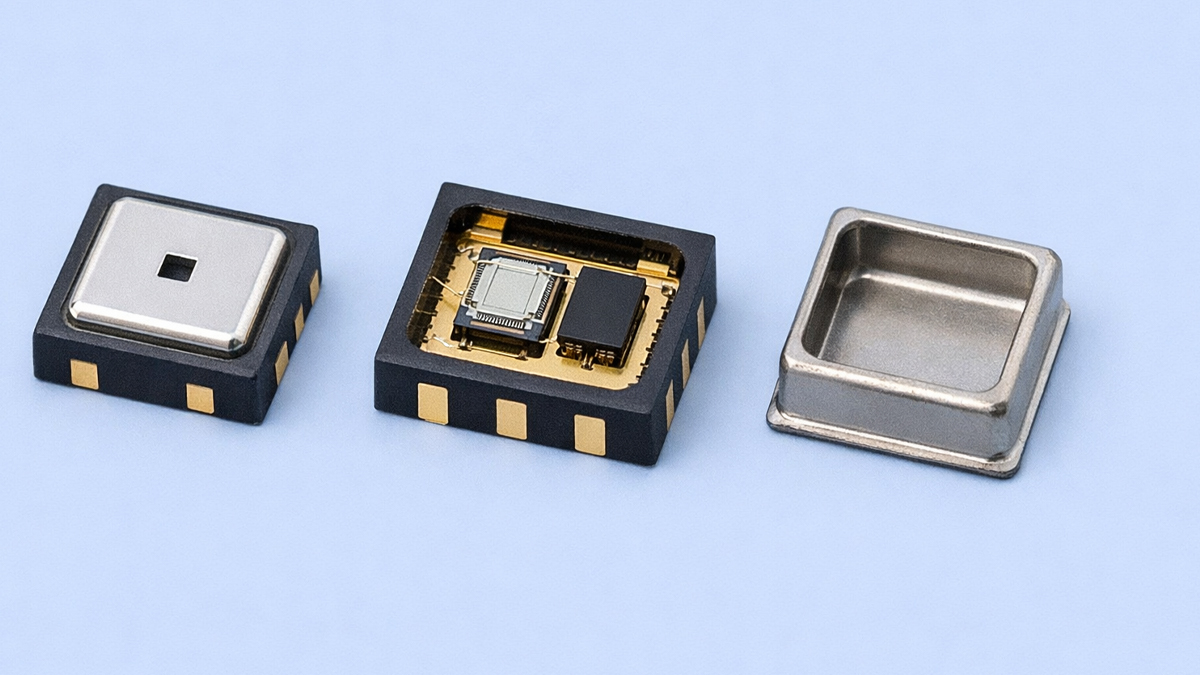
What is MEMS Barometric Pressure Sensor?
A MEMS Barometric Pressure Sensor is a miniature electronic sensor that measures atmospheric pressure by using a microfabricated sensing structure on silicon. MEMS stands for Micro Electro Mechanical Systems. In this kind of sensor, a very small pressure sensitive membrane reacts to air pressure changes, and the sensor electronics convert that physical response into readable pressure data. Many modern parts also measure temperature so the pressure reading can be compensated and made more stable. Bosch describes its BMP581 and BMP585 as absolute barometric pressure sensors, while ST describes the LPS22DF as an absolute pressure sensor that functions as a digital output barometer.
In simple terms, this sensor is a tiny digital barometer built for compact electronics. It is widely used where size, low power consumption, and good altitude related accuracy matter. Official product documentation from Bosch, ST, and Infineon shows that these sensors are intended for devices such as smartphones, GPS modules, wearables, drones, and IoT systems, which confirms that MEMS barometric pressure sensing has become a standard building block in modern portable electronics.
How does MEMS Barometric Pressure Sensor Work?
Working principle: A MEMS barometric pressure sensor works by exposing a microscopic membrane or sensing cell to ambient air pressure. When the outside pressure changes, the membrane deflects very slightly. That tiny mechanical change alters an electrical property inside the sensor. In piezoresistive designs, resistance changes as the membrane bends. In capacitive designs, capacitance changes as the structure moves. ST documentation for the LPS22DF explains a suspended membrane based sensing element, while Infineon describes the DPS310 and DPS368 pressure elements as based on a capacitive sensing principle.
Signal conversion: After the sensing element reacts to pressure, the internal analog front end conditions the signal, an ADC converts it into digital form, and digital logic applies compensation and filtering before sending data to the host processor. The block diagrams published by Bosch and ST show a typical chain made of sensing element, analog front end, ADC, digital logic, and serial interface blocks such as I2C, SPI, or MIPI I3C.
Practical result: The host system reads the pressure value, often together with temperature, and can use that information for altitude estimation, floor detection, weather trend observation, environmental logging, or drone height estimation. Bosch notes that sensors such as the BMP280 and BMP390 are suitable for altitude tracking and floor detection, while PX4 and ArduPilot documentation explains that barometers are used in drones as altitude sensors and as a primary source for altitude hold.
What are the Components of MEMS Barometric Pressure Sensor?
Sensing element: The heart of the device is the MEMS pressure sensing element. This is usually a suspended silicon membrane or cavity structure designed to react predictably to changes in atmospheric pressure. ST states that the LPS22DF sensing element consists of a suspended membrane manufactured with a dedicated process, while Bosch identifies the MEMS sensor element as the core pressure sensitive block in the BMP585 architecture.
Temperature sensor: Many barometric sensors include a temperature sensor because pressure readings drift with temperature if they are not compensated. Bosch states that the BMP585 provides both absolute pressure and absolute temperature to the host, and ST includes a temperature sensor in the LPS22DF architecture.
Analog front end and ADC: The raw signal from the sensing element is extremely small, so it must be amplified, conditioned, and digitized. The analog front end prepares the signal, and the ADC turns it into digital data that the processor can use. Both the Bosch BMP585 block diagram and the ST LPS22DF architecture diagram show these stages clearly.
Digital logic and memory: The digital section manages calibration data, compensation, filtering, power modes, interrupts, and output formatting. Bosch shows logic, FIFO memory, oscillator, power on reset, and nonvolatile memory blocks in the BMP585 architecture. ST also documents digital logic, filters, and FIFO behavior in the LPS22DF family.
Interface and package: The finished sensor must deliver its data to the rest of the system, so serial interfaces such as I2C, SPI, and sometimes MIPI I3C are common. The package also matters because the sensor needs a pressure opening or protected cavity that lets the environment reach the sensing element without damaging it. ST and Bosch both document compact molded or holed packages, and ST also offers water resistant variants for harsher environments.
What are the Types of MEMS Barometric Pressure Sensor?
By pressure reference: Pressure sensors are commonly divided into absolute, gauge, and differential types. ST explains that absolute pressure is measured relative to a perfect vacuum, differential pressure is the difference between two pressure sources, and gauge pressure is a form of differential pressure where one reference is ambient air. Since a barometer measures atmospheric pressure itself, MEMS barometric pressure sensors are generally absolute pressure sensors.
By sensing principle: One important classification is based on the sensing mechanism. Some MEMS barometric sensors are piezoresistive, where membrane strain changes resistance. Others are capacitive, where pressure changes the capacitance of the sensing structure. ST documents piezoresistive designs in devices such as the LPS22DF and LPS28DFW, while Infineon describes the DPS310 and DPS368 as capacitive.
By output and integration style: Older or specialized pressure sensors may provide analog output, but many modern MEMS barometric sensors are digital output devices with built in calibration and compensation. Infineon explains the distinction between analog and digital pressure sensors, while Bosch and ST product documentation highlights digital barometer designs meant for direct connection to processors.
By package robustness: Some are general purpose air pressure sensors for dry electronics, while others are designed for stronger environmental resistance. Bosch BMP585 and Infineon DPS368 emphasize water or harsh environment robustness, and ST LPS28DFW is designed as a water resistant barometric pressure sensor with dual use for altitude and water depth related applications.
What are the Applications of MEMS Barometric Pressure Sensor?
General electronics: MEMS barometric pressure sensors are used in smartphones, GPS modules, wearables, hearables, watches, and portable IoT devices. Bosch lists these product classes for the BMP390 and BMP581 families, while Infineon and ST also position their pressure sensors for mobile, wearable, and IoT applications.
Altitude and positioning: One major use is altitude estimation and floor detection. Bosch states that the BMP280 and related devices are suited for floor detection, and Bosch also highlights altitude tracking for the BMP390. ST notes that the LPS22DF received NextNav certification for geolocation related use cases, which points to the growing role of accurate vertical positioning.
Drones and autonomous platforms: PX4 states that barometers measure atmospheric pressure and are used in drones as altitude sensors, while ArduPilot explains that altitude hold relies primarily on a barometer and that external barometers can be useful when pressure disturbances must be reduced. This makes MEMS barometric sensors very relevant to aerial systems that need stable height control.
Environmental and liquid related uses: Some newer variants extend beyond simple air barometry. ST presents LPS28DFW and ILPS28QSW for water depth monitoring and water level management, while Bosch BMP585 and Infineon DPS368 emphasize more rugged packaging and liquid resistant operation.
What is the Role of MEMS Barometric Pressure Sensor in Cinema Industry?
Aerial cinematography role: In the cinema industry, the clearest role of a MEMS barometric pressure sensor is inside camera drones and unmanned platforms used for aerial shots. Since drone flight stacks use barometers as altitude sensors and as a primary input for altitude hold, the sensor supports smoother height keeping, repeatable flight movement, and more stable vertical framing during cinematic capture. This is a practical inference drawn from PX4 and ArduPilot flight documentation combined with the fact that pressure sensor vendors explicitly target drones as a major application.
Location and production support role: Film production often involves outdoor shoots, changing elevations, weather variability, and remote equipment use. A compact pressure sensor can support environmental logging, altitude tagged telemetry, and context aware devices that need to understand elevation changes during a shoot. Because these sensors are already common in mobile, wearable, and GPS related electronics, they fit naturally into portable cinematic tools such as smart controllers, field monitors, drone payload systems, and production tracking devices. This is an inference based on documented mobile, GPS, and altitude tracking applications.
Equipment reliability role: Cinema drones and electronic rigs can be affected by pressure disturbances, fast motion, and changing outdoor conditions. ArduPilot documentation notes that external barometers may be placed away from pressure disturbances, and it also describes how prop wash and air pressure changes can affect altitude behavior. For cinema workflows, that means better barometric integration can help maintain cleaner aerial motion and more dependable shot execution.
What are the Objectives of MEMS Barometric Pressure Sensor?
Measurement objective: The first objective is to measure absolute atmospheric pressure accurately in a very small electronic package. Bosch, ST, and Infineon all describe their modern barometric sensors as compact, low power, and high precision devices for portable electronics.
System objective: Another objective is to give the host processor reliable pressure and temperature data that can be used for altitude estimation, environmental awareness, and context sensing. This is why many devices integrate temperature measurement, digital filtering, factory calibration, and serial interfaces, reducing the burden on the rest of the system.
Design objective: A further objective is to achieve strong performance with very low power consumption and minimal board space. Product literature for BMP280, BMP390, BMP581, LPS22DF, and DPS368 repeatedly emphasizes small footprints, low current consumption, and integration in battery operated devices.
Application objective: In practical use, the goal is not only to sense pressure, but to enable useful functions such as floor detection, drone altitude hold, geolocation support, weather trending, and environmental robustness in mobile systems. That objective explains why newer generations focus on lower noise, better stability, better packaging, and improved vertical positioning performance.
What are the Benefits of MEMS Barometric Pressure Sensor?
Miniaturization benefit: One major benefit is size reduction. MEMS manufacturing allows the sensing structure and electronics to fit into packages small enough for compact consumer and professional devices. Bosch, ST, and Infineon all market these parts as ultra compact or miniaturized components for portable systems.
Power benefit: Another important benefit is low energy use. Low current consumption allows these sensors to operate continuously in battery powered products without causing a major power penalty. Bosch and ST data highlight very low current consumption figures, and this is one reason barometric sensing is practical in wearables, drones, and handheld electronics.
Performance benefit: MEMS barometric sensors offer strong relative accuracy, low noise, and built in compensation, which makes them useful for detecting fine height changes. Bosch states that BMP280 class devices can support about 1 meter altitude difference through relative accuracy, while newer Bosch material for BMP390 mentions height changes below 10 centimeters.
Integration benefit: Digital interfaces, factory calibration, embedded filtering, and FIFO options simplify system design. Engineers can connect the sensor directly to a microcontroller or application processor without building a large analog chain around it. ST and Bosch architecture information makes this integration advantage clear.
Robustness benefit: Newer product families are also becoming more resistant to water, dust, humidity, or harsh environments. That expands where barometric sensing can be used and makes the technology more useful for demanding field electronics, including outdoor and production related equipment.
What are the Features of MEMS Barometric Pressure Sensor?
Pressure and temperature output: Modern MEMS barometric sensors usually provide both pressure and temperature readings. The temperature channel is important for compensation and better overall measurement stability. Bosch explicitly states this for the BMP585, and Infineon does the same for DPS368.
Digital communication: Common features include digital serial interfaces such as I2C, SPI, and in some families MIPI I3C. ST documents I2C, SPI, and MIPI I3C options in various pressure sensor families, and Bosch includes I2C and SPI oriented digital integration.
Signal processing features: Many parts include ADC conversion, digital logic, filtering options, oversampling or averaging controls, FIFO buffering, interrupts, and multiple power modes. ST describes low pass filters and FIFO behavior in the LPS22DF application note, while Bosch shows FIFO memory and internal control logic in the BMP585 architecture.
Mechanical and environmental features: Depending on the model, features may include molded packages, holed packages, water resistant cavities, protection against dust or humidity, and wider operating ranges. ST and Bosch product materials show how package technology has become a major feature area, not just a protective shell.
Application oriented features: Vendors now highlight features such as floor detection, altitude tracking, geolocation support, water depth coverage, and drone suitability. This shows that the feature set is increasingly defined by the end use case, not only by raw pressure measurement.
What are the Examples of MEMS Barometric Pressure Sensor?
Bosch examples: BMP280 is a well known absolute barometric pressure sensor designed for mobile applications and known for low power use and floor detection suitability. BMP390 is a small, low power, low noise 24 bit barometric pressure sensor aimed at altitude tracking applications such as smartphones, GPS modules, wearables, and drones. BMP581 is positioned as a high end benchmark class barometric pressure sensor, and BMP585 adds stronger robustness for harsher or wetter environments.
ST examples: LPS22DF is an ultra compact absolute pressure sensor that functions as a digital output barometer and is aimed at wearables, GPS related products, altimeters, and drones. LPS28DFW is a water resistant barometric pressure sensor that can cover both altitude related and water depth related use cases.
Infineon examples: DPS310 is a miniaturized digital barometric air pressure sensor using a capacitive sensing principle, while DPS368 is a more robust pressure sensor with strong precision and added resistance to water, dust, and humidity. These examples show how the MEMS barometric sensor market covers standard mobile use, precision altitude use, and rugged field use.
What is the Definition of MEMS Barometric Pressure Sensor?
Formal definition: A MEMS Barometric Pressure Sensor is a microfabricated absolute pressure sensing device that measures atmospheric pressure through a silicon based MEMS structure and outputs pressure data, often with temperature compensated digital readout, for use in altitude, environmental, and system awareness applications. This definition matches the way Bosch, ST, and Infineon describe their absolute digital barometric pressure sensors in product documentation.
What is the Meaning of MEMS Barometric Pressure Sensor?
Term meaning: The term MEMS refers to the miniature mechanical and electrical structures built on silicon. Barometric pressure refers to atmospheric air pressure. Sensor means a device that detects a physical condition and converts it into readable information. Put together, MEMS Barometric Pressure Sensor means a tiny silicon based electronic device that senses atmospheric pressure and translates it into usable electrical or digital data.
Practical meaning: In everyday engineering language, it is the compact barometer inside modern smart electronics. It helps devices understand altitude, vertical motion, air pressure change, and environmental conditions without needing a bulky mechanical barometer. That practical meaning is reflected in the way these sensors are used in mobile devices, drones, wearables, and positioning systems.
What is the Future of MEMS Barometric Pressure Sensor?
Technology direction: The future of MEMS barometric pressure sensors is moving toward lower power, lower noise, better relative accuracy, stronger environmental protection, and better vertical positioning capability. Bosch BMP581 and BMP585 materials emphasize new performance levels and ruggedness, while ST highlights water resistant packages and certified vertical geolocation capability through the LPS22DF and related product families.
Market direction: Product families are expanding from simple mobile barometers into sensors for drones, industrial monitoring, rugged wearables, and even liquid depth or water level oriented use cases. Infineon DPS368 and ST LPS28DFW show that the same core sensing idea is being adapted for more demanding environments and broader functionality.
Cinema related future: For cinematic electronics, the future likely means more reliable aerial shot control, smarter field devices, and better fusion between barometric sensing, GNSS, IMU data, and onboard processing. This is an inference from current drone use of barometers for altitude estimation and the continued vendor push toward higher precision and stronger robustness. As cinema tools become more autonomous, more mobile, and more data aware, MEMS barometric sensing is likely to become more quietly important, even when the audience never sees it directly.
Summary.
- MEMS Barometric Pressure Sensor is a tiny silicon based sensor that measures atmospheric pressure and usually provides temperature compensated digital output.
- It works by using a micro scale sensing element, signal conditioning, ADC conversion, digital logic, and serial communication to deliver usable pressure data.
- Most barometric MEMS sensors are absolute pressure sensors, though pressure sensing in general also includes gauge and differential types.
- Key applications include smartphones, GPS devices, wearables, drones, altitude tracking, floor detection, geolocation, and environmental monitoring.
- In the cinema industry, its strongest role is in aerial cinematography systems and portable electronic tools that benefit from altitude awareness and environmental sensing.
- Its major benefits are compact size, low power use, strong precision, easy digital integration, and improving robustness in harsh conditions.
- Important examples include Bosch BMP280, BMP390, BMP581, BMP585, ST LPS22DF, LPS28DFW, and Infineon DPS310 and DPS368.
- The future points toward smaller, smarter, tougher, and more precise sensors that support vertical positioning, rugged field electronics, and more advanced cinematic and autonomous systems.

