

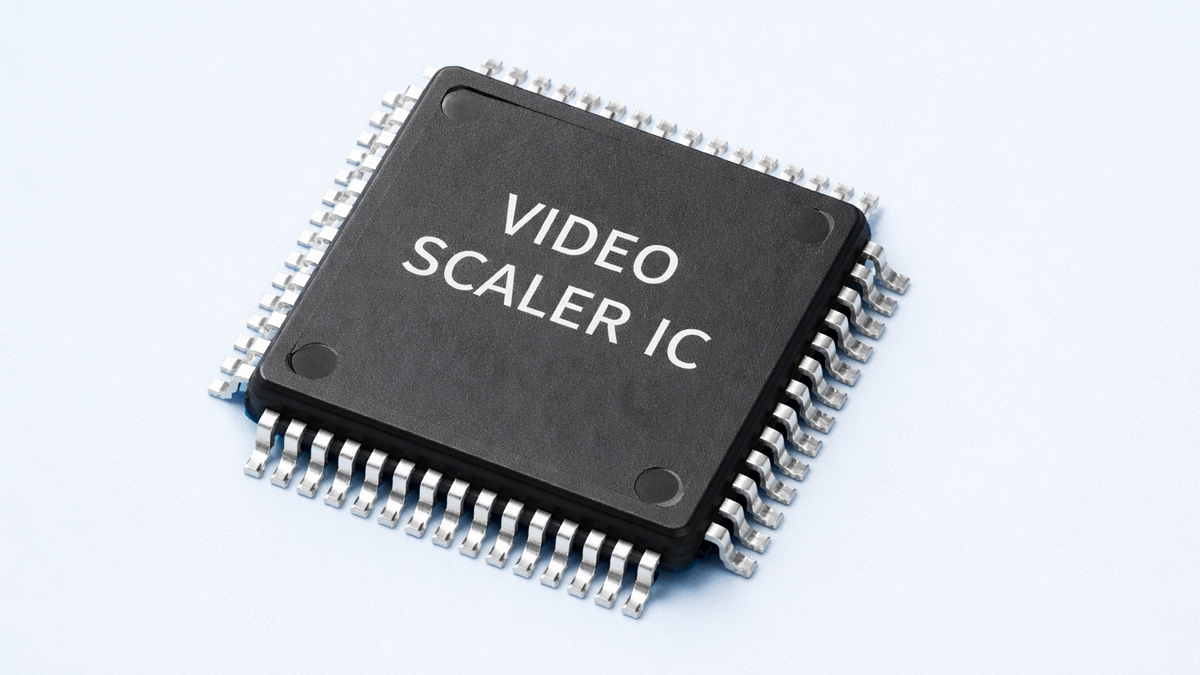
What is Video Scaler IC?
A Video Scaler IC is a specialized integrated circuit designed to convert video signals from one resolution or format to another while preserving visual clarity, color accuracy, and timing stability. In simple terms, it allows video content created at one resolution to be displayed correctly on screens or projection systems with a different native resolution. This function is essential in modern visual systems because video sources and display devices rarely operate at the same resolution or refresh characteristics.
Core concept: Video Scaler IC technology focuses on resizing video frames, adjusting pixel mapping, and synchronizing timing signals so that images appear natural and distortion free on the target display.
In cinematic electronics, a Video Scaler IC sits between video sources such as media servers, digital cinema packages, broadcast feeds, or playback systems and display devices such as digital projectors, LED cinema walls, or professional monitors. Without scaling, mismatched resolutions would result in stretched images, cropped frames, black borders, or visible artifacts.
Practical understanding: A film may be mastered in one resolution, while the cinema projection system may operate at a different resolution. The Video Scaler IC ensures that every frame is resized accurately so the audience experiences the content exactly as intended.
How does Video Scaler IC Work?
Signal intake stage: The Video Scaler IC first receives an incoming digital or analog video signal. This signal includes pixel data, synchronization information, color format, and frame timing. The IC analyzes these parameters to understand the source resolution, aspect ratio, frame rate, and color space.
Scaling engine operation: At the heart of the Video Scaler IC is a scaling engine that uses mathematical algorithms to map source pixels to target pixels. This process may involve upscaling, where lower resolution content is enlarged, or downscaling, where higher resolution content is reduced.
Interpolation process: The IC calculates new pixel values using interpolation techniques. These techniques estimate missing pixel information based on surrounding pixels. Advanced Video Scaler ICs use multi tap filters, edge adaptive scaling, and motion aware processing to avoid blurring and jagged edges.
Timing and synchronization control: After pixel scaling, the IC regenerates timing signals that match the requirements of the target display. This ensures smooth frame delivery, stable refresh rates, and proper synchronization with audio and other system components.
Output stage: The processed video is then output in the desired resolution, format, and timing. The display device receives a signal that matches its native capabilities, resulting in a clean and stable image.
What are the Components of Video Scaler IC?
Input interface block: This component handles incoming video signals from various sources. It supports different interfaces such as HDMI, DisplayPort, SDI, or proprietary cinema interfaces. Its role is to decode incoming data and prepare it for processing.
Scaling processor core: This is the central processing unit of the Video Scaler IC. It performs resolution conversion, pixel interpolation, and frame resizing. The quality of this core determines the sharpness and accuracy of the scaled image.
Frame buffer memory controller: Many Video Scaler ICs include or interface with external memory. This buffer temporarily stores video frames, allowing complex scaling, frame rate conversion, and image enhancement operations.
Color processing unit: This component manages color space conversion, gamma correction, and color depth adjustment. It ensures that colors remain accurate and consistent after scaling.
Timing controller: This block generates output synchronization signals. It aligns video frames with the display timing requirements, ensuring flicker free and stable projection.
Output interface block: The final component transmits the processed video signal to the display system. It supports high bandwidth outputs required for cinema grade resolutions and refresh rates.
What are the Types of Video Scaler IC?
Basic resolution scaler: This type focuses on simple upscaling or downscaling tasks. It is commonly used in cost sensitive applications where moderate image quality is acceptable.
High performance scaler: Designed for professional and cinematic environments, this type uses advanced algorithms to preserve detail, reduce artifacts, and maintain smooth motion.
Multi format scaler: This Video Scaler IC supports a wide range of input and output formats. It is ideal for cinema systems that handle multiple content sources.
Real time scaler: Optimized for low latency operation, this type is used where immediate video processing is required, such as live cinema events or real time playback systems.
Integrated processing scaler: These ICs combine scaling with additional video processing functions such as noise reduction, deinterlacing, and color enhancement.
What are the Applications of Video Scaler IC?
Professional cinema projection: Video Scaler ICs are used to match content resolution with projector native resolution, ensuring optimal image quality on large cinema screens.
Broadcast and post production: In editing suites and post production environments, scalers allow content to be viewed accurately on different monitors and reference displays.
Digital signage and cinema advertising: Cinemas often display advertisements and announcements created in various resolutions. Video Scaler ICs ensure consistent presentation across screens.
Live event cinema: For live broadcasts in cinemas, scalers adapt incoming feeds to match the cinema projection system.
Content distribution systems: Video Scaler ICs are embedded in servers and playback devices to ensure compatibility with multiple display setups.
What is the Role of Video Scaler IC in Cinema Industry?
Image consistency role: The cinema industry demands consistent visual quality across different theaters and projection systems. Video Scaler ICs ensure that films look the same regardless of the display resolution.
Compatibility role: Cinemas receive content from multiple studios and distributors. Video Scaler ICs enable seamless playback of diverse formats without manual adjustments.
Quality preservation role: High quality scaling preserves cinematic details such as texture, contrast, and color grading, which are critical to storytelling.
Operational efficiency role: By automating resolution adaptation, Video Scaler ICs reduce setup time and technical complexity for cinema operators.
Future readiness role: As cinema technology evolves, Video Scaler ICs help bridge the gap between legacy content and new display technologies.
What are the Objectives of Video Scaler IC?
Resolution adaptation objective: The primary goal is to adapt video content to different display resolutions without compromising quality.
Visual clarity objective: Video Scaler ICs aim to maintain sharpness, reduce artifacts, and preserve fine details.
System compatibility objective: They ensure interoperability between various video sources and display devices.
Performance objective: Efficient processing with minimal latency is essential, especially in cinematic environments.
Scalability objective: Video Scaler ICs are designed to support future resolutions and formats as technology advances.
What are the Benefits of Video Scaler IC?
Improved viewing experience: Audiences enjoy clear and immersive visuals that match the intent of filmmakers.
Reduced equipment constraints: Cinemas can use diverse content sources without worrying about resolution mismatches.
Enhanced flexibility: Operators can upgrade displays without replacing all content sources.
Cost efficiency: One scaler solution can support multiple formats, reducing the need for specialized equipment.
Long term usability: Video Scaler ICs extend the life of existing content by making it compatible with newer displays.
What are the Features of Video Scaler IC?
High precision scaling: Advanced algorithms ensure accurate pixel mapping and minimal distortion.
Wide format support: Video Scaler ICs handle multiple resolutions, frame rates, and color formats.
Low latency processing: Essential for real time cinema applications and live events.
Robust color management: Accurate color reproduction maintains cinematic quality.
Reliability and stability: Designed for continuous operation in professional cinema environments.
What are the Examples of Video Scaler IC?
Cinema projector scalers: Integrated into digital cinema projectors to adapt content resolution automatically.
Media server scalers: Used in cinema servers to prepare video streams for projection.
Professional video processor scalers: Standalone devices that include Video Scaler ICs for advanced cinema setups.
Embedded scaler chips: Built into display controllers for LED cinema walls and premium screens.
What is the Definition of Video Scaler IC?
Definition clarity: A Video Scaler IC is an integrated electronic circuit that converts video signals from one resolution or format to another while maintaining image quality, timing accuracy, and color integrity for display systems.
Functional definition: It serves as a bridge between video sources and display devices with differing technical specifications.
What is the Meaning of Video Scaler IC?
Conceptual meaning: The meaning of Video Scaler IC lies in its ability to adapt visual information to different display environments.
Practical meaning: It ensures that video content appears correctly sized, proportioned, and visually pleasing on any supported screen.
Industry meaning: In cinema, it represents a critical component that enables compatibility and consistency across diverse projection systems.
What is the Future of Video Scaler IC?
Technology evolution: Future Video Scaler ICs will support higher resolutions, higher frame rates, and wider color gamuts.
Intelligent processing: Integration of artificial intelligence based scaling algorithms will improve detail preservation and motion handling.
Energy efficiency focus: New designs will aim to reduce power consumption while maintaining performance.
Integration trend: Video Scaler ICs will increasingly be integrated with other video processing functions in single chip solutions.
Cinema innovation support: As immersive cinema formats evolve, Video Scaler ICs will play a key role in adapting content for advanced displays.
Summary
- Video Scaler ICs are essential integrated circuits that adapt video resolution and format for display systems.
- They work by analyzing input signals, scaling pixel data, and regenerating timing signals.
- Key components include input interfaces, scaling cores, memory controllers, and output interfaces.
- Different types of Video Scaler ICs address basic, high performance, and real time cinematic needs.
- In the cinema industry, they ensure visual consistency, compatibility, and quality preservation.
- Objectives focus on resolution adaptation, clarity, performance, and future scalability.
- Benefits include improved audience experience, operational flexibility, and cost efficiency.
- Features such as high precision scaling and robust color management define their value.
- The future of Video Scaler ICs points toward intelligent, efficient, and highly integrated solutions for next generation cinema systems.

