

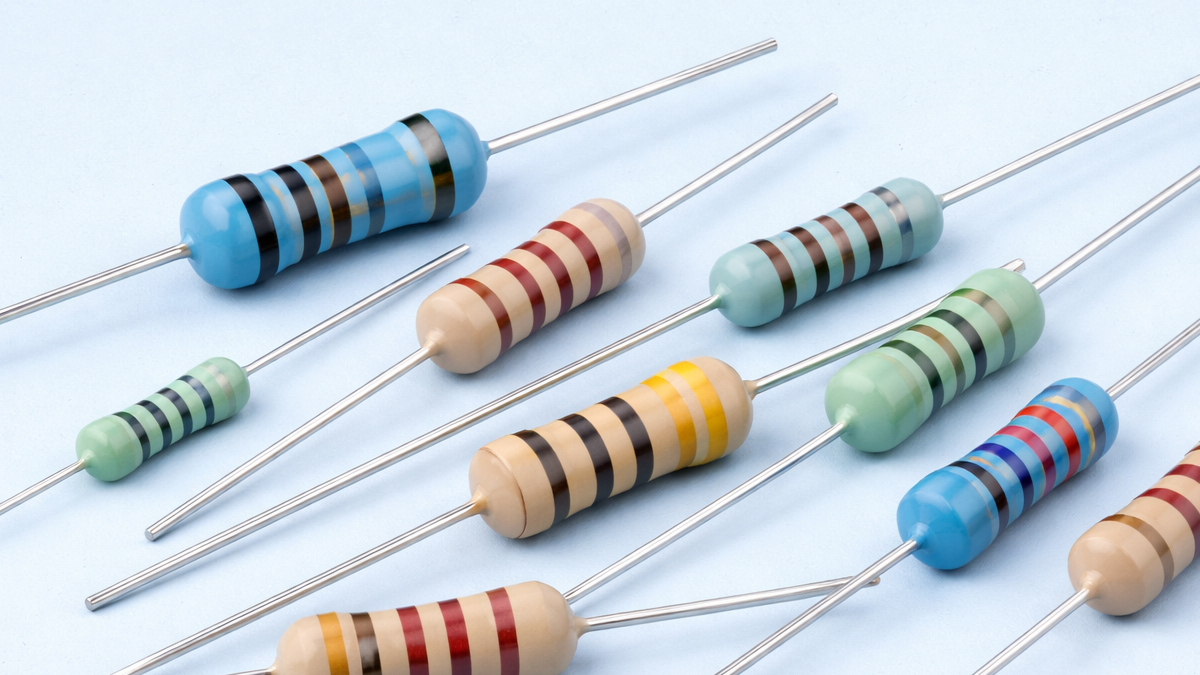
What is Tolerance?
Tolerance is the allowed variation between the marked resistance value of a resistor and its real measured value. In simple words, if a resistor is labeled 10 kilo ohms, it may not be exactly 10 kilo ohms in real life. It can be a little higher or a little lower, depending on its tolerance rating. This small difference is normal and expected in electronics.
Basic idea: Tolerance is usually written as a percentage. If a 10 kilo ohm resistor has a tolerance of 5 percent, its real value can fall within 5 percent above or below the stated value. That means the actual resistance may be somewhere between 9.5 kilo ohms and 10.5 kilo ohms. The resistor is still considered acceptable because it remains inside the allowed range.
In music electronics, tolerance matters because sound circuits often depend on stable and predictable behavior. Resistors are used in amplifiers, mixers, synthesizers, effects pedals, equalizers, microphones, and audio interfaces. If resistor values vary too much, gain levels, tone shaping, signal balance, and filter response may change. Tolerance helps designers know how accurate a resistor is likely to be before it is placed into a circuit.
How does Tolerance Work?
Tolerance works by defining how much a resistor can differ from its nominal value. The nominal value is the number printed on the resistor body or identified by the color code. The actual value is what the resistor measures in practice. Tolerance creates a safe zone around the nominal value so manufacturers, engineers, and repair technicians know what range is acceptable.
Working principle: Suppose a resistor has a nominal value of 1,000 ohms with 1 percent tolerance. One percent of 1,000 is 10. This means the resistor can measure from 990 ohms to 1,010 ohms and still meet its specification. If it measures outside that range, it does not meet the declared tolerance.
This matters because no manufacturing process can create millions of resistors with perfect, identical values every time. Slight changes in raw material, film thickness, temperature during production, trimming process, and aging can cause variation. Tolerance is the practical way of controlling those differences.
In audio circuits, this working system allows designers to predict how components will interact. A resistor in a tone control, filter network, feedback loop, or voltage divider will influence the signal path. If the resistor stays within a known tolerance, the circuit behaves close to the intended design. This improves consistency between one amplifier, pedal, or mixing channel and another.
What are the Components of Tolerance?
Tolerance may look like a simple percentage, but it is understood through several important elements. These elements help explain what the rating means and how it affects performance.
Nominal value: This is the target resistance the resistor is supposed to have, such as 100 ohms, 1 kilo ohm, or 100 kilo ohms. It is the reference point for all tolerance calculations.
Actual measured value: This is the real resistance found when the resistor is tested with a meter. It may be slightly higher or lower than the nominal value.
Percentage range: This is the tolerance figure itself, such as 1 percent, 2 percent, or 5 percent. It tells how far the actual value is allowed to move from the nominal value.
Upper and lower limits: These are the boundaries created by the tolerance percentage. They define the acceptable measurement window.
Marking method: On many through hole resistors, tolerance is shown using a color band. On surface mount resistors, it may be shown in part specifications rather than by color bands.
Material and manufacturing quality: Carbon composition, carbon film, metal film, wirewound, and thick film resistors may offer different tolerance levels because of how they are made.
Environmental influence: Temperature, humidity, mechanical stress, and aging can also affect how closely a resistor stays near its marked value over time.
Together, these components help engineers choose the right resistor for a musical device where sound quality, consistency, and reliability are important.
What are the Types of Tolerance?
Tolerance in resistors can be understood through common accuracy categories used in electronics. These categories tell how precise a resistor is.
Common grades: One common type is 20 percent tolerance. This is a wide tolerance and is used in simple circuits where exact resistance is not critical. Then there is 10 percent tolerance, which offers better control but is still considered broad for precision audio work. Five percent tolerance is very common in general electronics and is often suitable for many practical music applications. Two percent and one percent tolerance resistors are more accurate and are widely preferred in higher quality audio circuits. There are also very precise resistors with 0.5 percent, 0.25 percent, 0.1 percent, or even tighter tolerance for specialized equipment.
Functional view: Another way to understand types of tolerance is by how the resistor is used. General purpose resistors can work well in non critical positions such as simple indicator circuits or rough bias paths. Precision resistors are used where the exact value affects gain, filter frequency, timing, or channel matching.
By technology: Carbon resistors often have wider tolerance, while metal film resistors are known for tighter tolerance and better stability. Wirewound resistors can also offer good accuracy in power applications.
In music electronics, tighter tolerance is often chosen for preamps, equalizers, crossovers, active filters, studio gear, and measurement circuits where accurate performance matters.
What are the Applications of Tolerance?
Tolerance is important in many resistor applications because it affects how accurately a circuit performs. In electronics, resistors are not only used to reduce current. They also divide voltage, set bias points, shape frequency response, control gain, protect components, and match signal paths.
Circuit design use: Engineers use tolerance to predict the possible behavior of a finished circuit. During the design stage, they check whether a circuit will still work properly even when resistor values shift within their allowed range.
Testing and quality control: Tolerance is used when components are inspected before assembly. It helps manufacturers separate acceptable parts from parts that do not meet the specification.
Repair and maintenance: Technicians use tolerance when checking old resistors in audio amplifiers, keyboards, mixers, and speaker systems. A resistor may look normal, but its value may have drifted beyond tolerance.
Production matching: In stereo equipment, paired channels should sound balanced. Resistor tolerance affects how closely the left and right sides match.
Signal accuracy: In tone circuits, equalizers, and filters, resistor tolerance affects cutoff points, boost levels, and attenuation behavior.
Power control: In amplifier power supplies and protection sections, resistor tolerance influences current sensing, voltage division, and stable operation.
So, tolerance is applied not only to the resistor itself but also to design, manufacturing, service, and long term performance.
What is the Role of Tolerance in Music Industry?
In the music industry, electronics are everywhere. They are found inside live sound systems, recording consoles, digital and analog synthesizers, guitar pedals, microphones, studio monitors, amplifiers, audio interfaces, wireless systems, and instrument accessories. In all of these products, resistor tolerance plays a practical role.
Sound consistency: When a manufacturer builds many units of the same audio product, users expect them to sound similar. Tolerance helps keep resistor values close enough that the tone, gain, and response remain consistent from one unit to another.
Channel balance: In stereo systems and mixers, the left and right channels should behave alike. Tighter resistor tolerance improves matching and helps prevent uneven sound.
Tone shaping: Resistors work with capacitors and other parts in equalizers, filters, and tone stacks. If resistor values vary too much, the frequency response may shift. This can change bass, midrange, or treble behavior.
Gain control: In preamps, amplifier stages, and pedals, resistor values help set signal gain. Tolerance affects how strong or clean the amplified signal becomes.
Noise and reliability: Precision resistor types used for tighter tolerance often also offer better stability and lower noise, which is useful in studio and stage equipment.
For the music industry, tolerance supports dependable sound, predictable product quality, smoother repairs, and better user confidence.
What are the Objectives of Tolerance?
Tolerance exists for several clear and useful objectives in resistor design and application. It is not just a number added to a part. It serves a practical engineering purpose.
Accuracy control: One major objective is to define how accurate a resistor should be. Without tolerance, there would be no clear way to judge whether a resistor is close enough to its intended value.
Performance predictability: Circuit designers need to know how much variation can happen in real use. Tolerance gives them that predictable range.
Manufacturing practicality: Since no production line can create perfect values every time, tolerance allows efficient manufacturing while still maintaining quality standards.
Circuit reliability: The objective is also to ensure that circuits keep working correctly even with slight component variation. Good designs take tolerance into account from the beginning.
Product consistency: Manufacturers want one batch of pedals, amplifiers, or mixers to perform similarly to the next batch. Tolerance helps support that goal.
Service clarity: During maintenance or replacement, technicians can compare measured values against the rated tolerance and decide whether a component is still healthy.
Cost balance: Not every circuit needs the most precise resistor. Tolerance helps choose the correct accuracy level so a product can meet performance goals without unnecessary cost.
These objectives make tolerance a key concept in both electronics education and professional music equipment design.
What are the Benefits of Tolerance?
Tolerance provides many benefits in electronics, especially when resistors are used in music related devices. These benefits are technical, practical, and economic.
Design confidence: Tolerance gives engineers a clear idea of how much a resistor may vary. This helps them design stable circuits with fewer surprises.
Reliable performance: A resistor that stays within tolerance helps the circuit perform as expected. This is important for gain stages, filters, control circuits, and protection networks.
Better audio consistency: In music electronics, small changes can affect tone, balance, or sensitivity. Proper tolerance selection reduces unwanted differences between products.
Smarter component selection: Tolerance helps designers choose between general purpose and precision parts. They can spend more on accuracy where it matters and save cost where it does not.
Easier troubleshooting: Technicians can test a resistor and quickly decide whether it is still acceptable. This speeds up repair work.
Improved production quality: Manufacturers can maintain better standards because tolerance gives them measurable acceptance limits.
Long term dependability: When combined with stable materials, a proper tolerance resistor helps the circuit remain dependable over time.
Educational value: Tolerance teaches students and beginners that real components are not perfectly exact, which is an important lesson in practical electronics.
In short, tolerance brings order, predictability, and quality to the design and operation of music electronics.
What are the Features of Tolerance?
Tolerance has several recognizable features that make it useful and easy to apply in resistor selection and circuit analysis.
Percentage based expression: The most obvious feature is that tolerance is shown as a percentage of the nominal value. This makes it easy to calculate limits.
Bidirectional range: Tolerance usually allows variation both above and below the marked value. It is a balanced range around the nominal resistance.
Compatibility with color codes: In many traditional resistors, tolerance is identified by a final color band, making quick visual recognition possible.
Link to resistor quality: Tighter tolerance often suggests a more carefully made resistor, especially in precision types such as metal film parts.
Influence on circuit behavior: Tolerance is directly connected to how much a real circuit may differ from its theoretical design.
Relation to cost: Wider tolerance resistors are often cheaper, while tighter tolerance parts may cost more because of better materials or manufacturing control.
Use in specification sheets: Tolerance is a standard feature in technical datasheets, making comparison between components easier.
Importance in precision audio: In music electronics, tolerance becomes more important where exact gain, filtering, matching, or calibration is required.
These features make tolerance not just a label, but a meaningful performance characteristic that helps users choose the right resistor for the right job.
What are the Examples of Tolerance?
Examples make tolerance easier to understand, especially for students, technicians, and audio hobbyists.
Basic resistor example: A 100 ohm resistor with 5 percent tolerance can measure between 95 ohms and 105 ohms. If it measures 102 ohms, it is acceptable. If it measures 108 ohms, it is outside tolerance.
Precision example: A 10 kilo ohm resistor with 1 percent tolerance can measure between 9.9 kilo ohms and 10.1 kilo ohms. This tighter range is useful in accurate audio filter or feedback circuits.
Amplifier example: In a guitar amplifier, a feedback resistor helps set gain. If a wide tolerance resistor is used, the gain may differ from one amplifier to another. A tighter tolerance resistor keeps the result more consistent.
Equalizer example: In an equalizer section, resistors combine with capacitors to define frequency shaping. If resistor values drift too far, the target frequency response may shift.
Stereo channel example: In a mixer or audio interface, matching resistors in both channels helps maintain similar performance on the left and right sides.
Pedal example: In an overdrive or distortion pedal, resistor tolerance can influence clipping balance, bias setting, and output level.
These examples show that tolerance is not just a theory. It directly affects the behavior and sound of real music equipment.
What is the Definition of Tolerance?
Tolerance is the permitted amount by which a resistor can vary from its stated resistance value while still being considered acceptable for use. It is a standard specification used to describe component accuracy.
Technical definition: If a resistor is marked with a nominal value and a tolerance percentage, the actual resistance can fall within a calculated upper and lower limit. As long as it stays inside that range, the resistor meets its definition of tolerance.
Practical definition: Tolerance tells the user how exact the resistor really is likely to be. It does not promise perfection. Instead, it provides a controlled and declared level of variation.
This definition is important because all electronic circuits use real parts, not ideal textbook parts. In practical music electronics, every pedal, preamp, equalizer, and synthesizer must be designed around the truth that component values vary slightly. Tolerance gives that variation a formal boundary. This is why it is a core idea in resistor theory, circuit design, electronics education, and audio product manufacturing.
What is the Meaning of Tolerance?
The meaning of tolerance in resistors is acceptance of a controlled difference. It means a resistor does not need to be exactly equal to its printed value to be useful. It only needs to be close enough to remain within the declared acceptable range.
Simple meaning: Tolerance means allowed variation.
Engineering meaning: Tolerance means measurable accuracy limits that help designers and technicians work with real components in a predictable way.
In music electronics, the meaning becomes even more practical. A resistor with suitable tolerance helps a device sound and function the way the designer intended. If the tolerance is too wide for a sensitive circuit, the result may be inconsistent tone, shifted frequency response, unequal channels, or unstable bias conditions. If the tolerance is chosen wisely, the equipment performs more reliably.
So, the meaning of tolerance is not weakness or error. It is controlled flexibility. It accepts that parts are made in the real world and gives a precise boundary for acceptable performance.
What is the Future of Tolerance?
The future of tolerance in resistors is linked to better manufacturing, smaller devices, higher performance demands, and more advanced music technology. As audio products continue to evolve, resistor tolerance will remain important.
Higher precision demand: Modern studio gear, digital analog hybrid systems, measurement tools, and high end audio devices often require tighter control of analog sections. This encourages the use of more accurate resistors.
Miniaturization: Surface mount technology is becoming more common in music electronics. Even though parts are getting smaller, tolerance control is improving.
Automation and testing: Better production systems allow resistor values and finished circuits to be checked more precisely. This helps manufacturers achieve more consistent audio products.
Stable materials: Advanced resistor materials and improved trimming methods are making tight tolerance more available and more affordable.
Custom audio design: Boutique pedal builders, synthesizer makers, and premium amplifier brands may continue using carefully selected resistors to control tone and consistency.
Educational growth: As more people learn electronics through online platforms and practical building projects, awareness of tolerance will grow.
The future of tolerance is not about removing variation completely. It is about managing variation more intelligently so music equipment can become more reliable, more consistent, and better suited to the needs of performers, producers, and audio engineers.
Summary
- Tolerance is the allowed percentage variation between a resistor’s nominal value and its actual measured value.
- It helps engineers understand how accurate a resistor is and how much variation is acceptable.
- Common resistor tolerance ratings include 20 percent, 10 percent, 5 percent, 2 percent, 1 percent, and tighter precision grades.
- Tolerance works by creating an upper and lower acceptable range around the marked resistance value.
- Important parts of tolerance include nominal value, actual value, percentage limit, material quality, and environmental stability.
- In music electronics, tolerance affects tone control, gain, channel balance, filter response, and circuit consistency.
- Tighter tolerance is often preferred in audio equipment where accurate and repeatable performance matters.
- Tolerance helps in design, manufacturing, testing, troubleshooting, and long term reliability.
- The meaning of tolerance is controlled variation, not poor quality.
- The future of tolerance will include better precision, improved materials, smarter testing, and more dependable music electronics.

