

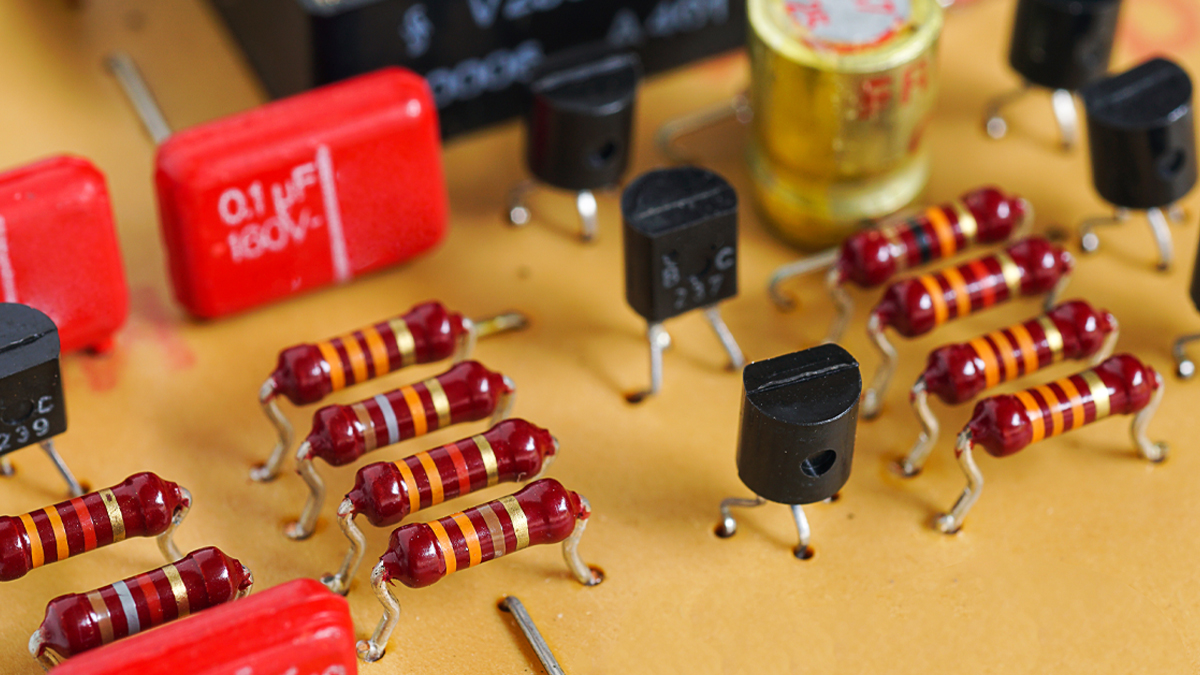
What is Equivalent Series Resistance?
Equivalent Series Resistance is the small internal resistance that exists inside a real capacitor. In theory, a capacitor stores and releases electrical energy without wasting power. In practice, every capacitor has tiny losses caused by its materials, internal construction, electrode connections, electrolyte behavior, and lead structure. These losses can be modeled as a small resistor placed in series with an ideal capacitor. That small resistive part is called Equivalent Series Resistance, often shortened to ESR.
In music electronics, ESR matters because audio equipment depends on clean, stable, and predictable electrical behavior. Capacitors are used in power supplies, audio coupling stages, tone controls, filter networks, loudspeaker crossovers, synthesizers, mixers, audio interfaces, studio monitors, microphones, and instrument amplifiers. If ESR becomes too high, the capacitor does not perform as efficiently as expected. It may create extra heat, weaken filtering, reduce transient response, change timing characteristics, or increase electrical noise. All of these effects can influence audio quality and equipment reliability.
Equivalent Series Resistance is not a separate physical resistor added beside the capacitor in most cases. It is a useful electrical model that represents the total resistive losses inside the component. A real capacitor behaves as a combination of capacitance, resistance, and a small amount of inductance. ESR is one of the most important non ideal properties because it directly affects how the capacitor handles ripple current, high frequency signals, and repeated charge and discharge cycles.
For people working in the music industry, from circuit designers to repair technicians, understanding ESR helps explain why two capacitors with the same capacitance and voltage rating may behave very differently in an audio device. One capacitor may keep a power rail smooth and quiet, while another may allow hum, reduced punch, or unstable operation. That difference often comes down to ESR.
How does Equivalent Series Resistance Work?
Equivalent Series Resistance works by representing the energy that is lost as heat when current flows through a capacitor. When alternating current or ripple current passes through a capacitor, the capacitor is not perfectly lossless. Some of the electrical energy is dissipated because the internal materials and connections resist the flow of current. This loss behaves much like current passing through an ordinary resistor, which is why engineers model it as a resistor in series with the capacitor.
To understand this more clearly, imagine a capacitor in a power supply section of a guitar amplifier or studio mixer. The capacitor is supposed to smooth out fluctuations in voltage after rectification. During this process, the capacitor repeatedly charges and discharges. If the ESR is low, it can respond quickly and efficiently, helping keep the voltage stable and reducing hum and ripple. If the ESR is high, part of the energy is lost inside the capacitor during each cycle. The capacitor then becomes less effective at smoothing the supply, and the circuit may suffer from higher noise, poor regulation, and extra heat generation.
ESR becomes especially important at higher frequencies. In audio electronics, even though the main audible range is from about 20 hertz to 20 kilohertz, many power supply and switching related behaviors involve much higher frequencies. Digital audio equipment, switching regulators, class D amplifiers, and certain signal conditioning circuits can place demanding conditions on capacitors. A capacitor with unsuitable ESR may fail to provide adequate filtering or decoupling under these conditions.
The power dissipated due to ESR can be understood by the basic relationship of resistive heating. When current flows through resistance, heat is produced. In a capacitor, this means higher ESR leads to more internal heating under ripple current. Heat can accelerate aging, especially in electrolytic capacitors. As the capacitor ages, ESR may increase further, creating a cycle of worsening performance. This is one reason why old audio equipment sometimes develops hum, weak bass response, or unstable behavior even when a capacitor still measures close to its original capacitance.
In signal paths, ESR can also subtly influence tonal and timing behavior. In coupling capacitors, filter circuits, or equalizer sections, the ideal behavior of the capacitor may be altered by ESR. The result may not always be dramatic, but in sensitive high fidelity or studio equipment, it can affect clarity, phase response, and consistency. In crossover networks for loudspeakers, ESR can influence how energy is divided among drivers, which can affect frequency balance and efficiency.
So, Equivalent Series Resistance works as the practical expression of internal loss. It shapes how well a capacitor performs under real operating conditions, especially when current is changing rapidly or when consistent low noise performance is important.
What are the Components of Equivalent Series Resistance?
Equivalent Series Resistance is not caused by one single factor. It comes from several internal sources of loss inside the capacitor. These sources combine to create the total ESR value seen by the circuit.
One component comes from the electrode material. The conductive plates inside a capacitor have some resistance of their own. Even though metals conduct electricity well, they are not perfect conductors. Very thin layers, etched surfaces, or long internal current paths can add measurable resistance.
Another component comes from the dielectric related losses. The dielectric is the insulating material between the capacitor plates. In real materials, polarization is not perfectly efficient. Some energy is lost as the dielectric responds to changing electric fields. This contributes indirectly to the resistive behavior represented by ESR.
The electrolyte is a major source in electrolytic capacitors. In aluminum electrolytic capacitors, the electrolyte helps form part of the internal conductive path. Its chemical composition, condition, temperature, and age all influence ESR. If the electrolyte dries out over time, ESR usually rises.
Internal connections also matter. The joints between foils, tabs, terminals, and leads add small amounts of resistance. These may seem minor, but in demanding circuits they contribute to the overall ESR value.
Lead resistance and terminal resistance are additional components. The external leads or terminals of the capacitor, along with their path into the internal structure, introduce a little resistance. Surface mount and radial leaded capacitors may show different ESR characteristics partly because of their connection geometry.
Temperature dependent behavior is another practical component of ESR. Many capacitor types, especially electrolytics, have ESR that changes significantly with temperature. At low temperatures, electrolyte conductivity may drop, causing ESR to rise. At higher temperatures, ESR may decrease temporarily, though long term heat exposure can shorten life.
Frequency dependence also shapes ESR. The measured ESR of a capacitor can vary with frequency because the internal losses do not behave exactly the same at all signal rates. For this reason, ESR values are often given at specific test frequencies.
Manufacturing quality and capacitor design complete the picture. Foil thickness, separator quality, winding style, electrolyte formulation, and overall construction all influence ESR. Two capacitors with the same capacitance and voltage rating can therefore have very different ESR values due to differences in design purpose and build quality.
What are the Types of Equivalent Series Resistance?
Equivalent Series Resistance is usually discussed in relation to capacitor type and intended application rather than as a stand alone category. In practical terms, the types of ESR can be understood by looking at how different capacitor families exhibit low, moderate, or relatively high ESR behavior.
Low ESR is common in capacitors designed for power supply filtering, switching regulators, high ripple current environments, and performance sensitive electronic circuits. Low ESR electrolytic capacitors are widely used where efficient smoothing and fast current delivery are needed. In music electronics, these are useful in amplifiers, digital processors, mixers, and active speaker systems where stable power rails are essential.
Standard ESR is found in general purpose capacitors. These are suitable for everyday applications where the electrical demands are moderate and extreme ripple handling is not required. In some simple audio circuits, general purpose capacitors may work adequately, but they may not be ideal for circuits that need strong filtering or precise transient handling.
High ESR is usually not a design goal in modern power applications, but it can occur naturally in older capacitors, aging parts, or certain capacitor types not intended for heavy ripple current. High ESR can also appear as a symptom of deterioration. In repair work, a high ESR reading often indicates that an electrolytic capacitor is becoming unreliable even if its capacitance reading still seems acceptable.
Ceramic capacitors generally have very low ESR and are excellent for high frequency decoupling. They are often used alongside electrolytic capacitors in audio gear to handle fast transient noise. Film capacitors also tend to have low ESR and are highly valued in signal path applications because of their stability and low loss characteristics.
Electrolytic capacitors vary widely. Some are specifically made as low ESR types for demanding circuits, while others are ordinary general purpose components. Tantalum capacitors can also offer low ESR in some designs, though they must be selected carefully because of their own limitations and failure characteristics.
Supercapacitors have ESR too, and in their case it can strongly affect how efficiently they charge and discharge. While they are less common in traditional music electronics, the concept remains important wherever energy storage and rapid current flow are involved.
So, the types of ESR are best understood as low ESR, standard ESR, and high ESR behavior across different capacitor technologies and usage conditions. The important point is that ESR is not the same for all capacitors, and matching the right ESR profile to the circuit is essential.
What are the Applications of Equivalent Series Resistance?
Equivalent Series Resistance has importance in many capacitor applications across music electronics. It affects both performance and component selection.
In power supply filtering, ESR plays a central role. Audio amplifiers, mixers, synthesizers, interfaces, and effects processors all require stable direct current supplies. Capacitors smooth the rectified voltage and reduce ripple. If ESR is too high, hum and noise can increase, which is especially harmful in recording and live sound environments.
In decoupling and bypassing, low ESR capacitors help suppress fast voltage fluctuations near integrated circuits, op amps, converters, and digital processing chips. Modern music equipment often combines analog and digital sections, making careful power management essential. ESR affects how effectively these capacitors control high frequency noise and sudden current demand.
In audio coupling circuits, capacitors pass alternating signal while blocking direct current. ESR can influence signal integrity, especially in sensitive preamp and equalizer stages. Although capacitance value is often the main concern, ESR still contributes to the real world behavior of the component.
In loudspeaker crossover networks, capacitors are used to shape frequency distribution between drivers. ESR affects the effective resistance in the network, which can alter crossover slope, output level, damping, and tonal balance. High quality crossovers often favor capacitor types with stable and low ESR.
In timing and filtering circuits, such as envelope generators, oscillators, and modulation sections in synthesizers, ESR can affect response accuracy. Stable low loss capacitors help ensure that timing constants remain predictable.
In class D amplification and switching circuits, ESR is critical because of fast current changes and higher frequency content. Poor capacitor choice can reduce efficiency, increase heat, and cause instability or noise problems.
In vintage audio restoration, ESR measurement is widely used to identify failing electrolytic capacitors. A capacitor may still have close to the correct capacitance value but become ineffective because ESR has risen. Replacing such parts can restore quiet operation, better bass response, and improved reliability.
Thus, the applications of ESR extend from design selection to maintenance, troubleshooting, and performance optimization throughout music electronics.
What is the Role of Equivalent Series Resistance in Music Industry?
Equivalent Series Resistance plays a practical and often overlooked role in the music industry because the industry depends heavily on reliable electronic equipment. Every recording studio, live venue, rehearsal space, broadcast setup, and instrument rig relies on devices that contain capacitors. The ESR of those capacitors influences sound quality, stability, efficiency, lifespan, and serviceability.
In recording environments, quiet power rails are essential. High ESR in filter capacitors can allow ripple and noise to enter microphone preamps, converters, compressors, headphone amplifiers, and monitor controllers. That noise can reduce recording quality and interfere with precision mixing decisions.
In live sound, equipment must operate consistently under stress. Mixers, powered speakers, wireless receivers, digital stage boxes, and effects units often run for long periods in demanding thermal conditions. Capacitors with appropriate ESR help maintain stable power delivery and reduce failure risk during performances.
In musical instrument amplifiers, especially bass and guitar amplifiers, ESR affects power supply stiffness and overall response. Aged filter capacitors with elevated ESR may contribute to hum, weak low end, reduced dynamic impact, or unstable bias conditions. In some cases, technicians and players notice a loss of clarity or punch long before total failure occurs.
In synthesizers and electronic instruments, low ESR capacitors support stable control voltages, reliable oscillator behavior, and proper filtering. Since many music devices mix analog tone generation with digital control, capacitor performance can influence both sonic character and operational consistency.
In speaker manufacturing and audio system design, ESR matters in crossover networks and active electronics. It can shape how accurately the system reproduces music and how efficiently it converts electrical energy into sound.
In repair and maintenance services across the music industry, ESR is an essential diagnostic concept. Technicians often test ESR to identify aging capacitors in vintage consoles, tape machines, outboard processors, and amplifiers. This helps preserve classic equipment that remains valuable in professional and creative settings.
So, the role of Equivalent Series Resistance in the music industry is both technical and practical. It supports dependable operation, good sound, reduced noise, and better long term equipment health.
What are the Objectives of Equivalent Series Resistance?
Equivalent Series Resistance itself is not something designers try to maximize. Instead, understanding and managing ESR serves several objectives in electronic design and maintenance.
One objective is to predict real world capacitor behavior. Ideal component values alone do not tell the full story. By considering ESR, engineers can model how the capacitor will actually perform in an audio circuit.
Another objective is to improve power supply quality. Since music electronics are highly sensitive to noise and voltage instability, selecting capacitors with suitable ESR helps achieve cleaner power rails and quieter operation.
A further objective is thermal control. Lower ESR usually means less power loss under ripple current, which reduces internal heating. This supports longer capacitor life and better equipment reliability.
Signal integrity is also an objective. In audio paths, filter stages, and crossover networks, understanding ESR helps preserve intended frequency response and dynamic behavior.
Troubleshooting is another major objective. ESR measurement allows technicians to detect failing capacitors more effectively than capacitance measurement alone in many cases. This makes repair work faster and more accurate.
A final objective is design optimization. By choosing capacitor types with the right ESR characteristics, engineers can balance size, cost, lifespan, efficiency, and sonic performance for specific music applications.
What are the Benefits of Equivalent Series Resistance?
Although ESR represents loss, understanding it brings many benefits to designers, technicians, and users of music electronics.
One benefit is better component selection. Knowing the ESR requirements of a circuit helps in choosing capacitors that suit the job, whether for a low noise preamp, a high current amplifier supply, or a stable digital audio processor.
Another benefit is improved reliability. Capacitors with proper ESR generate less heat and usually handle ripple current more effectively. This reduces the chance of premature failure in demanding equipment.
Noise reduction is a major benefit. Good ESR performance in supply filtering and decoupling helps keep hum, hiss, and switching noise under control. In the music industry, low noise is directly tied to professional sound quality.
Accurate diagnosis is another important benefit. ESR testing can reveal weak capacitors before they fail completely. This is extremely useful in preventive maintenance for consoles, amplifiers, and vintage gear.
There is also a benefit in preserving audio performance. In crossovers, filters, and timing circuits, correct ESR behavior helps the circuit operate as intended, maintaining tonal balance and response consistency.
Energy efficiency improves as well. Lower resistive loss means less wasted power and less internal heating, which is valuable in compact powered speakers, rack equipment, and portable music devices.
Finally, better lifespan prediction is a benefit. Since rising ESR is a known sign of capacitor aging, monitoring it helps plan maintenance and replacement schedules more intelligently.
What are the Features of Equivalent Series Resistance?
Equivalent Series Resistance has several important features that define how it is used and understood in electronics.
One feature is that it is an internal parasitic property. It is not the main intended function of a capacitor, but it is always present to some degree in real components.
Another feature is frequency dependence. ESR may change with frequency, so the value measured at one test frequency may not fully describe performance at another frequency.
Temperature sensitivity is another feature. Many capacitors, especially electrolytics, show higher ESR at low temperatures and different behavior as temperature rises.
Aging sensitivity is especially important in music equipment. As capacitors age, ESR often increases. This makes ESR a valuable condition indicator.
Construction dependence is also a key feature. The materials, electrolyte type, plate design, lead structure, and manufacturing quality all influence ESR.
Ripple current interaction is another feature. ESR directly affects how much heat is generated when alternating current flows through the capacitor. This links ESR to power handling and reliability.
Measurement practicality is a useful feature too. ESR can often be measured with specialized ESR meters, making it a convenient diagnostic parameter in repair work.
Circuit influence is the final major feature. ESR changes how the capacitor behaves in filtering, coupling, decoupling, timing, and crossover applications. It is therefore not just a laboratory number but a property with direct design consequences.
What are the Examples of Equivalent Series Resistance?
A simple example is a filter capacitor in a guitar amplifier power supply. Suppose the capacitor has enough capacitance on paper, but its ESR has risen due to age. The amplifier may produce more hum because the capacitor cannot smooth the supply effectively anymore. Replacing it with a healthy low ESR capacitor often restores quieter operation.
Another example is a powered studio monitor. Inside the amplifier section, capacitors must handle ripple current and support stable supply rails. If ESR becomes too high, the monitor may develop noise, reduced bass authority, or intermittent shutdown caused by excess heat and poor regulation.
A third example is a synthesizer voice circuit. Capacitors used for timing and filtering need predictable behavior. Excessive ESR can slightly alter the response of envelopes, filters, or modulation stages, especially in older analog equipment.
A fourth example is a loudspeaker crossover capacitor. Even when the capacitance value is correct, higher ESR can act like extra resistance in the network. This can reduce output to a tweeter or alter the crossover point enough to affect tonal balance.
A fifth example is a digital audio interface. Decoupling capacitors around converters and processing chips need low ESR to suppress noise and sudden current spikes. If they are poorly chosen or degraded, the device may become noisier or less stable.
A final example is vintage console restoration. Technicians often find electrolytic capacitors that still measure near their rated capacitance but have very high ESR. These parts may be the real cause of hiss, hum, weak transient response, or unstable channel behavior.
What is the Definition of Equivalent Series Resistance?
Equivalent Series Resistance is the effective internal resistance that models the energy losses within a real capacitor as though those losses were produced by a resistor connected in series with an ideal capacitance.
This definition is important because it separates ideal behavior from actual behavior. An ideal capacitor stores and releases electrical charge without any resistive loss. A real capacitor does not. The concept of ESR provides a simplified and practical way to represent that non ideal behavior in circuit analysis, design, and maintenance.
In technical terms, ESR includes losses caused by electrode resistance, dielectric loss, electrolyte resistance where applicable, internal contact resistance, and other construction related factors. It is usually expressed in ohms and may be specified at a certain frequency and temperature.
What is the Meaning of Equivalent Series Resistance?
The meaning of Equivalent Series Resistance is that every real capacitor wastes a small part of electrical energy when it operates, and that waste can be represented as a series resistance.
In plain language, ESR tells us how far a real capacitor is from the perfect ideal capacitor found in theory. A lower ESR generally means the capacitor can move current more efficiently, create less heat, and do a better job in filtering or support functions. A higher ESR generally means more loss, weaker performance, and a greater chance of noise or aging related problems.
For music electronics, the meaning becomes even more practical. ESR is a way of understanding why a capacitor can affect hum, stability, punch, tonal precision, and long term reliability in real equipment. It connects electrical theory to audible and operational outcomes.
What is the Future of Equivalent Series Resistance?
The future of Equivalent Series Resistance is closely connected to the future of electronic design. As music equipment continues to become more compact, more powerful, more digital, and more energy efficient, ESR will remain a critical specification in capacitor design and selection.
Modern music electronics increasingly combine analog warmth with digital precision. Devices such as audio interfaces, digital mixers, networked stage systems, portable recorders, class D amplifiers, and hybrid synthesizers all depend on clean, efficient power distribution. This means capacitor technology must continue to provide lower ESR, better thermal endurance, smaller package sizes, and longer service life.
Manufacturers are likely to keep improving low ESR electrolytic designs, conductive polymer capacitors, and advanced film and ceramic solutions. These improvements will help reduce noise, increase efficiency, and support faster transient performance in demanding circuits.
The future will also involve better diagnostic methods. Smarter maintenance tools may make ESR testing faster and more accurate, helping technicians maintain both modern and vintage equipment more effectively.
Sustainability may also shape the future. Longer lasting capacitors with stable ESR can reduce waste and extend the useful life of musical equipment. This is important for professional studios, touring systems, and preservation of classic gear.
In short, the future of ESR is not about eliminating it completely, because real components will always have some non ideal characteristics. The future is about reducing harmful effects, improving predictability, and designing better capacitors for increasingly demanding music electronics.
Summary
- Equivalent Series Resistance is the internal resistive loss present in every real capacitor.
- ESR is modeled as a small resistor in series with an ideal capacitor.
- It affects heat generation, ripple handling, filtering quality, noise control, and long term reliability.
- Low ESR is especially important in power supplies, decoupling, crossovers, amplifiers, synthesizers, and digital audio gear.
- High ESR can cause hum, weak filtering, extra heat, unstable operation, and reduced audio performance.
- ESR comes from electrode resistance, dielectric loss, electrolyte behavior, internal connections, and capacitor construction.
- Different capacitor types show different ESR behavior, with ceramic and film types often having lower ESR than many standard electrolytics.
- In the music industry, ESR matters because electronic equipment must deliver clean sound and dependable performance.
- ESR testing is a valuable maintenance and troubleshooting method, especially for aging electrolytic capacitors.
- Understanding ESR helps engineers choose better parts and helps technicians diagnose failing components more accurately.
- The meaning of ESR is simple in practical terms: real capacitors are not perfect, and ESR explains part of that imperfection.
- The future of ESR lies in better capacitor materials, lower loss designs, smarter diagnostics, and more reliable music electronics.

