

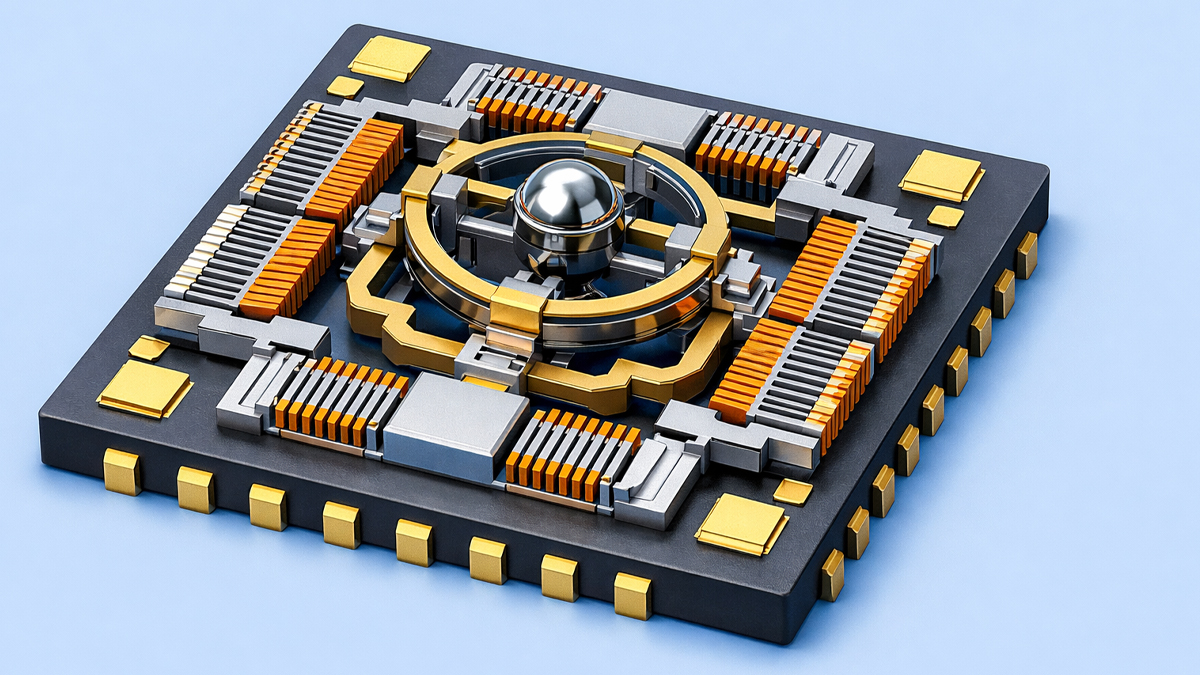
What is MEMS Gyroscope?
A MEMS gyroscope is a microelectromechanical sensor that measures angular rate, which means how fast an object is rotating around one or more axes. In simple terms, it senses turning motion rather than straight line motion. The word MEMS refers to microelectromechanical systems, meaning tiny mechanical structures and electronic circuits built together on silicon using semiconductor-style manufacturing. In modern electronics, MEMS gyroscopes are often packaged alone as gyroscope chips or combined with accelerometers inside an IMU, which is an inertial measurement unit.
In the context of cinematic electronics, a MEMS gyroscope is important because modern image capture systems depend on stable orientation data. Cameras, action cameras, drones, gimbals, virtual production tools, and lens stabilization systems all benefit from fast motion feedback. When a camera operator walks, pans quickly, rides on a vehicle, or moves through a handheld shot, the gyroscope helps detect unwanted rotation so the system can correct for shake, smooth motion, or improve post-processing alignment. This is why MEMS gyroscopes have become foundational sensing elements in compact and mobile cinema technology.
How does MEMS Gyroscope Work?
Core principle: A MEMS gyroscope works by vibrating a tiny internal structure and then measuring how that vibration changes when the device rotates. The operating principle is based on the Coriolis effect. When a mass is moving in one direction and the whole device rotates, an apparent force acts in a perpendicular direction. MEMS gyroscopes exploit this effect by driving a proof mass or resonant structure into controlled motion and then sensing the tiny deflection caused by rotation.
Signal path: First, an internal drive system keeps the resonating structure moving at a known frequency. Second, when the device rotates, the Coriolis force creates motion along the sense axis. Third, capacitive or similar sensing electrodes detect that movement. Fourth, on-chip electronics amplify, filter, digitize, and compensate the signal so the output becomes a usable angular rate value. In many commercial devices, the Coriolis-induced displacement is converted into capacitance variation and then processed into digital data proportional to rotational rate.
Practical result: If a camera tilts, rolls, or yaws, the gyroscope detects that rotational change almost immediately. A stabilization controller can then move a lens element, a sensor, or a gimbal motor to counter the motion. This fast feedback loop is one reason gyroscopes are so valuable in image stabilization and motion control systems.
What are the Components of MEMS Gyroscope?
Mechanical sensing structure: At the heart of a MEMS gyroscope is a tiny vibrating element, often called a proof mass or resonator. This structure is suspended by micro-scale springs so it can move in controlled directions. In many designs there are two orthogonal vibration modes, commonly called drive mode and sense mode. The drive mode creates the intentional oscillation, while the sense mode receives the Coriolis-induced motion.
Electrodes and transducers: The device also includes drive electrodes and sense electrodes. Drive electrodes maintain vibration, while sense electrodes detect tiny displacement changes. In many commercial designs the sensing method is capacitive, so motion changes capacitance and that electrical change becomes the basis for the output signal.
Readout and control electronics: A MEMS gyroscope is not only mechanical. It also contains or interfaces with integrated electronics that handle excitation, amplification, filtering, analog-to-digital conversion, temperature handling, and communication with the host processor. Many products also include digital outputs and embedded support features such as temperature sensing and FIFO buffering.
Packaging and reliability elements: The final product includes packaging, calibration, and sometimes self-test functions. High performance industrial gyroscopes may include factory calibration, digital SPI interfaces, and built-in self-test for integrity checking.
What are the Types of MEMS Gyroscope?
Structural types: MEMS gyroscopes can be grouped by the geometry of their vibrating structure. Well-known categories include tuning fork gyroscopes, gimbal gyroscopes, vibrating ring gyroscopes, and multi-axis gyroscopes. Tuning fork designs are especially common because the paired proof masses can move in opposite directions, which helps reject external vibration and improve signal quality.
Axis-based types: Another practical way to classify MEMS gyroscopes is by the number of measured axes. A single-axis gyroscope measures rotation around one axis. Dual-axis versions detect two axes. Tri-axis gyroscopes measure roll, pitch, and yaw together. In many commercial electronics, the gyroscope is packaged as part of a 6-axis IMU that combines a 3-axis gyroscope and a 3-axis accelerometer in one compact unit.
Application-oriented types: There are also categories based on performance goals. Consumer-grade gyroscopes prioritize low power, small size, and cost. Industrial or tactical-grade devices focus more on bias stability, vibration rejection, ruggedness, and calibration quality.
What are the Applications of MEMS Gyroscope?
MEMS gyroscopes are used wherever rotational motion must be sensed quickly and accurately. In consumer electronics they support smartphones, tablets, wearables, XR devices, gaming controllers, and action cameras. In industrial systems they assist robotics, motion control, stabilization platforms, and navigation equipment. In drones and autonomous systems they help maintain attitude awareness and motion tracking.
Image stabilization is one of the most visible applications. Gyroscope and accelerometer data can support OIS and EIS for camera applications. Recent action camera solutions use gyroscope data to help keep footage sharp and stable.
Another important application is closed-loop stabilization. MEMS IMUs are used for camera, antenna, and gimbal stabilization, where bandwidth, small size, and low power are critical. MEMS gyroscopes are also used as inertial references in camera stabilization platforms and gimbal systems.
What is the Role of MEMS Gyroscope in Cinema Industry?
Motion stabilization: In the cinema industry, the MEMS gyroscope plays a central role in controlling unwanted camera rotation. Whether a shot is handheld, mounted on a moving rig, attached to a drone, or placed on a motorized gimbal, tiny rotational disturbances can reduce image clarity and create distracting wobble. The gyroscope senses these changes in real time and feeds them into stabilization logic. This data can guide lens movement in OIS systems, digital correction in EIS workflows, or motor corrections in gimbal heads and stabilized platforms.
Action cameras and compact cinema tools: Action and compact production cameras work in dynamic environments where size and weight are limited. Accurate gyroscope data can reduce the need for time-consuming post-editing of shaky footage. That point matters directly to cinema workflows because cleaner footage at capture stage can save time in post-production and preserve more natural motion.
Gimbals and camera heads: Professional movement tools in film production rely heavily on orientation sensing. In cinema practice, that translates into smoother pans, steadier tracking, and better horizon control on moving shots. Even when a full cinema rig uses more than one sensor type, the gyroscope is often the fastest source for rotational feedback.
Virtual production, motion tracking, and robotics: Modern cinema is no longer limited to a camera and a tripod. Virtual production stages, robotic camera systems, XR capture environments, and camera-equipped mobile platforms all benefit from low-latency orientation feedback. In film and television production, these capabilities support responsive motion tracking, more stable framing, and better synchronization between physical movement and digital environments.
What are the Objectives of MEMS Gyroscope?
The first objective of a MEMS gyroscope is to measure angular motion accurately in a very small package. Modern electronic systems need reliable rotational data without the size, weight, and cost of traditional bulky inertial hardware. MEMS technology makes it possible to place this capability inside highly compact equipment such as camera modules, drones, wearable systems, and portable cinema accessories.
The second objective is to provide fast feedback for control systems. A stabilization loop is only as good as the quality and speed of the sensor data it receives. Because MEMS gyroscopes are designed for rapid motion sensing, they help systems respond quickly to shake, tilt, and unintended rotation. This is essential in OIS, EIS, and gimbal stabilization.
The third objective is system efficiency. Product makers aim for low power consumption, digital integration, calibration support, and features that simplify the rest of the design. Modern gyroscopes are expected not only to sense motion but also to reduce total system complexity.
What are the Benefits of MEMS Gyroscope?
A major benefit of the MEMS gyroscope is compactness. It delivers rotational sensing in an extremely small footprint, which allows designers to build stabilization into devices that must remain light and portable. This is especially valuable in cinematic electronics, where large sensor payloads can affect rig balance, operator fatigue, and mounting options.
Another benefit is low power consumption. Portable cameras, wireless accessories, drones, and battery-powered stabilization systems need efficient components. Several commercial MEMS gyroscope and IMU families emphasize low power operation while still maintaining enough responsiveness for demanding motion tasks.
A further benefit is fast real-time motion awareness. Gyroscopes produce direct angular rate data, which is very useful for immediate correction of rotational shake. This supports optical image stabilization, electronic image stabilization, and low-latency motion control.
A final benefit is scalability. MEMS fabrication enables high-volume manufacturing, broad availability, and integration with accelerometers, digital processing, and sensor fusion software. That combination helps make advanced motion sensing accessible across both consumer and professional imaging ecosystems.
What are the Features of MEMS Gyroscope?
Common features of MEMS gyroscopes include multi-axis sensing, digital output, small packages, and compatibility with SPI or I2C-style interfaces. Many devices are designed as low-power 3-axis angular rate sensors or integrated motion modules for embedded systems.
Many gyroscopes also include supporting features such as embedded temperature sensors, FIFO buffers, self-test, and factory calibration. These features improve usability because they help the host system manage timing, monitor health, and compensate environmental effects.
Advanced imaging-oriented devices may add low latency data paths, timestamp precision, and dedicated support for OIS or EIS functions. These features are especially useful in modern imaging and XR-related MEMS solutions.
What are the Examples of MEMS Gyroscope?
Examples in standalone or high performance categories include industrial and instrumentation gyroscopes designed for stabilization applications in high-vibration environments, as well as high-stability digital MEMS gyroscopes with factory calibration and built-in self-test. These show how MEMS gyroscopes can be tailored for demanding motion control tasks.
Examples in compact integrated formats include 3-axis gyroscope chips, 6-axis inertial modules supporting OIS applications, and compact IMUs designed for fast and accurate inertial sensing and imaging-related use cases.
From a cinema viewpoint, these examples matter because they represent the range from compact camera-oriented sensors to more rugged stabilization-grade inertial products. Some are ideal for embedded camera modules, while others are better suited to higher-end stabilized rigs and control systems.
What is the Definition of MEMS Gyroscope?
A MEMS gyroscope can be defined as a micro-scale inertial sensor that measures angular velocity by using a vibrating mechanical structure fabricated with microelectromechanical systems technology. When the device rotates, Coriolis force causes a measurable change in the motion of that structure, and integrated electronics convert that change into an electrical output that represents rotational rate.
What is the Meaning of MEMS Gyroscope?
In plain language, the meaning of MEMS gyroscope is a tiny electronic motion sensor that tells a system how quickly it is turning. If an accelerometer answers the question of straight line movement, a gyroscope answers the question of rotational movement. In real products, this meaning becomes practical very quickly. A camera uses it to detect shake, a gimbal uses it to keep a shot level, and an XR device uses it to follow head movement with low delay.
Within cinematic electronics, the meaning goes even further. It is not just a sensor that detects motion. It is a key enabler of visual smoothness, framing stability, and motion confidence. The audience may never see the chip, but they see its effect in cleaner handheld shots, steadier action footage, and more reliable stabilization across complex camera movement.
What is the Future of MEMS Gyroscope?
The future of MEMS gyroscope is moving toward better precision, lower noise, smarter calibration, stronger sensor fusion, and more specialized imaging support. Recent commercial developments already highlight trends such as self-calibrating gyroscopes, ultra-low latency, precise timestamps, low-noise architectures, and dedicated support for OIS, EIS, XR, and responsive motion tracking.
Another future direction is deeper integration. Instead of acting as isolated sensors, gyroscopes are increasingly becoming parts of intelligent motion subsystems that combine accelerometers, embedded processing, context awareness, and software libraries.
For the cinema industry, this future means lighter stabilization tools, better performance in compact cameras, reduced post-processing burden, and improved coordination between physical camera motion and digital workflows. As virtual production, robotic cinematography, and mobile high-quality capture continue to expand, MEMS gyroscopes are likely to become even more important as silent, always-on motion intelligence inside cinematic electronics.
Summary
- MEMS gyroscope is a tiny microelectromechanical sensor that measures angular rate, which is rotational speed around one or more axes.
- It works by vibrating an internal structure and sensing Coriolis-force-induced motion when the device rotates.
- Core parts include the proof mass or resonator, suspension springs, drive and sense electrodes, readout electronics, and protective packaging.
- Common types include tuning fork, ring, gimbal, multi-axis, and single-axis to tri-axis variants.
- Major applications include smartphones, XR systems, robotics, drones, motion control, OIS, EIS, and stabilized platforms.
- In the cinema industry, MEMS gyroscopes help reduce shake, support gimbals, improve action footage, and enable smoother camera motion.
- Their main objectives are accurate angular sensing, fast control feedback, and efficient integration into compact electronic systems.
- Key benefits include small size, low power, fast response, and suitability for integrated motion sensing systems.
- Typical features include digital interfaces, embedded temperature sensing, FIFO, self-test, calibration, and imaging support functions.
- The future of MEMS gyroscopes is centered on lower noise, smarter calibration, stronger sensor fusion, and better real-time support for imaging and immersive media.

